




Gold Price Forecast 2026: Why Is Gold Falling Below $4,000 and Is It Time to Buy?

Gold has long been regarded as one of the world's most reliable safe-haven assets, but even safe havens experience periods of sharp volatility. After surging to a record high above US$5,590 per ounce earlier in 2026, gold has undergone a dramatic correction, briefly falling below the important US$4,000 psychological level for the first time in months.
In this article, we'll examine what caused gold's latest selloff, analyse the key technical support and resistance levels, and provide our Gold Price Forecast for the rest of 2026. We'll also discuss whether now is a good time to invest in gold, compare different investment methods, and explain how Australian traders can potentially profit from both rising and falling prices through Gold CFDs.
Gold Price Today: What Happened?
Gold Price Today
Gold remained under heavy pressure on 26 June 2026, extending its recent correction after briefly falling below the key US$4,000 per ounce level earlier this week—the first break beneath that psychological support since November 2025. Although prices stabilized around the $4,000 mark during Friday's session, bullion was still on track for its fourth consecutive weekly decline, highlighting a sharp shift in market sentiment.
The latest selloff was driven primarily by a stronger US dollar and growing expectations that the Federal Reserve will keep monetary policy tighter for longer. Following stronger-than-expected US inflation data and hawkish comments from Fed officials, traders significantly increased expectations for additional interest rate hikes later in 2026. Higher interest rates raise the opportunity cost of holding non-yielding assets like gold, while a stronger dollar makes gold more expensive for overseas buyers.
Despite briefly recovering above the $4,000 level during Thursday's US trading session after inflation data matched market expectations, buying momentum remained limited. Investors continued to reduce exposure to precious metals in favor of dollar-denominated assets, keeping gold near its lowest level in more than seven months.
The recent decline also marks a dramatic reversal from gold's explosive rally earlier this year. After reaching an all-time high above US$5,590/oz in January amid geopolitical tensions and safe-haven demand, gold has now corrected by nearly 30%, making it one of the largest pullbacks of the current bull cycle. Profit-taking, easing geopolitical risk premiums and changing interest rate expectations have all contributed to the sharp correction.
Gold Price Snapshot (26 June 2026)
For traders, the US$4,000 level has become the market's most important technical battleground. A sustained break below this support could expose gold to further downside toward the US$3,900–3,800 range. On the other hand, if buyers successfully defend this level and expectations for Fed tightening begin to ease, gold could stage a technical rebound after becoming increasingly oversold following several weeks of heavy selling.
“Trade gold CFDs with an ASIC-regulated broker. Fast AUD funding via PayID. ”
Why Is Gold Falling Below $4,000?
After reaching record highs above US$5,590 per ounce earlier in 2026, gold has entered one of its sharpest corrections in recent years. The metal briefly slipped below the important US$4,000 psychological level this week, leaving many investors wondering whether the bull market has come to an end.
In reality, several macroeconomic and market-driven factors are weighing on gold prices simultaneously.
Higher US Treasury Yields Reduce Gold's Appeal
One of the biggest headwinds for gold is the sharp rise in US Treasury yields. As bond yields move higher, investors can earn more income from fixed-income assets, making non-yielding assets like gold relatively less attractive.
Following stronger-than-expected US economic data, the yield on long-term Treasury bonds has climbed steadily, increasing the opportunity cost of holding bullion. Historically, rising real yields have been one of the strongest bearish signals for gold.
Stronger US Dollar Is Putting Pressure on Gold
Gold is priced globally in US dollars, meaning a stronger dollar generally weighs on precious metal prices.
Over the past several weeks, the US Dollar Index (DXY)has rebounded as investors shifted toward safe US assets and expectations for higher interest rates increased. A stronger dollar makes gold more expensive for international buyers, reducing global demand and adding downward pressure to prices.
Unless the dollar weakens again, gold may struggle to regain strong upward momentum in the short term.
Markets Have Scaled Back Fed Rate Cut Expectations
Earlier this year, investors expected the Federal Reserve to begin cutting interest rates aggressively during the second half of 2026.
However, resilient inflation and stronger labour market data have forced markets to rethink that outlook. Fed officials have continued to signal that rates could remain "higher for longer," pushing back expectations for monetary easing.
Higher interest rates typically reduce demand for gold because they increase returns on cash and fixed-income investments while raising financing costs across financial markets.
Investors Are Taking Profits After Gold's Historic Rally
Gold gained more than 70% during its powerful rally from 2025 into early 2026, driven by geopolitical tensions, central bank buying and safe-haven demand.
Such a rapid advance inevitably attracted profit-taking once bullish momentum began to fade. Many institutional investors and hedge funds have been locking in gains, contributing to increased selling pressure over recent weeks.
Corrections of 15%–30% are not unusual during long-term commodity bull markets and often serve to reset market positioning before the next trend develops.
ETF Outflows and Softer Safe-Haven Demand
Another factor weighing on gold has been declining investment demand from exchange-traded funds (ETFs). As market fears eased and equity markets recovered, some investors shifted capital out of gold-backed ETFs into higher-risk assets.
Meanwhile, geopolitical tensions that previously fuelled safe-haven buying have become less dominant in financial markets, reducing one of gold's strongest catalysts from earlier this year.
Although central banks continue to accumulate gold over the long term, weaker short-term investment flows have amplified recent price volatility.
Gold Technical Analysis: Key Levels to Watch
Following its break below US$4,000, gold has entered an important technical zone where buyers and sellers are battling for control. While the long-term uptrend remains intact, short-term momentum has clearly weakened after several weeks of heavy selling.
For traders, the next few sessions could determine whether gold stages a technical rebound or extends its correction toward lower support levels.
Current Trend
The short-term trend remains bearish, with gold trading below several key moving averages after breaking multiple support zones during June.
Momentum indicators suggest sellers continue to dominate, although the pace of the decline has slowed as prices approach a major psychological support level.
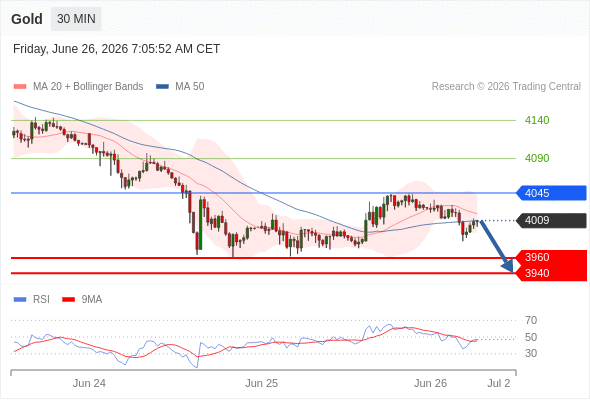
Key Support Levels
If gold closes decisively below US$4,000, bearish momentum could accelerate toward the US$3,900–3,800 region.
Major Resistance Levels
A sustained move above US$4,150 would improve the short-term outlook and increase the probability of a recovery toward US$4,300.
Given the elevated volatility, many short-term traders are increasingly using Gold CFDs to take advantage of both upward and downward price movements while applying strict risk management through stop-loss orders and controlled position sizing.
“Trade gold CFDs with an ASIC-regulated broker. Fast AUD funding via PayID. ”
Gold Price Forecast for the Rest of 2026
After gold's sharp correction in June, investors are increasingly asking the same question: Has the bull market ended, or is this simply a healthy pullback before another rally?
While no forecast is guaranteed, gold's outlook for the remainder of 2026 will largely depend on three major drivers: Federal Reserve policy, the US dollar, and global geopolitical risks. If inflation continues to ease and the Fed signals a shift toward lower interest rates, gold could regain upward momentum. However, if interest rates remain elevated and the US dollar strengthens further, the correction may continue in the months ahead.
Below are three possible scenarios for the rest of 2026.
Bullish Scenario: Gold Rebounds Above US$4,500
Target Price: US$4,500–4,900/oz
Although gold has fallen nearly 30% from its January peak, the longer-term investment case remains intact if macroeconomic conditions begin to shift in favour of precious metals.
A bullish recovery would likely be supported by:
The Federal Reserve beginning its first rate cuts later in 2026
Cooling US inflation reducing real interest rates
A weaker US dollar boosting international demand
Renewed geopolitical tensions increasing safe-haven buying
Continued central bank gold purchases, particularly from emerging economies
If these catalysts materialise, buyers could regain control above the key US$4,150 resistance level, potentially driving prices back toward the US$4,500 area before testing US$4,900 later in the year.
Base Case: Gold Stabilises Around US$4,000–4,300
Target Price: US$4,000–4,300/oz
Our base-case scenario assumes that inflation gradually moderates but the Federal Reserve maintains a cautious stance, keeping interest rates relatively high for longer.
Under this environment:
Economic growth slows but avoids recession.
The US dollar remains firm without strengthening significantly.
Central bank demand continues to provide long-term support.
ETF inflows recover only gradually.
In this scenario, gold is likely to consolidate after its steep correction, trading within a broad range between US$4,000 and US$4,300 for much of the second half of the year.
Periods of heightened volatility around major economic releases—including US CPI, Non-Farm Payrolls and Federal Reserve meetings—could create frequent short-term trading opportunities.
Bearish Scenario: Gold Falls Toward US$3,800
Target Price: US$3,700–3,900/oz
The bearish case assumes that inflation remains stubbornly high and the Federal Reserve keeps interest rates elevated for longer than markets currently expect.
Additional downside pressure could come from:
Continued strength in the US Dollar Index (DXY)
Rising US Treasury yields
Stronger-than-expected US economic growth
Declining ETF demand
Increased investor rotation into equities and fixed-income assets
Should gold fail to hold the important US$4,000 support level, selling momentum could accelerate toward US$3,900, with a deeper correction toward US$3,800 becoming increasingly likely.
While such a move would represent a significant short-term decline, it would still fall within the historical range of corrections seen during previous long-term commodity bull markets.
Is It Time to Buy Gold Now?
Gold's sharp correction has divided investors. While some see the recent decline as a warning sign that the rally is over, others believe it represents an attractive buying opportunity after one of the strongest bull runs in the precious metals market.
Whether now is the right time to buy depends largely on your investment goals, time horizon and risk tolerance.
For Long-Term Investors
If your objective is long-term wealth preservation and portfolio diversification, the recent pullback may offer a more attractive entry point than the record highs seen earlier this year.
Gold continues to benefit from several long-term structural drivers, including:
Central bank diversification away from the US dollar
Persistent geopolitical uncertainty
Rising global debt levels
Inflation risks over the longer term
Rather than trying to predict the exact market bottom, many investors prefer a dollar-cost averaging (DCA) strategy, gradually building positions over time to reduce timing risk.
For Short-Term Traders
Short-term traders should remain cautious.
Although gold is approaching oversold territory technically, the broader trend remains bearish as long as prices stay below key resistance around US$4,150.
Upcoming market-moving events such as:
US CPI inflation reports
Federal Reserve meetings
Non-Farm Payrolls (NFP)
PCE inflation data
could trigger sharp price swings in either direction.
Instead of attempting to catch a falling market, traders should wait for confirmation of either a technical reversal or a decisive breakout before increasing exposure.
For CFD Traders
For CFD traders, periods of elevated volatility often create the best trading opportunities.
Unlike buying physical gold, Gold CFDs allow traders to speculate on both rising and falling prices. This means you don't need gold to recover before potentially benefiting from market movements.
If gold rebounds from the US$4,000 support level, traders can consider long (Buy) positions. Conversely, if prices break below support and bearish momentum accelerates, short (Sell) positions may also present opportunities.
The key advantage of CFDs is flexibility—but successful trading still requires disciplined risk management, including appropriate position sizing and stop-loss orders.
How to Trade Gold CFDs During Volatile Markets
Gold has become significantly more volatile in recent weeks, creating larger intraday price swings than earlier in the year. While increased volatility also means higher risk, it can provide more trading opportunities for experienced CFD traders.
Here's a practical step-by-step approach.
Step 1: Choose a Regulated CFD Broker
Selecting a reliable broker is the first step toward managing risk effectively.
For Australian traders, Mitrade is a popular choice because it offers:
ASIC-regulated trading environment
Competitive spreads on Gold CFDs
Commission-free trading
Low minimum deposit
Free demo account for beginners
Advanced charting tools
Mobile trading on iOS and Android
Built-in Stop Loss and Take Profit features
For beginners, practising with a demo account before trading with real money can help build confidence while learning how gold reacts to major economic events.
Step 2: Watch the Economic Calendar
Gold prices often experience significant volatility during major macroeconomic announcements.
Key events to monitor include:
Trading around these events requires caution, as price movements can be rapid and unpredictable.
Step 3: Build a Trading Plan
Before opening any position, define:
Entry price
Profit target
Stop-loss level
Maximum risk per trade
Many professional traders limit risk to 1%–2% of their trading capital per position, helping protect their accounts during periods of heightened volatility.
Step 4: Use Technical Analysis to Time Entries
Rather than entering trades based solely on headlines, combine fundamental analysis with technical signals such as:
Support and resistance levels
RSI (Relative Strength Index)
Moving averages
Trendline breakouts
Candlestick reversal patterns
Waiting for confirmation can improve trade quality and reduce emotional decision-making.
Step 5: Manage Leverage Carefully
Leverage allows traders to control larger positions with a relatively small amount of capital, but it also magnifies both profits and losses.
During volatile market conditions, using lower leverage and keeping position sizes moderate can help reduce unnecessary risk.
Remember, preserving capital is just as important as generating returns.
👉 Trade Gold CFDs with Mitrade
Looking to take advantage of gold's price movements without owning physical bullion?
Mitrade gives Australian traders access to Gold CFDs with:
✅ ASIC-regulated trading platform
✅ Tight spreads and zero commission on Gold CFDs
✅ Free unlimited demo account for practice
✅ Trade rising and falling gold prices with one account
✅ Advanced charts, technical indicators and risk management tools
✅ Fast account opening and user-friendly mobile app
Whether you expect gold to rebound above US$4,150 or continue its correction below US$4,000, Gold CFDs allow you to respond quickly to changing market conditions.
Open a free Mitrade demo account today and practise trading gold risk-free before entering the live market.


1. Why is gold falling below US$4,000?
Gold has fallen below US$4,000 mainly because of a stronger US dollar, higher US Treasury yields and expectations that the Federal Reserve will keep interest rates elevated for longer. Higher interest rates increase the opportunity cost of holding non-yielding assets like gold, while a stronger dollar reduces international demand for the precious metal.
2. What are the most important price levels to watch?
The key support level is US$4,000, followed by US$3,900 and US$3,800. On the upside, important resistance levels are US$4,150, US$4,300, and US$4,500. These levels may influence short-term trading decisions as market sentiment changes.
3. Can Australians trade Gold CFDs?
Yes. Australian residents can trade Gold CFDs through ASIC-regulated brokers. Gold CFDs allow traders to speculate on both rising and falling gold prices without owning physical bullion, making them a popular choice for active traders seeking flexibility.
4. Is trading Gold CFDs better than buying physical gold?
The answer depends on your goals. Physical gold is generally preferred for long-term wealth preservation, while Gold CFDs are designed for short-term trading and speculation. CFDs also offer leverage and the ability to profit in both rising and falling markets, although they carry higher risk.
5. What is the best platform for trading Gold CFDs in Australia?
Many Australian traders choose Mitrade because it offers commission-free Gold CFD trading, competitive spreads, an ASIC-regulated trading environment, a free demo account and intuitive trading tools suitable for both beginners and experienced traders.
Disclaimer: The content presented above, whether from a third party or not, is considered as general advice only. CFD trading involves significant risk of loss. Past performance does not guarantee future results. This article serves informational purposes only and does not constitute financial advice. Consider your risk tolerance before trading.


