


Tesla's stock price through 2030 depends less on how many cars it sells and more on whether Robotaxi and Optimus become real, profitable businesses. Investors are paying for that future rather than today's thin car margins, which makes TSLA one of the hardest large-cap stocks to forecast and explains why price targets range from carmaker valuations to AI platform valuations.
This article covers how TSLA has moved over the past year and why, its bear, base and bull price targets for 2026 to 2030 alongside Wall Street forecasts, the key drivers behind them, a possible SpaceX merger, the main risks, which investors Tesla suits, and how to trade TSLA on Mitrade.
*Capture every market move with flexible CFD trading, 0 commission and low spreads.
Tesla Price Targets 2026-2030 at a Glance
The table below shows year-end price scenarios for each year to 2030. These are scenario estimates, not institutional forecasts, and they assume Tesla's share count stays broadly stable. The further out the forecast, the more the share price depends on Robotaxi and Optimus rather than car sales.
The wide gap between the bear and bull cases is deliberate. By 2030, the difference between a carmaker valuation and an AI platform valuation could be worth trillions of dollars, and the outcome is still open.
Tesla Stock Price Movements Over the Past Year
Tesla shares have moved through a wide range over the past 12 months. The stock set a record high in December 2025, slid through the first half of 2026, hit its lowest level of the year in late July and then recovered through the autumn. The table below summarises the main phases and what drove each one.
Key factors behind recent price moves
Margin recovery: Automotive gross margin excluding regulatory credits rose to 18.1% in the third quarter of 2026 from 15.4% a year earlier, and free cash flow turned positive again after a negative second quarter. This eased fears that AI spending would drain Tesla's cash.
Thin overall profits: Operating margin was only 2.6% in the third quarter, down from 5.8% a year earlier, as research and development costs rose. This keeps the share price dependent on future businesses rather than today's earnings.
Lower spending plan: Tesla cut its 2026 capital spending forecast to about $20bn from more than $25bn. That supports cash flow, but it also raised questions about how hard Tesla will push on AI and robotics.
SpaceX merger talks: In October 2026, Tesla and SpaceX formed committees of independent directors to explore a combination. The prospect of a takeover premium helped lift the shares and led Barclays to upgrade the stock.
Robotaxi progress: Unsupervised robotaxi miles grew to about 3.1 million across six cities by mid-October 2026, from roughly 400,000 in mid-July, according to Barclays. Investors see faster expansion as a sign that autonomy is moving from promise to proof.
TSLA Technical View
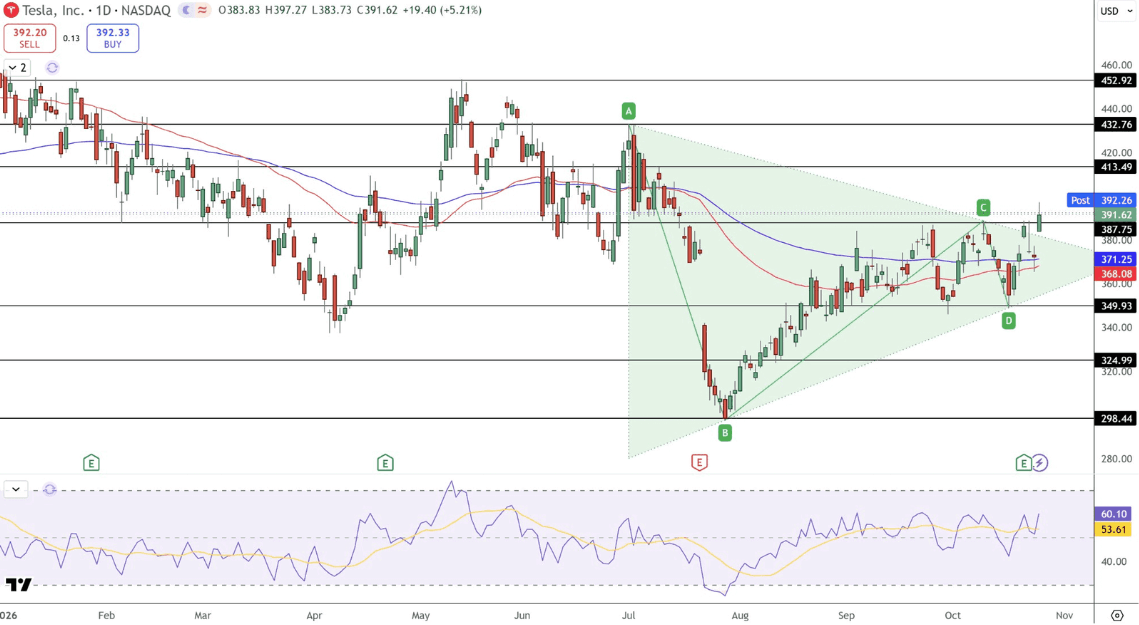
On the daily chart, TSLA has formed a contracting triangle since its early-July peak, with lower highs from the $433 area and higher lows from the late-July bottom near $298. In late October 2026, the price broke above the upper edge of that triangle and reclaimed the $387.75 level, while trading above both moving averages on the chart. The RSI near 60 points to improving momentum without overbought conditions.
The next resistance levels are $413.49, $432.76 and the May high near $452.92. Support sits at $387.75, then $349.93, $324.99 and the July low near $298.44. Holding above $387.75 would keep the breakout intact, while a daily close back below it would point to another test of the $350 area.
TSLA daily chart - Source: TradingView
Could a Tesla-SpaceX Merger Boost TSLA Stock?
A merger has moved from speculation to a real possibility. On October 20, 2026, Elon Musk said combining Tesla and SpaceX would be "a good idea" and confirmed that both companies have formed committees of independent directors to explore a deal. He also said a deal is not certain, and no terms have been agreed.
What might the valuation be? At the October 20, 2026 close, Tesla was worth about $1.48tn and SpaceX about $2.01tn, so a combined group would be valued at roughly $3.5tn before any premium. Barclays, which upgraded Tesla to Overweight in late October 2026 with a $450 target, expects SpaceX, the larger company, to buy Tesla in an all-stock deal. Its target builds in a possible takeover premium, while its downside case is $250 if no deal happens.
Could it boost the stock? In the short term, a deal at a premium would likely lift TSLA, and Musk has pointed to large gains from sharing AI, chip and robotics work. Over the longer term, Tesla holders would own less than half of a much bigger group that adds SpaceX's rockets, Starlink and AI businesses to Tesla's cars, robotaxis and Optimus. The hurdle is high: Musk said a deal would need approval from 50% of all Tesla shares, and no merger vote is on the agenda for Tesla's December 3 annual meeting.
Key Drivers of Tesla Stock Through 2030
Five drivers will decide which price scenario plays out by 2030. The first three, Robotaxi, Full Self-Driving and Optimus, carry most of the long-term value, while energy storage and auto margins decide how easily Tesla can pay for them.
1. Robotaxi: the main source of upside
Robotaxi is the business most likely to change how Tesla is valued, because a driverless car earns money on every ride, not just once when it is sold. If the service scales to many more cities without safety drivers and proves profitable, the stock could move toward the bull case. Delays or safety setbacks would pull it back toward a carmaker valuation.
2. Full Self-Driving: the software bridge
FSD links today's car business with the robotaxi future. Growing paid subscriptions show that drivers will pay recurring fees for Tesla software, the same model a robotaxi network depends on. Each new market approval widens that base and adds high-margin revenue, which supports the base case through 2030.
3. Optimus: the long-term option
Optimus is the biggest but most distant opportunity. A useful humanoid robot could open a market larger than cars, but the stock will only fully price it in once outside customers start buying. External orders would support the bull targets for 2028 to 2030, while further delays would keep Optimus a story rather than an earnings driver.
4. Energy storage: the steadier business
Megapack and Powerwall give Tesla revenue that does not depend on car demand, helped by rising power needs from utilities and AI data centers. Energy will not set the share price on its own, but steady growth here cushions the bear case and helps fund autonomy while it develops.
5. Auto margins and cash flow: paying for the future
Robotaxi and Optimus need heavy investment in AI computing, factories and batteries. If car margins keep recovering, Tesla can fund that spending from its own cash flow and the stock can hold its premium. If margins slip again, rising costs would weigh on free cash flow and make investors less patient with long timelines.
Tesla Stock Forecast 2026
For 2026, the base case is a year-end price of about $400, with a range of $280 to $500. The near-term question is whether Tesla can keep improving margins while expanding robotaxi to more cities.
Wall Street's view is close to this base case. After the third-quarter results, the average 12-month analyst target sat at about $409, according to StockAnalysis and TipRanks, only modestly above where the stock traded in late October 2026. Individual targets range from about $130 to $600, and ratings are split, with TipRanks counting 14 Buy, 12 Hold and 2 Sell ratings over the past three months.
That gap reflects the same question at the heart of this forecast. Analysts who value Tesla mainly as a carmaker see limited upside, while those who credit Robotaxi, Optimus or a possible SpaceX deal see much higher prices. The table below shows where selected firms stood in late October 2026.
Tesla Price Prediction 2027-2030
Beyond 2026, the Tesla story shifts from cars to autonomy and robotics. That is where the biggest upside, and the biggest risk, sits.
Most banks only publish 12-month targets, so Wall Street's view reaches only into late 2027, and even there the range is extreme. It runs from Wells Fargo's $130, based on the view that the valuation rests on self-driving hopes rather than car profits, to Wedbush's street-high $600, close to this article's 2027 bull case.
Longer-term institutional forecasts are further apart still. ARK Invest's latest model, reported in October 2026, has a base case of about $4,400 per share by 2031, with robotaxis making up around 80% of the value. The $650 base case for 2030 in this article sits between these camps, assuming autonomy grows, but more slowly than Tesla's strongest supporters expect.
The table below sets out the year-by-year base case, the range between the bear and bull cases, and the milestone each year depends on.
2027: The proof year
The base case is $450. This is when Cybercab volume, unsupervised FSD for customer cars and early external Optimus sales should either show up in the numbers or slip again. Investors are likely to reward measurable robotaxi revenue more than new announcements.
2028 to 2029: Scaling up
The base case is $520 in 2028 and $580 in 2029. By then, robotaxi revenue and FSD subscriptions should matter more to investors than quarterly deliveries. If Optimus reaches meaningful volume, the bull case of $800 to $950 comes into play.
2030: The AI company test
The base case is $650, which implies a market value of roughly $2.6tn based on about 3.95bn shares outstanding. The bull case of $1,100, a value above $4tn, requires Tesla to deliver on most of its robotaxi and robot ambitions. The bear case of $300 assumes Tesla remains mainly a carmaker with an expensive AI bet attached.
Bull, Base and Bear Scenarios for Tesla Stock
The three scenarios below show how far apart Tesla's 2030 outcomes could be. Each rests on a different answer to the same question: how quickly Robotaxi and Optimus turn from promises into profits.
Bull case ($1,100 by 2030): Tesla becomes an AI platform
If robotaxi margins prove far higher than car sales, FSD grows into a large recurring revenue stream and Optimus finds paying customers outside Tesla, investors could start to value Tesla like a software and robotics company. In that scenario, the stock could climb toward $1,100 by 2030, a market value of more than $4tn. This is the path Musk's pay package is built around.
Base case ($650 by 2030): Gradual progress, uneven timing
If autonomy works but scales more slowly than promised, cars and energy storage would likely keep funding the transition. The stock could then grind higher toward about $450 in 2027 and $650 by 2030, roughly $2.6tn in market value, with large swings around each earnings report and product event.
Bear case ($300 by 2030): The car business sets the value
If regulators or technical hurdles slow driverless expansion while Chinese rivals keep pressuring prices, investors may stop paying for the AI story. Tesla's valuation could then compress toward that of a high-quality carmaker, leaving the stock near $300 by 2030, below where it traded in late October 2026.
What would change the outlook
More bullish: Unsupervised FSD launches for customer cars, robotaxis expand quickly beyond Texas and Florida, or Optimus wins external orders.
More bearish: Operating margins stay near zero, robotaxi incidents trigger regulatory action, or the spending plan strains the balance sheet.
Key Risks for Tesla Investors
Tesla's wide range of price targets comes with equally wide risks. Most of them trace back to one issue: the share price already assumes success in autonomy and robotics, so setbacks can hit the stock harder than they would hit a typical carmaker.
❌1. Valuation risk: Tesla trades at more than 400 times trailing earnings, while traditional carmakers usually trade at single-digit to low double-digit multiples. Almost all of that premium rests on Robotaxi, FSD and Optimus. If those businesses scale more slowly than expected, Tesla's valuation could shrink toward that of a carmaker, even while its sales keep growing.
❌2. Autonomy and regulatory risk: Robotaxi depends on safety records and regulatory approval. A serious incident or slower approvals could delay expansion, while rivals such as Waymo compete for the same market.
❌3. Spending and cash flow risk: Building AI computing, robot lines and new factories is expensive. Tesla's free cash flow turned negative in the second quarter of 2026 before recovering in the third, and a return to cash burn would test investor patience.
❌4. Competition in electric vehicles: Chinese carmakers such as BYD continue to pressure prices globally, which limits how quickly Tesla's car margins can recover.
❌5. Key person risk: Tesla's strategy and valuation are closely tied to Elon Musk. His attention across several companies remains a risk that investors cannot diversify away inside the stock.
Is Tesla Stock a Good Investment Right Now?
Tesla can suit some investors and not others. The answer depends on time horizon, risk tolerance and what the investor expects to own, and there is no perfect entry point for a stock this volatile.
🔷Long-term growth investors: Suitable with conditions. Tesla is a bet on autonomy and robotics, not on car sales. If Robotaxi and Optimus scale by 2030, the late-October 2026 price sits well below the base and bull targets. Building a position gradually, in three or four purchases over time, reduces the risk of buying at a short-term high, while more cautious investors may wait for clear progress in margins or robotaxi revenue before buying.
🔷Short-term traders: Suitable for disciplined trading. Tesla is highly liquid and swings sharply around earnings, product events, Musk headlines and SpaceX merger news. Contracts for difference (CFDs) are a practical tool here, because they let traders go long or short on TSLA price moves without owning the shares, so both rallies and sell-offs can be traded. Many traders wait for the price to confirm a direction after earnings rather than trying to catch the bottom, and because CFDs are leveraged, they set a stop-loss before entering.
🔷Value and income investors: Not suitable at present. Tesla trades at a very high earnings multiple and pays no dividend.
🔷High-risk investors: Suitable only with a limited position size, because a stock priced this richly can fall sharply when timelines slip.
Whatever the approach, setting position size and exit levels before entering matters more than finding the perfect entry.


How to Trade Tesla on Mitrade?
Mitrade lets you trade Tesla share price movements through contracts for difference (CFDs), without owning the shares.
CFDs are leveraged products, so both gains and losses are magnified. Start small and size each trade so a single move cannot seriously hurt your account.
Summary
Tesla's share price is no longer a bet on car sales. Its long-term value depends on whether Robotaxi and Optimus become meaningful, sustainable businesses, with FSD, energy storage and the car business supporting that path. The base case points to about $400 by the end of 2026 and $650 by 2030, with a bull case of $1,100 if autonomy and robotics scale successfully and a bear case of $300 if Tesla remains mainly a carmaker. A possible merger with SpaceX adds another wildcard, although no terms have been agreed. With such a wide range of outcomes, position size and risk control matter more than any single price target.
Risk-Free Demo Account
CMA-regulated | 24х5 | 0 commission | low spreads. Enjoy limit and stop loss for every trade!
Is Tesla stock overvalued based on current earnings?
On current earnings, yes. Tesla trades at more than 400 times trailing earnings, far above other carmakers and most large technology companies. The valuation only makes sense if Robotaxi, FSD and Optimus deliver large new profit streams over the next few years.
Can TSLA reach $1,000 by 2030?
It is possible, but only in the bull case. A $1,000 share price would mean a market value of roughly $4tn based on about 3.95bn shares outstanding. That level becomes realistic in 2029 or 2030 only if autonomy and robotics scale successfully.
What will drive Tesla stock through 2030?
Robotaxi and Optimus are the main drivers, because they decide whether Tesla earns software and robotics profits rather than car profits. FSD subscriptions, energy storage and a recovery in auto margins support that path.
What are the biggest risks to Tesla investors?
Key risks include its high valuation, delays to autonomy timelines, regulatory action on driverless cars, price competition from Chinese EV makers, heavy capital spending, and dependence on Elon Musk's leadership and attention.
Does Tesla pay a dividend?
No. Tesla has never paid a cash dividend. It reinvests its cash in factories, AI computing, robotaxis and Optimus.
* The content presented above, whether from a third party or not, is considered as general advice only. This article should not be construed as containing investment advice, investment recommendations, an offer of or solicitation for any transactions in financial instruments.


