


NVDA Stock Prediction 2026-2030: Short-Term Outlook and Long-Term Price Forecast

Nvidia has lost its founding chief executive. Jensen Huang resigned as CEO on November 12, 2026, after a board investigation and reports about his personal conduct, ending 33 years at the head of the company. NVDA fell as much as 14% that day, to about $149, its lowest level since June 2025, before closing at $166.19, about 32% below its October 6 record of $243.
This article explains what drove the fall and what the leadership change means for investors, what could move the stock over the next few months, including the November 17 earnings report, and where NVDA could trade by the end of 2026, 2027 and 2030, with practical suggestions for different types of investors.
NVDA Price Targets 2026-2030 at a Glance
The targets below are this article's own scenarios, not institutional forecasts. They started from NVDA near $166 on November 12, 2026, and were lowered after Jensen Huang's resignation to allow for a lower valuation while Nvidia operates under an interim CEO.
NVDA Stock Price Movements Over the Past Year
Over the 12 months to November 2026, NVDA traded between about $149 and $243. The table splits the year into six phases.
The stock reacted more to the mood around AI spending and interest rates than to its own results, slipping after both its May and August 2026 reports despite beating forecasts.
NVDA Stock News: Why Nvidia Fell in November 2026?
NVDA's slide in November 2026 started with doubts about AI spending as a whole. On November 5, the Nasdaq 100 had its worst day since March 2020 after the US midterms raised fears of tighter rules on AI and data centres, and NVDA fell about 9%. Google's launch of two new AI chips on November 9 and a board investigation into CEO Jensen Huang added to the pressure, and on November 12 Huang resigned. The stock fell as much as 14% that day, to about $149, before closing at $166.19.
Jensen Huang's Resignation: What It Means for NVDA Stock?
On November 12, 2026, Nvidia announced that Jensen Huang had resigned as President, CEO and board member with immediate effect, ending 33 years at the head of the company he co-founded. Chief financial officer Colette Kress is serving as interim CEO while keeping her CFO role. Harvey Jones has become the board's first chair, and the board has started a search for a permanent CEO among internal and external candidates.
For investors, the loss of a founder adds a leadership risk that the share price did not carry before. The board said operations, customer commitments and the product roadmap would continue without interruption, and the November 17 earnings report remains on schedule.
Short-Term NVDA Stock Prediction
The base case is a recovery toward $180 by the end of 2026, back to the price gap left on November 9. After muted reactions to its last two beats, the guidance and the tone on 2027 demand are likely to matter more than the quarter itself, alongside any sign of stability at the top of the company.
Short-term drivers
Several events could move NVDA before the end of 2026. The biggest is Nvidia's report for the third quarter of fiscal 2027, due after the US market closes on November 17, 2026, and the first earnings call under interim CEO Colette Kress. In August, Nvidia guided for revenue of about $108bn, plus or minus 2%, and a gross margin of about 74%. The Fed's December meeting, US inflation data, the search for a permanent CEO and the wider mood around AI stocks will also shape the stock's direction.
💡What to watch in the report
Beating the $108bn guidance is largely expected, so these five areas are more likely to decide the reaction:
🔺Fourth-quarter guidance: The outlook for the January quarter will show whether customers slowed orders during the AI sell-off.
🔺Gross margin: Higher memory costs could pull margins below the 74% guide, while holding near 74% to 75% would ease pricing concerns.
🔺Vera Rubin ramp: Updates on Rubin shipments and supply limits will show whether 2027 forecasts are realistic.
🔺Commitments and customer financing: Supply commitments and Nvidia's role in funding customers' data centres are the main concern behind Seaport's Sell rating.
🔺Leadership and China: Comments from interim CEO Colette Kress on the transition, the CEO search, Megaspeed or export licences could move the stock as much as the numbers.
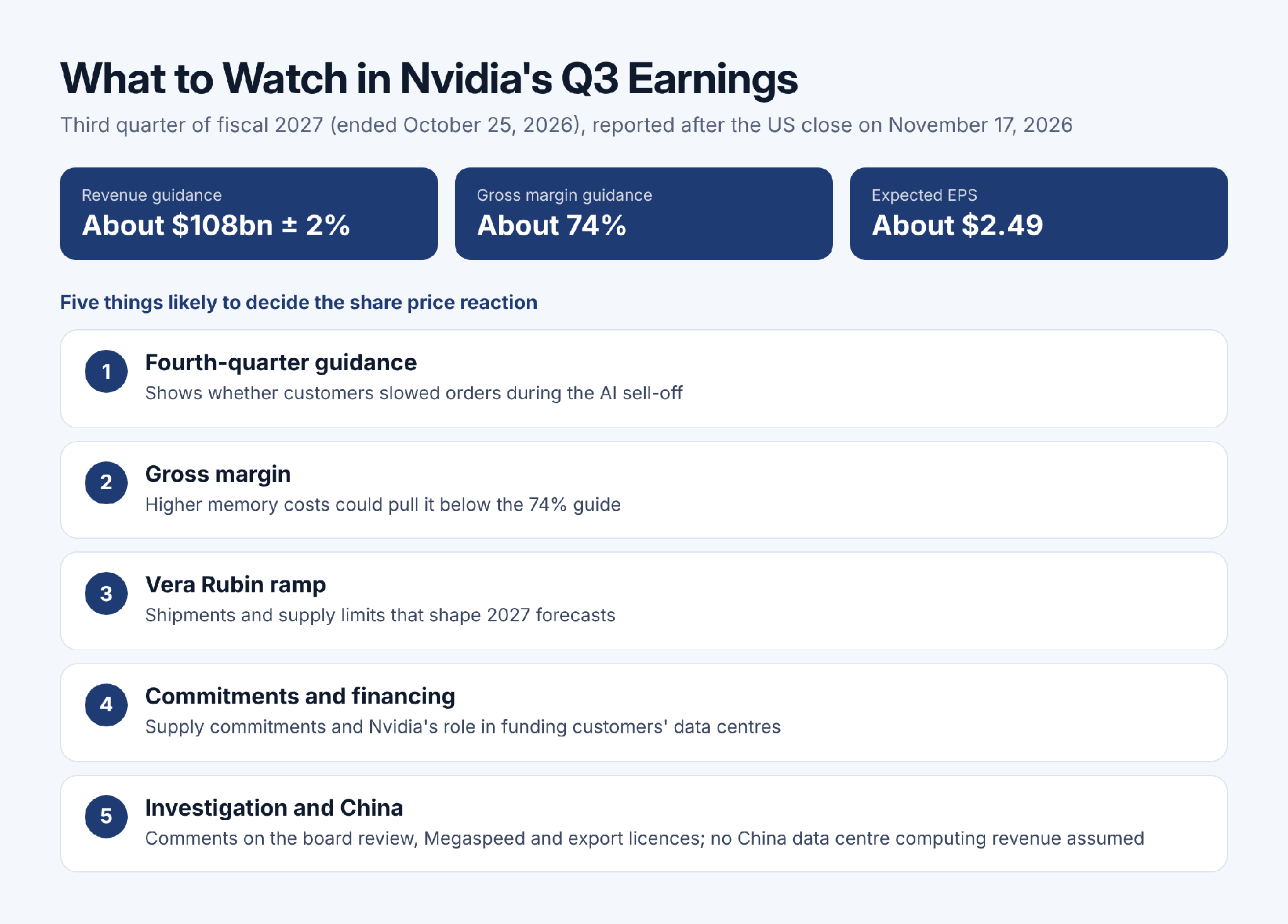
What to watch in Nvidia's third-quarter fiscal 2027 earnings report.
Technical view of NVDA stock price for short term
The daily chart, which guides the outlook for the next four to six weeks, turned bearish in mid-October 2026, when the MACD crossed below its signal line a few days after the October 6 record high of $243.37. On November 12, the day Huang resigned, NVDA fell to $148.80 shortly after the open, its lowest level since June 2025, then recovered to close at $166.19. The long lower shadow on that candle shows strong buying near $150. The 14-day RSI, at about 26, stayed in oversold territory below 30, while the MACD, at about -13.2 against a signal line of about -9.1, remained well below zero, so selling pressure had not yet faded.
The key levels to watch are:
🔹 Support at $164 to $166: The March 30, 2026 low of $164.27 and the November 10 low of $165.89, the zone where NVDA closed on November 12.
🔹 Support at $149 to $150: The November 12 low of $148.80, where buyers stepped in after the CEO news.
🔹 Resistance at $180: The price gap NVDA left on November 9, between that day's high near $180 and the November 5 low near $181.
🔹 Resistance at $195: The November 6 rebound high, a level that also capped the stock several times between October 2025 and February 2026.
Holding the $164 to $166 zone would be the first sign that selling is easing. A daily close above $180 would point to a deeper recovery toward $195, while a break below the November 12 low near $149 would open the way to about $140.
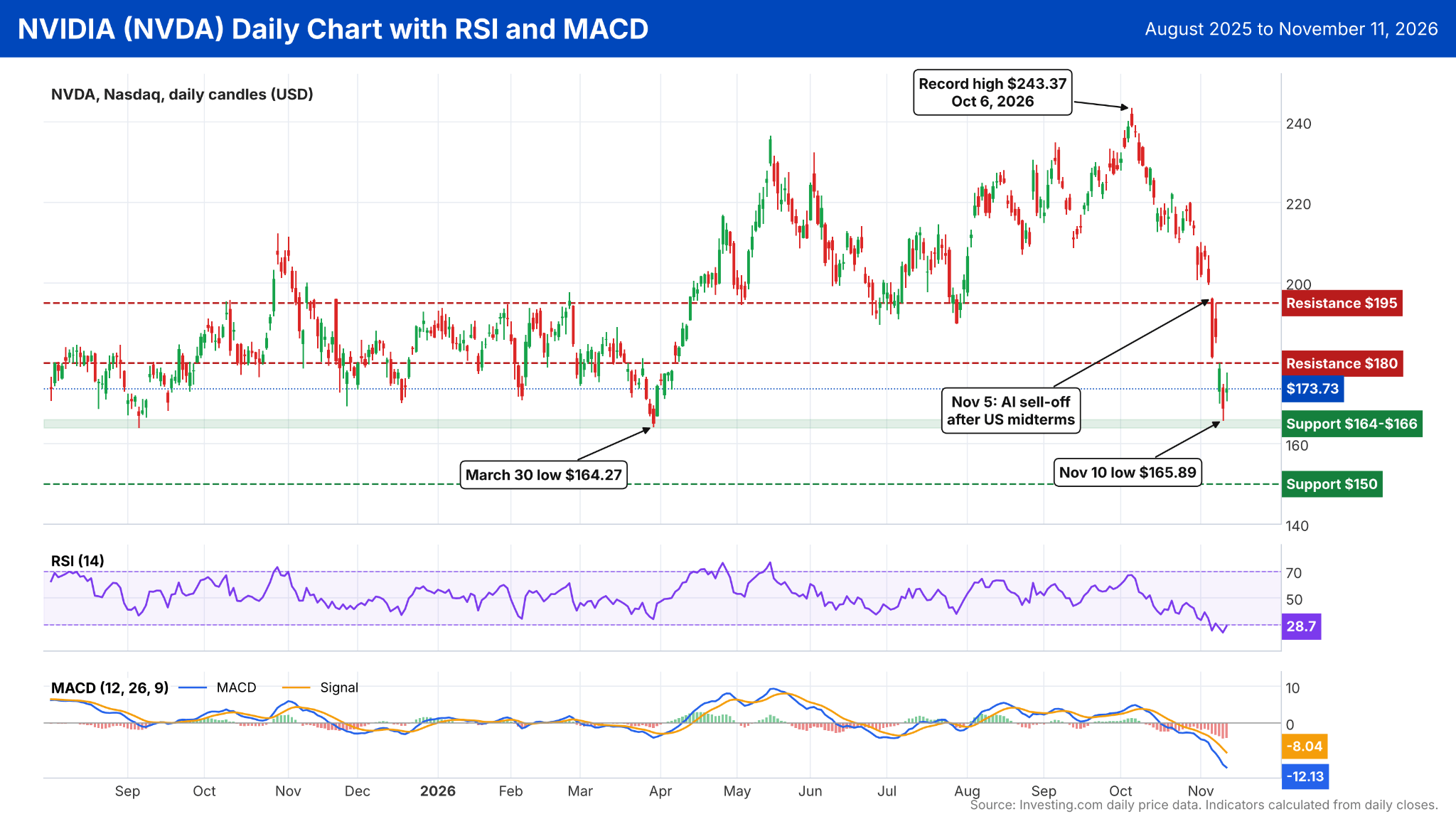
NVDA daily price chart with RSI and MACD, to November 12, 2026. Source: Investing.com price data.
NVDA Stock Forecast: What Wall Street Expects
Wall Street was far more positive than the share price before the leadership change. In early November 2026, 59 of the 62 analysts tracked by S&P Global rated NVDA a Buy or Strong Buy, two rated it a Hold and one a Sell, with an average 12-month target of about $327. Most firms cut their targets after Huang resigned, so that average is now out of date.
After the resignation, Truist and Craig-Hallum downgraded NVDA to Hold, with targets of $174 and $180, Evercore ISI downgraded it and cut its target to $186 from $465, and Oppenheimer moved to Perform and withdrew its target.
Analysts expected earnings of $9.31 per share for fiscal 2027, which ends in January 2027, and $15.91 for fiscal 2028. At $166, NVDA traded at about 10 times next year's expected earnings, a sign the market doubts growth can last beyond 2027. The table shows four firms with different views.
Seaport's $180 target dates from October, before the sell-off. The range from Bernstein's $200 to Morgan Stanley's $300 shows how far analysts disagree on how much the leadership change matters.
Long-Term NVDA Stock Prediction by 2030
By 2030, NVDA's price will depend less on single quarters and more on whether AI spending keeps growing after the first wave of data centre building, and on whether new leadership can keep Nvidia's product lead. Five drivers matter most, in order of importance:
✅ AI data centre spending: Data centres produced more than 90% of Nvidia's revenue in the second quarter of fiscal 2027, so how long cloud companies and AI labs keep expanding capacity is the biggest driver of the share price.
✅ The product cycle after Rubin: Nvidia launches a new data centre platform roughly every year, with Rubin Ultra and Feynman next. Keeping that pace after Huang's departure is the key test for new leadership, and it makes it harder for rivals to catch up.
✅ Competition and custom chips: Google's TPUs, AMD's GPUs and cloud companies' own chips are winning more AI work, especially in inference, which could pressure Nvidia's gross margin of about 75%.
✅ Margins and supply: Memory costs, power and data centre capacity limit how fast Nvidia can deliver. Margins in the mid-70s would support earnings growth.
✅ Regulation and China: Export rules, a US Justice Department inquiry into its licensing deal with Groq and possible limits on data centre construction all affect growth, while a reopening of China would add upside.
Huang estimated in August 2025, while still CEO, that AI infrastructure spending could reach $3tn to $4tn by the end of the decade. The scenarios below are conjecture, not forecasts. Each 2030 target was lowered after his resignation to allow for a lower valuation during the leadership transition.
1 Bull case ($520 by 2030): Nvidia remains the AI standard
If a strong permanent CEO keeps the annual product cycle on track, AI agents and reasoning models keep demand ahead of supply and later platforms keep Nvidia well ahead of rivals, the stock could reach about $520 by 2030, a market value of about $12.6tn.
2 Base case ($360 by 2030): Slower but steady growth
If Rubin ships in volume and Nvidia meets its $1tn Blackwell and Rubin outlook, earnings could approach analysts' $15.91 per share forecast for fiscal 2028, putting NVDA near $240 by the end of 2027 at about 15 times earnings, a lower multiple than before the leadership change. If AI spending then grows more slowly and Nvidia gives up some share in inference, the stock could still reach about $290 in 2028, $325 in 2029 and $360 by 2030, a market value of about $8.7tn.
3 Bear case ($180 by 2030): The build-out peaks
If cloud companies cut spending after 2027, custom chips win a large part of the market and the leadership change slows Nvidia's product cycle, NVDA could stay near $150 to $180, around its November 2026 level.
These developments would change the outlook:
✅ Two or more of the largest cloud companies cutting their AI spending plans.
✅ Nvidia's gross margin falling below 70% for more than one quarter.
✅ A long or difficult search for a permanent CEO, or the departure of other senior executives.
✅ New US limits on data centre construction or AI chip exports after the midterms.
✅ Further Fed rate hikes after the hotter-than-expected October 2026 inflation report, which would weigh on growth stocks.
✅ Nvidia's data centre sales to China resuming, or the appointment of a highly regarded permanent CEO, either of which would add upside.
Is NVDA a Good Stock to Buy?
NVDA can still suit long-term investors, but the earnings report and the CEO transition make the weeks ahead unusually uncertain:
- Long-term investors: Suitable with gradual buying, such as a first portion around $160 to $166 and more near $150, close to the November 12 low.
- Cautious investors: Waiting for a daily close above $180 after the earnings report, or the appointment of a permanent CEO, means a higher entry price but more certainty.
- Short-term traders: With CFDs on Mitrade, traders can go long or short on NVDA's moves around earnings. A daily close above $180 could open a rebound toward $195, with a stop loss below $148, while a break below the November 12 low near $149 could open the way to about $140. The price can gap past a stop loss after results.
- Income investors: Not suitable. Nvidia pays $0.25 per share each quarter, a yield of about 0.6% at $166.
- High-risk investors: Suitable only with a small position, given the 32% fall from the October 6 record.


How to Trade NVDA on Mitrade
Mitrade lets you trade NVDA's price moves in either direction through CFDs, without owning the shares. It is regulated by the UAE Capital Market Authority (licence number 20200000397), charges zero commission with competitive spreads and accepts deposits from $50 in USD or AED. Stop loss, take profit and negative balance protection help you manage risk around volatile events such as earnings.
Step 1. Open and verify your account: Sign up on the Mitrade website or app, upload your ID and answer a short trading-experience questionnaire. Live accounts are for adults aged 18 and over.
Try a free $50,000 demo with zero commission and low spreads.
Step 2. Practise on the demo account: A free demo account with $50,000 in virtual funds lets you test NVDA trades before using real money.
Step 3. Fund your account: Deposit from $50, in USD or AED.
Step 4. Find NVDA and choose a direction: Search for NVIDIA or NVDA and choose Buy if you expect the price to rise or Sell if you expect it to fall.
Step 5. Set your risk controls: Add a stop loss and take profit before you confirm, and keep the trade size small around earnings, when the price can gap.
Conclusion
Nvidia's long-term case still rests on AI data centre demand, but Jensen Huang's resignation on November 12, 2026 adds a leadership risk the stock had not faced before, and most Wall Street firms have since cut their targets. In the short term, the November 17 earnings report, interim CEO Colette Kress's first comments and the search for a permanent CEO will decide whether NVDA recovers toward $180 or retests its November 12 low near $149. The base case is about $180 by the end of 2026, $240 by the end of 2027 and $360 by 2030. Building any position in stages, or practising NVDA trades on a free Mitrade demo account with $50,000 in virtual funds first, keeps the risk manageable.
Risk-Free Demo Account
CMA-regulated | 24х5 | 0 commission | low spreads. Enjoy limit and stop loss for every trade!
Can NVDA stock reach $300?
Yes, but probably not quickly. From $166, $300 would need a rise of about 81%. In this article's scenarios, NVDA reaches $300 during 2029 in the base case and during 2027 in the bull case.
What is the NVDA stock prediction for 2030?
The base case is about $360 by 2030, within a range of $180 to $520, depending mainly on whether AI infrastructure spending keeps growing after 2027, how much of it Nvidia keeps and how well its new leadership performs.
Is Nvidia stock overvalued?
Not on earnings forecasts. At about $166 on November 12, 2026, NVDA traded at about 18 times expected fiscal 2027 earnings and 10 times the fiscal 2028 forecast. The risk is that those forecasts fall if AI spending slows or the leadership change disrupts the business.
* The content presented above, whether from a third party or not, is considered as general advice only. This article should not be construed as containing investment advice, investment recommendations, an offer of or solicitation for any transactions in financial instruments.


