


Meta Platforms (META) is in the middle of the biggest spending cycle in history. Revenue is growing fast, but investors are asking how long a very profitable ad business can fund an AI build-out this large before it pays off. That question shapes every Meta stock forecast through 2030.
In this article, we will be looking at the main forces behind Meta’s long-term outlook and what the bear, base, and bull cases could look like. Prices mentioned here are pre-split. Meta’s 2-for-1 split via non-voting new Class C shares takes place in January 2027, and per-share figures will roughly halve then.
Price Target Summary Table
What’s the outlook for Meta’s stock price right now?
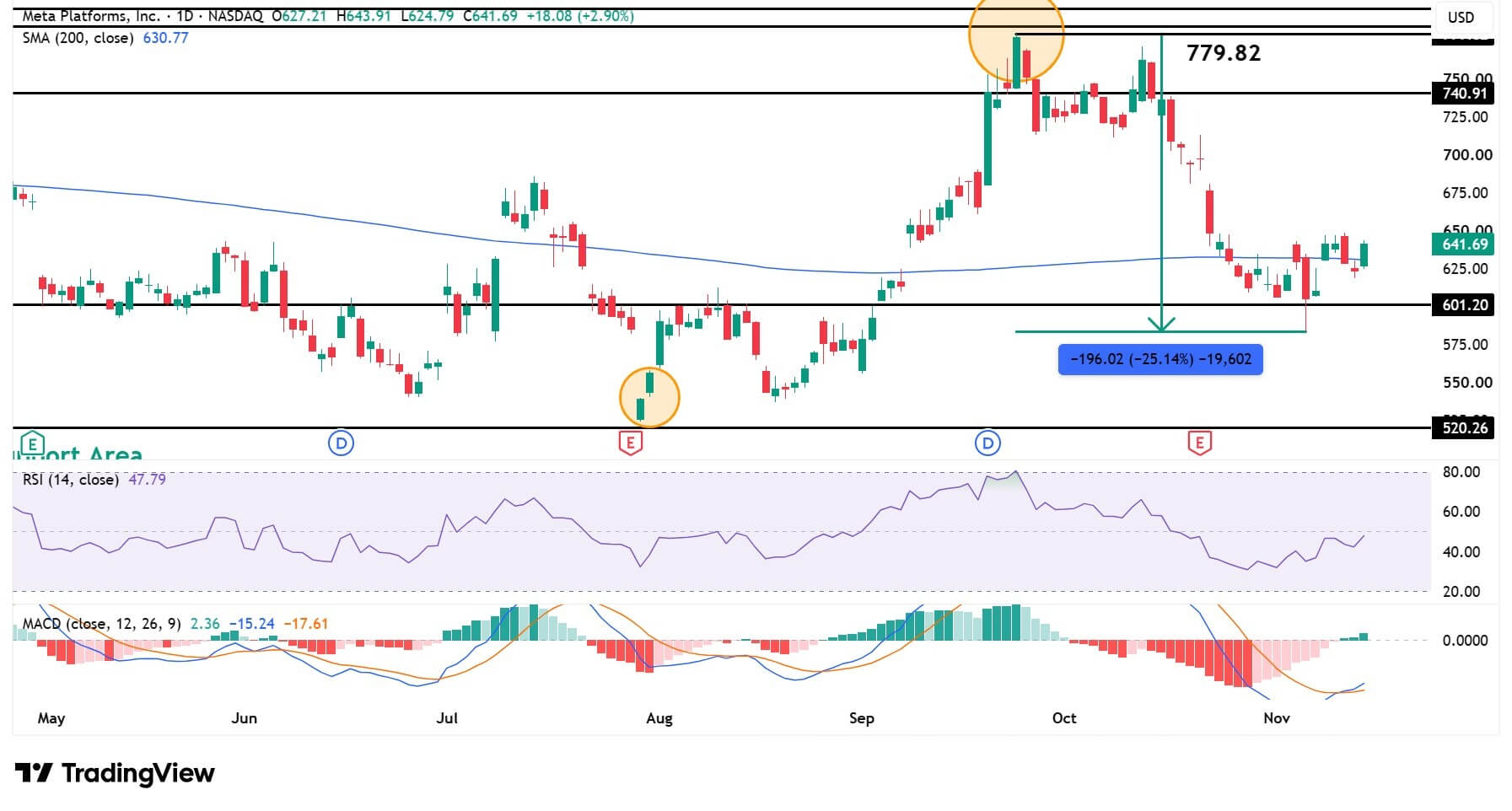
Meta’s stock price has been under pressure, falling 25% from its September peak of $779.82. It is currently trading around $640, and lower price levels could provide long-term buyers with an accumulation opportunity.
AI spending vs. cash generation - The business is not the problem. Advertising remains strong, and AI is improving how well Meta targets and prices ads. The concern is the cash, as Meta has plans to spend $135-145 billion in 2026, roughly double from last year, and that the spending now exceeds the cash the company generates.
The new Class C shares, which Meta may issue from time to time, have also led investors to wonder whether outside capital will be needed to fund the AI build.
Reasonable Valuation, but cautious sentiment - Meta’s stock is now trading at a modest 20.8 P/E multiple, compared to its 5-year average of 24.86. The market has been quite sensitive to the spending story, with its stock price trading within a wide range between $500 and $800 since 2025, experiencing heightened volatility.
Macro backdrop adds pressure - Interest rate expectations and geopolitical tensions weigh on growth stocks, and Meta is no exception. With oil trading near $90/barrel, market analysts expect a possible rate hike in December, and higher interest rates tend to weigh most on growth stocks as they reduce the present value of future earnings.
What Will Drive META Stock Higher?
Meta’s upside over the next four years depends on a handful of forces: a core advertising business that keeps growing, AI products that can earn their own revenue, and a market backdrop that gives growth stocks room to re-rate. The main drivers that will influence Meta’s stock are outlined below:
1. Accelerating ad growth - Enhanced AI targeting is lifting both pricing and volume, with both average price per ad and ad impressions growing at double digits. Creator and brand partnership ads have become a fast-growing multi-billion-dollar line, with brands shifting budgets from the open web into walled-garden apps.
2. Muse and subscriptions - Meta’s frontier AI models are transitioning from a cost story to a revenue story. A wider rollout of Meta One and subscription tiers for businesses and consumers gives Meta a recurring revenue stream that is not dependent on ads.
3. Falling compute costs - Management has talked about large efficiency gains in running AI models, which would improve margins on AI products once they scale.
4. New platforms - Smart glasses are the one hardware line with real momentum, and Reality Labs losses are expected to shrink towards 2027. Success there would reduce a long-running drag on profits and give Meta a position in the next computing device.
5. Valuation Reset - With the stock near 17 times 2027 earnings, the market may have already priced in a lot of the bad news. Consensus 2028 EPS estimates near $40 leave room for upside if the plan works.
6. Easing Interest Rates - Growth stocks like Meta are sensitive to interest rates, because their biggest payoffs are expected years from now. If inflation cools and the Fed holds or cuts rather than hikes, lower yields would support higher valuations across the big tech.
Critical Risks & Key Challenges of Meta Stock
The same investment cycle that creates the upside also creates the main risks. These risks center on whether AI spending pays off, how Meta funds it, and how much of the outlook depends on factors outside the company’s control, such as regulation, competition, and the economy.
⚠️The AI return gap - Hundreds of billions of dollars are being committed to data centers, cloud capacity, and leases, and the payoff is still unproven. If AI revenue grows more slowly than costs, margins and the valuation both suffer.
⚠️Funding and dilution - Meta’s new Class C shares allow it to raise equity from time to time. A modest raise would barely register, but a large one could dilute existing shareholders at a time when cash flow is already thin.
⚠️Legal and regulatory pressure - Teen mental health litigation, privacy cases, and antitrust actions mean legal costs may stay a recurring item rather than a one-off.
⚠️Ad Concentration - Advertising forms about 98% of its revenue. Thus, a recession, a drop in ad budgets, or a shift in consumer attention hits Meta harder than its diversified rivals.
⚠️AI Competition - Google, OpenAI, and others are competing for the same users, talent, and chips. Thus, Meta’s frontier model has to be good enough to justify the spending.
⚠️Macro and sentiment - Big tech stock valuations are sensitive to geopolitical shocks and interest rates, as seen in early 2026 when the stock fell ~30% during a broad selloff.
Meta Stock Price Forecast 2026: Mid-Term Catalysts
Meta’s base case for year-end 2026 is $700, about 9-10% above the current market price, assuming the market stabilizes after the selloff. The bull case is $820, and the bear case is $520, which would mean a return to this year’s low, which would require an ad slowdown or a broader tech selloff.
Several factors that will decide which of these paths the stock follows are as follows:
✅Q4 results and 2027 guidance - The 2027 capex number will matter more than the Q4 revenue itself.
✅Fed policy and rates - Growth stocks are sensitive to the rate outlook, and a December hike would add pressure.
✅Big Tech earnings - Peers’ AI spending comments shape how the market treats every large AI spender.
✅Legal developments - Further settlements or penalty rulings would weigh on sentiment.
✅AI adoption data - Usage numbers for Meta AI and Muse will show whether the product momentum is real.
✅Split mechanics - Class C shares begin trading in late January 2027, which could bring short-term trading interest.
What Do Analysts Expect for META?
Analysts remain bullish despite the drop, and several firms have strengthened their calls in recent days. The average 12-month price target is about $850, roughly 32% above the current price, with estimates ranging from $629 to $1,050. Ratings are mostly Buy, with a small number of Holds. Their confidence rests on strong ad growth, early signs that AI products can earn revenue beyond advertising, and a pullback that has made valuation more attractive.
Recent targets from major firms:
Most of the targets sit well over 30% above the current price, and BMO is the most cautious of the group. It rates the stock Hold, citing uncertainty about the return on Meta’s heavy 2026 and 2027 AI spending, though its target of $685 still implies a modest upside.
Technical Analysis & Key Price Levels
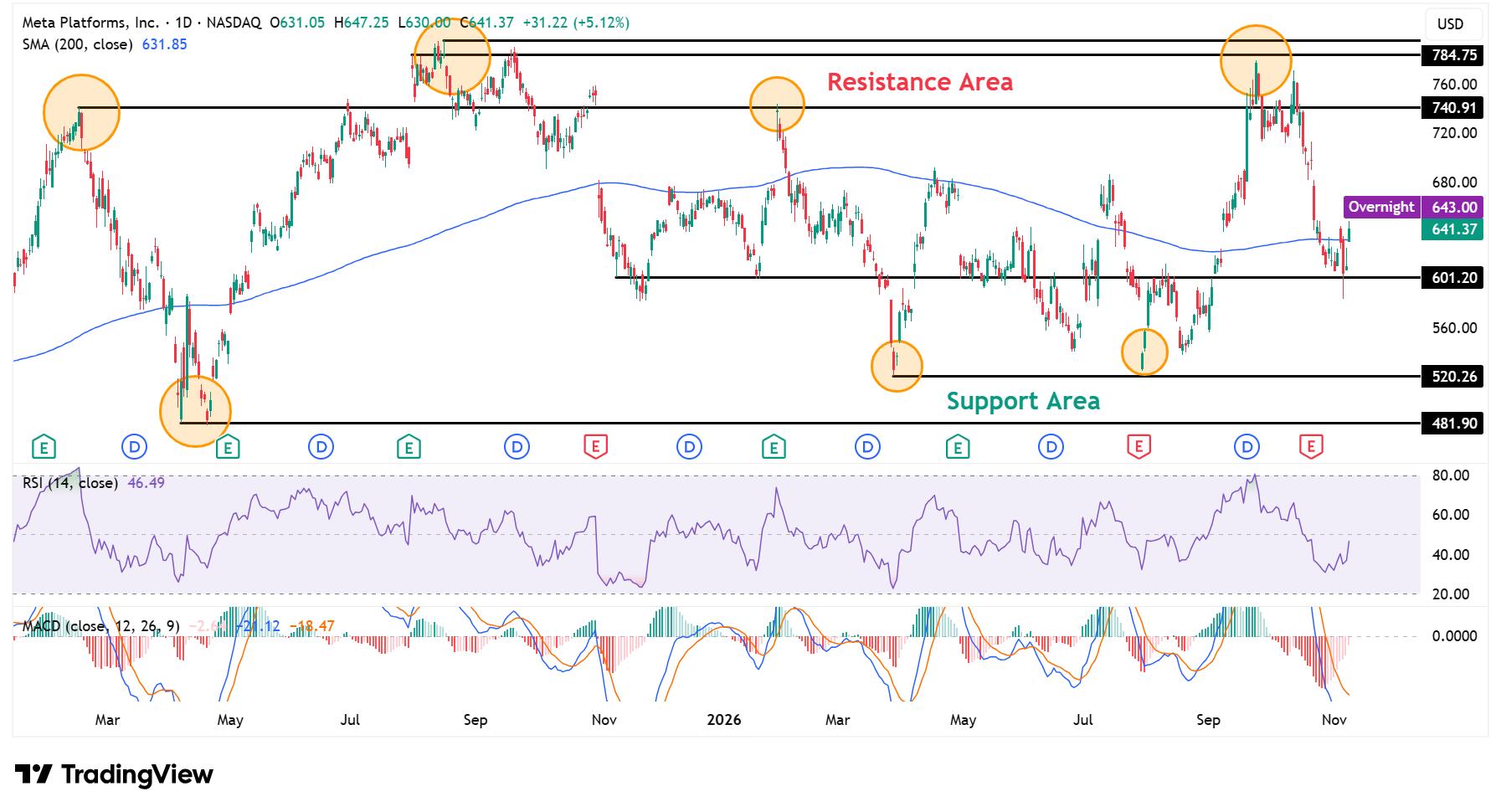
Meta’s stock price has been trading within a broad range of $480-$800 since February 2025. The stock price corrected from $740 to $480 during Feb-Mar 2025, and then rebounded to touch an all-time high (ATH) of $796.25 in August 2025. The area around $740-795 has been acting as a strong resistance, with the stock failing to cross the important $800 level.
Key Resistance Levels
$740-$750: The first key resistance area, which the price managed to break above for the first time in August 2025 to touch its ATH.
$780-$785: The 2026 high stands at $779.82, which the price touched in September 2026.
$795-$800: ATH is at $796.25, with $800 acting as a key pivot level. Any breakout above this could open the bull case targets for the upcoming years.
The price touched its 52-week low of $520.26 in March 2026 during the time of a broad market selloff triggered by the US-Iran conflict. The stock managed to hold above this level thereafter and is currently trading above its 200-day simple moving average, which stands at $631.85.
Key Support Levels
$630-$600: First key support area below the 200-day moving average.
$525-520: 52-week low will act as a critical support area, which the buyers manage to defend during July 2026.
$500-$480: Major support area, coinciding with the bear case target of 2027.
If the price retests the support area, then it could be seen as a buying opportunity. The resistance levels can be used to book partial profits in the short term, and a price breakout above the ATH driven by fundamental catalysts could open the gate for bull case targets in the upcoming years.
Is Meta Stock a Buy, Hold, or Sell for Short Term?
Over the next few months, Meta’s share price is likely to be driven less by the long-term AI story and more by sentiment: how investors read AI spending, where interest rates are heading, and how big tech trades as a group. That makes the short-term picture more uncertain than the long-term one.
Hold, with a bias to buy on dips. The Q3 earnings beat removed some uncertainty, but the stock has seen a selloff post-earnings and has struggled to hold gains. Short-term traders can prefer entries near key support levels, rather than chasing strength.
The next major catalyst: Q4 results and 2027 capex guidance, which is a few months away, will decide the future price direction. Any capex surprises can trigger sharp drops, as seen before. Thus, position sizing matters more than direction here.
On Mitrade, traders can access Meta through CFDs and take long or short positions to seek opportunities in both rising and falling markets. CFDs require less upfront capital than buying an equivalent value of shares, but they do not confer ownership of the underlying shares.

Scenario-Based Meta Stock Price Forecasts: 2026, 2027, and 2030
Meta’s long-term price path is hard to pin to a single number, because the outcome depends on whether its heavy AI investment turns into profitable growth. The three scenarios below show how the stock could look in 2026, 2027, and 2030 if the investment pays off, partly pays off, or falls short.
Bull case ($820 in 2026, $950 in 2027, $1,450 in 2030)- Ad growth stays above 20%, Muse subscriptions scale, and compute costs fall sharply in 2027. Free cash flow turns positive, equity raises stay small, and the market pays a premium multiple again.
Base case ($700 in 2026, $780 in 2027, $1,060 in 2030)- Growth cools to the mid-to-high teens, capex stays heavy through 2027 and then flattens, and dilution is manageable. The stock compounds with earnings, but the multiple stays near its historical average.
Bear case ($520 in 2026, $480 in 2027, $680 in 2030)- Ad growth slows in the weaker economy while spending keeps rising. Meta raises large amounts of equity or debt, legal costs mount, and AI products fail to monetize. Even then, the 2030 figure assumes capex eventually normalizes.
Is Meta Stock a Buy, Hold, or Sell for the Long Term?
Over a multi-year horizon, Meta’s share price will depend less on quarterly swings and more on whether its AI investment turns into profitable growth. For investors with a long time frame, the case rests on a strong core business, a reasonable valuation, and the potential for new revenue lines.
Buy, for investors who accept volatility. Meta is growing revenue at 26% and has a core business that generates $30 billion in operating cash flow per quarter. It currently trades at a trailing P/E of 20.81, which is not demanding for that growth rate.
The thesis rests on one assumption: that AI spending eventually earns a return. Investors with doubts may allocate a smaller position or wait for 2027 guidance, which would be more reasonable. Further, dollar-cost averaging can help manage the risk of poor timing.
How to Trade Meta on Mitrade?
Investors can buy Meta shares directly or trade Meta CFDs on the Mitrade platform. CFDs let traders take a larger position with less capital, but they do not confer ownership of the underlying shares.
Why trade Meta CFDs on Mitrade?
✅Zero commission - Trading on the Mitrade platform is commission-free with competitive spreads.
✅Free demo account - The demo account comes with $50,000 in virtual funds and access to all platform features.
✅Flexibility in both directions - Traders can go long if they expect price to rebound, or short if they expect further weakness, without owning the shares.
✅Low-entry barrier - Mitrade platform requires a low minimum deposit (from $50), allowing trades to start from small sizes.
You can trade Meta through CFDs on the Mitrade Platform by following a simple, typical process:
Step 1: Open an account and complete identity verification.
Step 2: Practice on the demo account before using real money.
Step 3: Fund your account with a supported payment method.
Step 4: Search for META in the US stocks list and open the chart.
Step 5: Choose Buy or Sell based on your view of direction.
Step 6: Set Size, stop-loss, and take-profit before confirming the order.
Conclusion
Meta’s stock has pulled back to about $642, as investors weigh 26% revenue growth against negative free cash flow and rising AI spending. In the short term, the stock looks like a Hold, with a bias to buy on dips.
The next major catalyst is the Q4 results, when management will give its 2027 capex plan. For long-term investors, the outcome depends on whether AI spending turns into profitable growth through ads, subscriptions, and business agents without heavy dilution from new share issuance.
Investors who accept volatility can consider building a position gradually, while those with doubts can wait for clearer guidance on 2027 spending. Short-term traders may also find opportunities in Meta’s swings and can trade Meta CFDs on Mitrade in either direction, going long or short by managing risk with stop-loss and take-profit orders.

What is the 5-year target for Meta stock (2030)?
The base case target is about $1,060 per share by 2030, within a range of $680 (bear) to $1,450 (bull), on a pre-split basis. The base case assumes earnings growth in the low-to-mid teens and a recovery in margins after the AI buildout peaks.
Is Meta’s heavy AI CapEx a risk for stock performance?
Yes, it is definitely a risk, which is why the stock fell after record Q3 numbers. Spending already exceeds operating cash flow, so Meta may rely on debt, leases, or new Class C share sales. The risk is manageable while ad revenue grows fast, but it grows if growth slows.
Does Meta stock pay dividends?
Yes, Meta pays a quarterly dividend of $0.5250 per share, or $2.10 per year. The dividend yield is 0.34%, and the payout is under 10% of earnings, which is safe but small.
* The content presented above, whether from a third party or not, is considered as general advice only. This article should not be construed as containing investment advice, investment recommendations, an offer of or solicitation for any transactions in financial instruments.


