



Did you know that in financial markets, traders and investors can either buy an asset or sell it first when they expect its price to fall?
This is called short selling. It can create opportunities in bearish markets. In this guide, we explain how short selling works and how to use it properly.
Key Takeaways
Short selling aims to profit from falling prices, but it should be used carefully.
Traditional short selling involves borrowing the asset before selling it, while CFD shorting directly uses a Sell position instead of a Buy position.
Short selling requires good analysis and risk management to find high-quality setups and protect capital.
What is Short Selling?
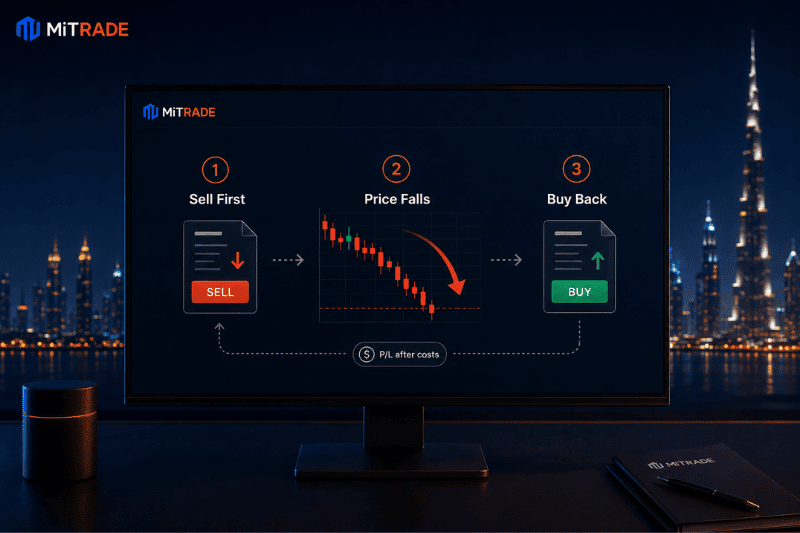
Short selling means opening a position that aims to profit when the market price falls.
In traditional stock short selling, a trader borrows shares, sells them, then tries to buy them back at a lower price. The shares are returned to the lender, and the difference becomes profit or loss after costs.
A simple daily-life example can make this easier.
Imagine you borrow a phone worth $1,000 and agree to return the same model later. You believe the phone will be cheaper next month, so you sell it today for $1,000. Later, the price drops to $800. You buy the same model, return it, and keep the $200 difference.
★ That is the basic logic of short selling: sell high first, then buy back lower later.
But if the phone price rises to $1,200, you still need to buy it back. In that case, you lose $200.
Traders short sell for three main reasons:
To profit from falling prices
To hedge another position
To express a view that an asset is overvalued
Short selling can be useful. However, you should always consider the possibility that the price may rise instead. That is why proper risk management, including stop-loss orders, is important to help protect your capital.
Classic Historical Examples of Short Selling
Short selling became famous through major market events. These examples show how research, timing, capital, and risk control can matter when taking bearish positions.
George Soros shorting the British pound in 1992
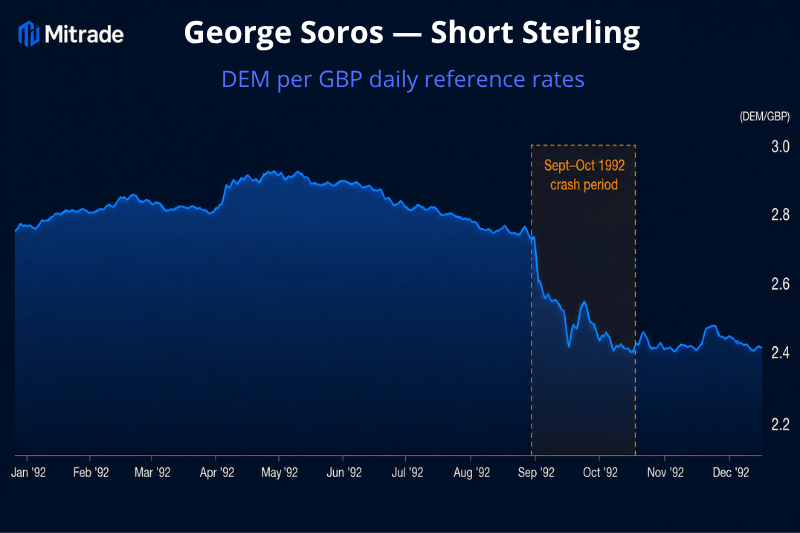
In 1992, Britain artificially propped up the pound to match the German mark. George Soros saw through the illusion; the UK economy was too weak. Betting big, his fund borrowed and aggressively dumped billions of pounds. On "Black Wednesday," the Bank of England panicked, hiking interest rates to an astonishing 15% to buy back currency. Soros didn't blink. He told his traders to "go for the throat" and keep selling. The UK ran out of cash and quit the system. The pound collapsed, earning Soros a legendary $1 billion in a single day.
Michael Burry shorting the U.S. housing market

In 2005, America was drunk on a housing boom, but Dr. Michael Burry actually read the ugly mortgage data. He discovered millions in loans given to people with zero income. To bet against housing, he forced banks to create Credit Default Swaps (CDS)—essentially paying heavy monthly insurance premiums until a crash. For two years, the market defied him. Investors called him a lunatic and threatened to sue. Burry bled cash but held his ground. In 2007, the subprime bubble finally burst, Lehman Brothers collapsed, and Burry’s lonely bet net his investors $725 million.
What’s the Difference Between Long and Short?
Going long and going short are opposite market directions. A long position aims to profit from rising prices, while a short position aims to profit from falling prices.
💡 Conclude in one sentence: Going long means “buying and holding”: losses are limited, but profits are unlimited; whereas going short means “borrowing and selling”: profits are limited, but risks are unlimited.
What Can You Short Sell?
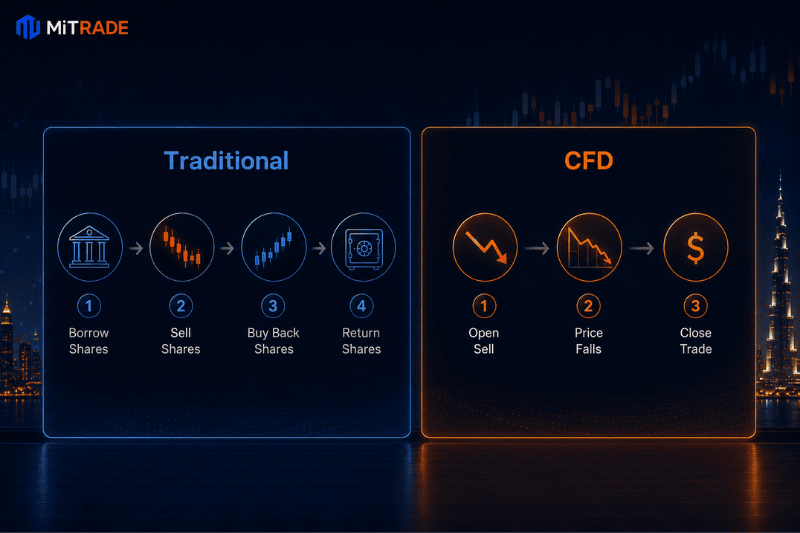
Short selling can be done in two main ways: traditional short selling and short selling through financial derivatives.
1. Traditional Short Selling
Traditional short selling means borrowing an asset first, selling it in the market, then buying it back later.
The process works like this:
❶ The trader or investor borrows the asset from a broker or lender.
❷ The borrowed asset is sold in the market.
❸ If the price falls, it is bought back at a lower price.
❹ The asset is returned to the lender.
❺ The difference becomes profit or loss after fees.
Traditional short selling is mainly used in markets where the asset can be borrowed, such as:
✅Stocks
✅ETFs
✅Some bonds or debt securities
✅Some fixed-income securities, depending on market access and availability
Please note: Traditional short selling can involve borrowing fees, margin requirements, dividend or coupon adjustments, and availability issues. If the asset is not available to borrow, a platform may show messages such as “asset not borrowable” or “cannot short sell.”
2. Short Selling of Financial Derivatives
Short selling can also be done through financial derivatives. In this case, traders do not usually borrow the asset directly. Instead, they use Sell position orders when they expect the market price to fall.
Derivative products used for short selling include CFDs, futures, options, inverse ETFs, and credit default swaps.
This method usually provides leverage compared with traditional short selling, which improves capital efficiency because traders do not need to pay the full value of the underlying asset upfront.
Using CFDs as an example, the process works like this:
❶ The trader or investor chooses the asset or market they want to short.
❷ A Sell position is opened.
❸ If the market moves lower, the position gains value. If the market rises instead, the position loses value.
❹ The position is closed to lock in profit or cut losses.
Markets commonly shorted through derivatives include:
✅Stocks
✅Indices
✅Forex pairs
✅Commodities such as gold or oil
✅Bonds
✅Cryptocurrencies, where available
✅Mortgage-backed securities, through products such as credit default swaps
This approach typically provides greater buying power without requiring large amounts of capital, making it convenient for retail traders looking to test small-scale short positions, especially those with limited funds. Not only does it require minimal upfront capital, but brokers like Mitrade also provide negative balance protection, helping you manage risk more effectively.
Also with Mitrade, you can practice short selling using a demo account before committing real capital, allowing you to familiarize yourself with how Sell positions work and the overall process without risking your money.
Risk-Free Demo Account
CMA-regulated | 24х5 | T+0 | low spreads. Enjoy limit and stop loss for every trade!
When Can You Short Sell?
Short selling should be based on a clear reason, proper analysis, and a risk management plan. Traders may use technical, fundamental, and sentiment analysis to find short opportunities and protect against potential losses.
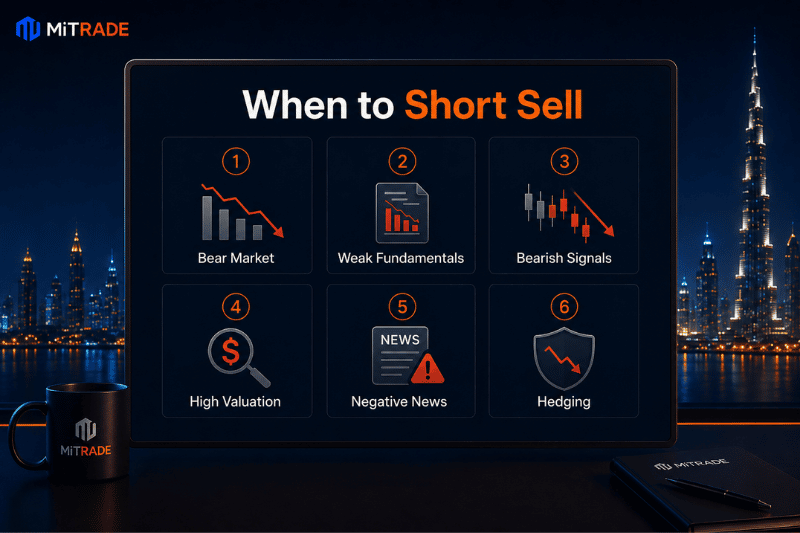
1. Bear market
A bear market is a period when prices are generally falling.
💡Suggestion: Wait for a pullback, bearish rejection, or support break before entering a short position.
2. Deteriorating fundamentals
A company may weaken if earnings decline, debt rises, margins shrink, or guidance disappoints.
💡Suggestion: Combine weak fundamentals with price confirmation instead of shorting only because the news looks negative.
3. Bearish technical indicators
Traders may consider shorting when price breaks support, rejects from resistance, forms large bearish candles, trades below falling moving averages, shows overbought signals, or loses momentum.
💡Suggestion: Backtest your strategy and do not use indicators randomly.
4. High valuations
An asset may look overvalued if price rises faster than earnings, revenue, or realistic growth expectations.
💡Suggestion: Do not short only because an asset looks expensive. Wait for a catalyst, bearish rejection, or breakdown.
5. Negative news or catalysts
Earnings misses, regulatory pressure, weak economic data, or geopolitical events can create downside pressure.
💡Suggestion: Support fundamental analysis with technical analysis, avoid rushing into trades during high-impact news, and stay patient.
6. Portfolio hedging
A trader may short an index CFD or another related market to reduce exposure if they already hold long positions.
💡Suggestion: If the goal is hedging, use modest size and make sure the short position matches the risk you want to reduce.
How to Short Sell and Calculate Profits
To short sell, a trader opens a Sell position, waits for the price to move lower, then closes the position.
The basic calculation is: Short selling profit or loss = (opening sell price - closing buy price) × position size - costs
Traditional stock short selling example: AAPL
This is an educational example for traditional stock short selling. It does not mean every platform offers physical share borrowing.
XAUUSD CFD short selling example on Mitrade
XAUUSD CFDs allow traders to utilize leverage for higher capital efficiency. By putting up a small margin, you control a much larger position; however, because PnL is calculated on the full exposure, gains and losses are equally amplified. Traders must employ strict risk control, as adverse market moves can swiftly wipe out capital.
What Costs Are Associated with Short Selling?
Short selling costs can reduce expected profit, and they depend on the trading or investing style chosen, the market traded, and the platform used. Traders should check them before opening a position.
Spread: The difference between the buy price and sell price.
Commission: Some instruments or brokers may charge a commission to open or close a position.
Borrow fee: In traditional stock short selling, traders may pay a fee to borrow shares.
Margin interest: If a trade uses borrowed funds or margin, interest may apply.
Overnight financing or swap: CFD positions held overnight may involve financing costs.
Dividend adjustment: In traditional stock short selling, if the borrowed stock pays a dividend while a trader is short, the short seller usually needs to pay a dividend-related adjustment.
Slippage: In fast markets, especially during high volatility or low liquidity, the execution price may differ from the expected price.
Before opening a short position, check the product details, margin requirements, and trading costs.
Pros and Cons of Short Selling
Pros of Short Selling
✅Can profit from falling prices, which can be useful during crashes or crises.
✅Can help hedge a portfolio when long positions may lose value.
✅Allows traders to act on overvalued assets.
✅Gives traders more strategy options, such as bearish trades, hedge trades, or market-neutral ideas.
✅May support price discovery by reflecting weak fundamentals, negative news, or overvaluation risks.
Cons of Short Selling
❌Losses can become very large if price keeps rising.
❌Short squeezes can force traders to close at bad prices.
❌Timing is difficult because prices can keep rising longer than expected.
❌Costs such as spreads, commissions, borrow fees, or overnight financing can reduce returns.
How to Open Your First Short Position?
Before opening a short position, choosing a trusted broker is important because traders need accurate pricing, efficient execution, and minimum slippage. A good broker should also provide an advanced, user-friendly platform that is easy to use.
Mitrade brings these tools into one place, including market search, charts, drawing tools, economic calendar, market data, news, sentiment analysis, and order management.
Step 1: Scan the Markets and Build Your Short Watchlist
Open the Mitrade trading platform and look for markets that show structural weakness. Instead of browsing randomly, focus on instruments—whether commodities, forex pairs, indices, or stock CFDs—that are facing clear fundamental or macroeconomic headwinds.
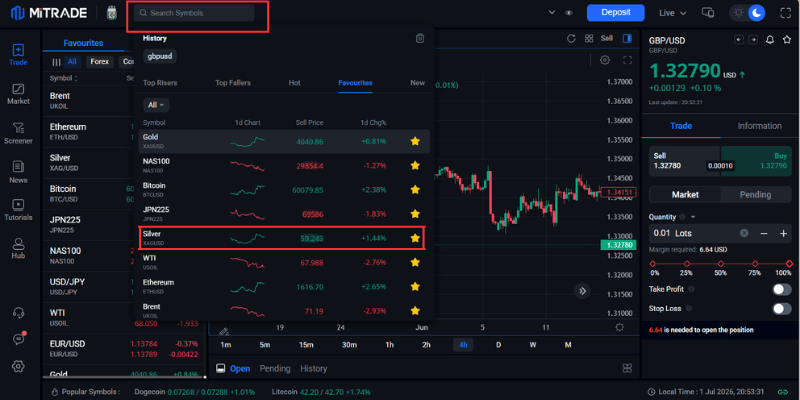
💡 Pro-Tip for Beginners: Never short an asset simply because "the price looks too high." Markets can stay irrational longer than you can stay solvent. Instead, look for tangible catalysts: a looming economic recession, weak corporate earnings, negative industry news, or a broader sector sell-off.
Step 2: Analyze the Charts and Wait for Technical Confirmation
Once you have selected a market from Step 1, do not jump in immediately. Switch to the charting interface to find your precise entry point. You want to see the technical price action align with your bearish thesis before pulling the trigger.
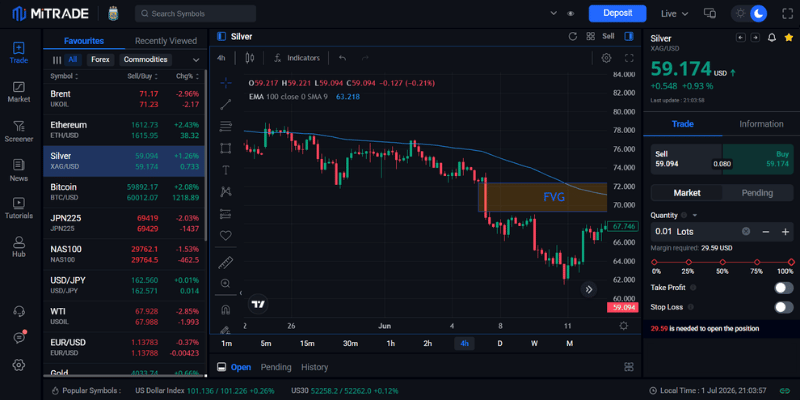
🔖What to look for: Wait for a clear bearish trigger, such as a breakdown below a major support level, a sharp rejection from a key resistance zone, or price trading consistently below significant moving averages (e.g., the 50-day or 200-day EMA).
💡 Pro-Tip for Beginners: Avoid "FOMO shorting" (Fear Of Missing Out) when a market is already crashing off a cliff. Entering too late exposes you to sudden short-covering rallies. Always wait for a temporary bounce to resistance, establish a clear confirmation signal, and pre-define your exact entry, stop-loss, and take-profit targets.
Step 3: Place an order with a stop-loss and take-profit
After price confirms your short-selling idea, place the Sell order with a stop-loss and take-profit. The stop-loss is important because short positions lose money when the market rises, while the take-profit helps lock in gains if the price falls as expected.
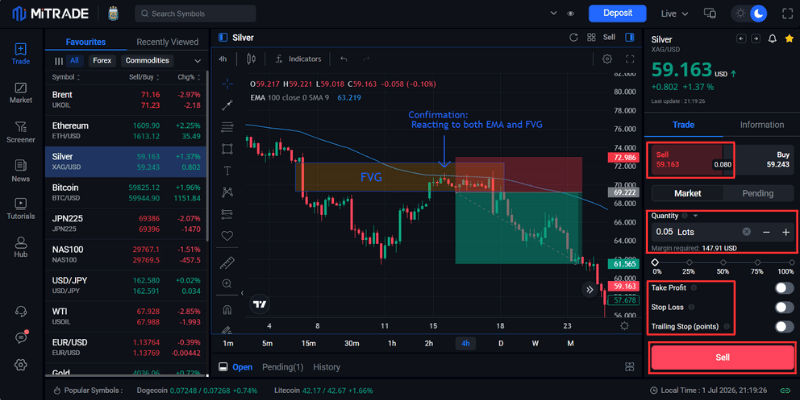
⚠️ The Leverage Warning: Since you are trading CFDs, you will likely utilize leverage. Remember that while leverage maximizes capital efficiency, it is a double-edged sword—it amplifies both profits and losses. Keep your leverage low, especially as a beginner.

What Should You Note If You Want to Profit from Short Selling?
Short selling is not only about predicting a drop. Traders can be right about direction but still lose because of poor timing, oversized positions, or weak risk control.
Build a plan: define the market, timeframe, entry reason, stop-loss, take-profit, and maximum risk before entering.
Use proper analysis: combine technical analysis with fundamentals, especially on higher timeframes, before opening a short position.
Control position size: for stock shorting, beginners should generally keep one short position per stock, with risk not exceeding 2% to 5% of total capital. For CFD trading, risk no more than 1% to 3% per trade.
Choose short targets carefully: avoid stocks with very high short interest, very small market capitalization, or low liquidity, because they can move sharply against short sellers.
Wait for real bearish signals to avoid overtrading: do not short every market that looks high. Look for price breaking below the 50-day moving average, losing key support, forming lower highs, or reacting badly to earnings/news.
Check costs: spreads, overnight fees, borrow fees, dividends, and slippage can reduce profit.
Keep improving: practice with a demo account (Like Mitrade offers a demo account valued at $50,000), backtest your strategy, journal your trades, and focus on long-term consistency.
Conclusion
Short selling can be useful when market prices are falling, but it works best when it is based on clear analysis, proper timing, and strong risk management. Traditional short selling involves borrowing and selling an asset, while CFD short selling allows traders to open Sell positions without owning or borrowing the underlying asset.
For traders who want to profit in both rising and falling market scenarios, Mitrade offers CFD trading tools, chart analysis, risk management features, and a demo account to test short-selling ideas before using real capital.

What is a Short Squeeze?
A short squeeze happens when a heavily shorted asset rises sharply. Short sellers may rush to buy back and close their positions, which can push the price even higher.
What is the difference between shorting traditional stocks and shorting CFDs on Mitrade?
Traditional shorting usually involves borrowing shares, selling them, then buying them back later. CFD shorting means speculating on price movement without owning or borrowing the underlying asset.
Why does the platform sometimes display “Asset not borrowable” or “Cannot short sell”?
This can happen when shares are not available to borrow, the product is restricted, or short selling is not offered for that instrument.
* The content presented above, whether from a third party or not, is considered as general advice only. This article should not be construed as containing investment advice, investment recommendations, an offer of or solicitation for any transactions in financial instruments.


