


Prediction: $200 a Month Invested in Nvidia Will Be Worth This Much by 2035
Key Points
Nvidia is the engine behind the AI revolution.
Its revenue more than doubled year over year in its latest quarter, but that type of growth can't continue for the next nine years.
- Motley Fool Issues Rare "Total Conviction" Buy Alert ›
Putting aside $200 to invest every month is not something everyone can do. Yet for those who can and do, the potential rewards are real.
If you start next month and continue through December 2035, you'll have put aside $22,000 in contributions alone. But along the way, if you put that money into the right investments -- for example, Nvidia (NASDAQ: NVDA) -- those contributions could grow into a much larger nest egg.
Missed AI’s "Act 1"? Act 2 Could Be 15x Bigger. Most investors think they missed the AI boat because they didn't buy Nvidia in 2005. But according to our analysts, we’re only at the end of "Act 1"—the R&D phase. "Act 2" is the global rollout. Continue »
But what's a realistic return to expect from that strategy over the next nine years, especially given how much Nvidia stock has already grown recently?
The answer starts with Nvidia's business model and ends with how much investors are willing to pay for its future.

Image source: Getty Images.
How Nvidia can keep growing as AI becomes commonplace
Imagine it's 2035. Artificial intelligence (AI) chatbots have moved from the fringes to everyday use.
Scheduling an appointment? You'll almost certainly be talking to an AI chatbot. At the drive-thru? An AI chatbot might take your latte order. Have a question about your taxes? There will likely be an AI chatbot for that.
In short, AI isn't going anywhere. In fact, as the systems improve, organizations will rely more on AI-powered tools to stay competitive and meet consumer expectations for speed, accuracy, and 24/7 availability.
To power these applications, AI hyperscalers will need a far greater number of expensive graphics processing units (GPUs), the brains of the latest and greatest AI applications. Or as Nvidia CEO Jensen Huang recently said, "AI has reached its inflection point."
What Huang means by this is that AI systems are increasingly moving from learning about the world (training) to problem-solving (inference). As we move forward, these systems will be able to handle increasingly difficult tasks, often independently once they've received their initial instructions.
Based on that, we can expect AI to follow a path similar to the ones previously charted by technologies such as electricity, telecommunications, and the internet: evolving from a novelty we marvel at to an engine of rapid growth, and ultimately becoming an essential utility.
How $200 a month in Nvidia stock could grow
Putting aside $200 per month adds up to $2,400 per year. Do that for just over nine straight years (110 months), and you end up with $22,000 just from contributions.
To plot what that might turn into over time, let's look at several paths forward, running from bearish to bullish.
| Months | Total Contributions | Negative 5% Annualized Growth | 5% Annualized Growth | 10% Annualized Growth | 20% Annualized Growth |
| 12 | $2,400 | $2,346 | $2,456 | $2,513 | $2,633 |
| 24 | $4,800 | $4,577 | $5,037 | $5,289 | $5,843 |
| 36 | $7,200 | $6,699 | $7,751 | $8,356 | $9,758 |
| 48 | $9,600 | $8,717 | $10,603 | $11,745 | $14,531 |
| 60 | $12,000 | $10,637 | $13,601 | $15,487 | $20,352 |
| 72 | $14,400 | $12,463 | $16,753 | $19,622 | $27,449 |
| 84 | $16,800 | $14,200 | $20,066 | $24,190 | $36,104 |
| 96 | $19,200 | $15,852 | $23,548 | $29,236 | $46,658 |
| 108 | $21,600 | $17,423 | $27,209 | $34,811 | $59,527 |
| 110 | $22,000 | $17,677 | $27,837 | $35,795 | $61,931 |
At the low end, if Nvidia endures a negative 5% annualized return, you'd end up with a position worth $17,677. On the other hand, the total skyrockets to more than $61,930 with a 20% annualized return. For context, Nvidia has averaged an eye-popping 63% compound annual growth rate (CAGR) over the last 10 years. But given that it's now the world's largest company, accounting for about 7% of the value of the entire U.S. stock market all by itself, it's unreasonable to think that it could repeat that type of performance over the next decade.
What could derail Nvidia's growth?
There are two obvious threats that could put hurdles in the way of Nvidia's growth. First, regardless of demand, the company might not actually be able to source enough components or production capacity to deliver fully on that demand. On the latest earnings call, Huang noted that "our entire supply chain is challenged." Ultimately, Nvidia can only grow as fast as its suppliers and foundry partners allow, and if the supply chain begins to bend and creak under the enormous weight of the AI revolution, that could slow Nvidia's growth.
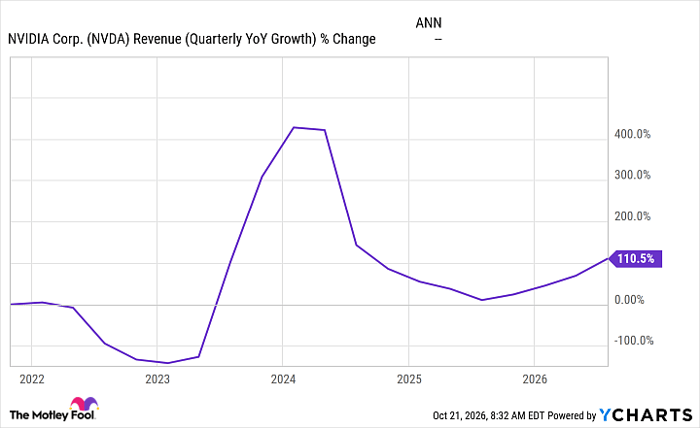
NVDA Revenue (Quarterly YoY Growth) data by YCharts.
Second, Nvidia's customers and competitors (which in some cases are the same companies) might alter their courses. AI hyperscalers are spending enormous amounts of money building out AI infrastructure at breakneck speed. If one or more were to pull back on spending, Nvidia's top line could take a hit.
Similarly, rising competition could begin to erode Nvidia's margins. Direct rivals like AMD are gaining ground with new products, and even Nvidia's largest customers like Alphabet, Amazon, and Microsoft are investing heavily in developing their own AI chips in partnership with players like Broadcom and Marvell Technology.
A monthly Nvidia investment: Is it worth it?
For argument's sake, let's say that Nvidia could deliver a 10% annualized return over the next 110 months. At that rate, the total value of your position would grow to just over $35,000.
This growth rate assumes Nvidia will face continued supply chain challenges, but not catastrophic ones. It also assumes that, even as competition continues to increase, Nvidia will maintain a significant competitive advantage in data center processors.
In summary, the $200/month habit is entirely controllable; the results are not. Nonetheless, a person who consistently invests is already paying their future self and is likely to be rewarded. Even if Nvidia falls well short of its recent returns, a market-matching 10% return would still deliver significant benefits.
Should you buy stock in Nvidia right now?
Before you buy stock in Nvidia, consider this:
The Motley Fool Stock Advisor analyst team just identified what they believe are the 10 best stocks for investors to buy now… and Nvidia wasn’t one of them. The 10 stocks that made the cut could produce monster returns in the coming years.
Consider when Netflix made this list on December 17, 2004... if you invested $1,000 at the time of our recommendation, you’d have $361,596!* Or when Nvidia made this list on April 15, 2005... if you invested $1,000 at the time of our recommendation, you’d have $1,303,935!*
Now, it’s worth noting Stock Advisor’s total average return is 910% — a market-crushing outperformance compared to 211% for the S&P 500. Don't miss the latest top 10 list, available with Stock Advisor, and join an investing community built by individual investors for individual investors.
See the 10 stocks »
*Stock Advisor returns as of October 24, 2026.
Jake Lerch has positions in Alphabet, Amazon, and Nvidia. The Motley Fool has positions in and recommends Advanced Micro Devices, Alphabet, Amazon, Broadcom, Marvell Technology, Microsoft, and Nvidia. The Motley Fool has a disclosure policy.
Recommended Articles


