


What Will a $10,000 Investment in Palantir Be Worth by 2030?
Key Points
Palantir is far more expensive than some of its big tech peers.
Palantir must grow to justify its stock price, but its profit margins are nearly maxed out.
- Motley Fool Issues Rare "Total Conviction" Buy Alert ›
Palantir (NASDAQ: PLTR) investors have had a fairly rocky 2026. For most of the year, the stock was losing money. However, starting in August, Palantir reversed the decline and has now gained about 12% for the year. That is roughly in line with the gain for the S&P 500 (SNPINDEX: ^GSPC).
However, if you survey the average Palantir investor, almost all of them will say that beating the market is their long-term priority for holding Palantir shares. So, 2026 has been a disappointing year so far. But as long-term investors, there is still plenty of time to deliver strong returns.
Missed AI’s "Act 1"? Act 2 Could Be 15x Bigger. Most investors think they missed the AI boat because they didn't buy Nvidia in 2005. But according to our analysts, we’re only at the end of "Act 1"—the R&D phase. "Act 2" is the global rollout. Continue »
So, if you invested $10,000 into Palantir now, what could that be worth by 2030? And will it be good enough to beat the market? Let's take a look.
Image source: The Motley Fool.
Palantir's AI business is booming
Palantir originally started off offering its AI platform to government entities. This was an incredibly popular offering, and Palantir's government contracts still make up the majority of its revenue stream today. However, Palantir also expanded to the commercial side of the business, and it's seeing huge adoption of its AI platform.
Essentially, Palantir is an AI platform that plugs into existing data streams and helps derive actionable insights. Through automation, Palantir can also assist in deploying AI agents that do tasks on behalf of its users. Palantir's platform dramatically improves the efficiency of one person in their role and can provide decision-making capabilities that far exceed what a human can deliver.
Companies and governments are adopting Palantir's software at a breathtaking pace, which is evidenced by its 93% revenue growth rate in Q2. U.S. commercial revenue grew even faster, with revenue from this segment increasing at a 149% pace. AI adoption is happening rapidly, and Palantir is one of the companies that's taking market share.
One of the biggest surprises with Palantir is how great its margins are. New headlines are filled with stories about how quickly some AI firms are growing, but also highlight that they're spending far more than they make. Palantir isn't in that boat, as it delivered an impressive 55% profit margin in Q2.
It doesn't get better than that, but this also opens up a new problem.
Palantir's stock is pricey
Palantir's stock is one of the more expensive on the market, and it trades for almost 125 times this year's earnings.
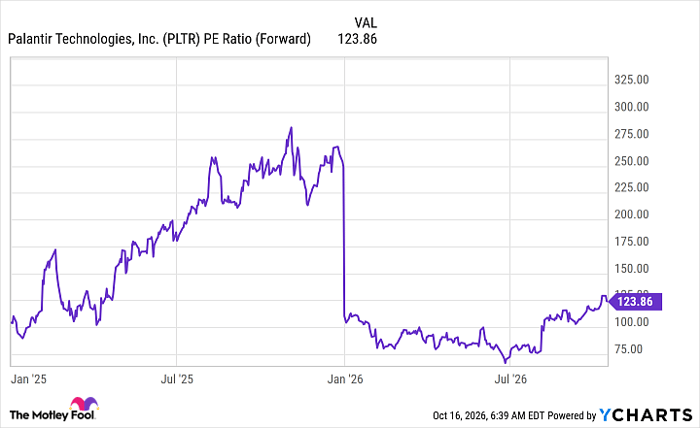
PLTR PE Ratio (Forward) data by YCharts
That's a very pricey stock, and with its profit margin being incredibly high, it can't increase that figure too much to get itself out of this high valuation pickle. Instead, the only path is to grow out of it. Most big tech stocks trade for about 30 times forward earnings, regardless of how fast the business is growing. Take Nvidia (NASDAQ: NVDA), for example. Its revenue rose 106% in Q2 (faster than Palantir), yet shares trade for 23 times this year's estimated earnings.
So, for Palantir to get to a reasonable 30 times forward earnings valuation, it must quadruple its revenue, which results in its earnings quadrupling as well. That could take a long time, especially considering what Wall Street thinks Palantir's growth rate will be next year. The average Wall Street analyst estimate is that Palantir's revenue will rise 50% during 2027. Palantir has a history of outperforming expectations, so this may be an undershoot. However, if we utilize a 50% growth rate from 2027 to 2030, then it becomes a rather aggressive projection.
Should Palantir's revenue increase at a 50% compounded annual growth rate (CAGR) from 2027 to 2030, that would result in its revenue rising fivefold. That's more than the quadrupling we established above that was required to get Palantir to a reasonable valuation. So, the remaining double could turn a $10,000 investment into about $20,000. That is still market beating-growth, but there are other AI stocks that appear to be in-line for better performance due to a much lower starting valuation.
All of this is because of how expensive Palantir's stock is now. I think this could damp future returns, and it's something that Palantir will have to grow out of.
Missed Nvidia in 2009? This Rare Signal Is Flashing Again
In 2009, a "Double Down" signal flashed for a little-known chipmaker called Nvidia. If you’d invested $5,000 then, you’d be sitting on $2,758,512 today.*
Now, for the first time in years, that same "Total Conviction" signal is flashing for a company 1/100th the size of Nvidia. It’s a key player in the $1.8 trillion space race, and with the stock recently sitting 20% off its highs, the window to get in early is closing fast.
Continue »
*Stock Advisor returns as of October 24, 2026.
Recommended Articles


