


Uranium Is Near $90 a Pound. Here's My Prediction for What's Ahead for the Fuel.
Key Points
Nuclear energy is experiencing a global revival, driven by energy security, decarbonization efforts, and soaring electricity demand.
Uranium supplies are struggling to keep pace as inventories shrink and utilities compete to secure long-term fuel contracts.
Uranium prices could remain near $100 per pound, benefiting producers such as Cameco and Uranium Energy.
- Motley Fool Issues Rare "Total Conviction" Buy Alert ›
The nuclear revival is gaining momentum. Governments worldwide are turning to nuclear energy to strengthen energy security. Meanwhile, hyperscalers need reliable, around-the-clock power to support surging electricity demand. Nuclear energy stands out for its emission-free, 24/7 baseload power, unlike intermittent renewables.
That combination is strengthening the outlook for nuclear energy and its essential fuel, benefiting uranium miners like Cameco (NYSE: CCJ) and Uranium Energy (NYSEMKT: UEC). With spot prices near $90 per pound and approaching historic highs, investors are asking a crucial question: Where does uranium go from here? Here's what I predict will happen to uranium next.
Missed Nvidia in 2009? This Rare Signal Is Flashing Again. In 2009, a "Double Down" signal flashed for a little-known chipmaker called Nvidia. For the first time in years, that same "Total Conviction" signal is flashing for a company 1/100th the size of Nvidia. Continue »
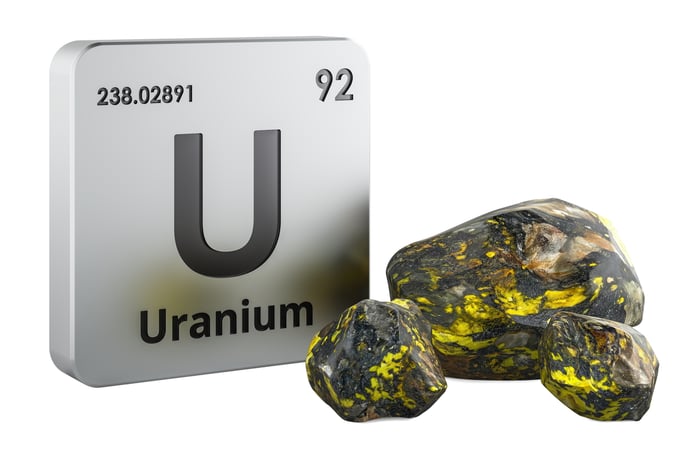
Image source: Getty Images.
New nuclear reactors are coming online at a rapid rate
In the mid-2000s, nuclear energy was enjoying a resurgence. However, economic shifts, project delays, and the 2011 Fukushima disaster derailed this momentum and delivered a final blow to the industry for a decade.
However, things have shifted recently. At COP28 in 2023, over 20 nations, including the U.S., U.K., Japan, Canada, South Korea, and France, pledged to triple global nuclear energy capacity by 2050. The driving force behind this pledge was net-zero carbon-emission goals, which would be nearly impossible without nuclear energy.
China is leading the charge, with 38 commercial reactors under construction. The country aims to approve 10 to 15 gigawatts (GW) of new capacity annually and hopes to surpass the U.S. in nuclear generation by the end of the decade. In Japan, reactor restarts are working through regulatory approval. Meanwhile, in the U.S., power purchase agreements are bringing decommissioned plants, such as Three Mile Island Unit 1 and Palisades, back online.
In addition, President Donald Trump's administration wants to quadruple nuclear energy capacity by 2050. As part of this, policymakers want to have 10 new large-scale commercial nuclear reactors under construction by 2030. The Department of Energy is also fast-tracking testing of advanced nuclear reactors through its Reactor Pilot Program.
Uranium faces structural shortages as demand surges
Nuclear fuel procurement differs from oil and gas. Nuclear fuel accounts for no more than 10% of a plant's operating expense, so utility fuel buyers are price-insensitive and lock in long-term supplies. After Fukushima, utilities could secure cheap secondary supplies and rely on the spot market for uranium. However, buyers are now looking to secure fuel commitments for the next decade.
Uranium markets are reaching an inflection point. Inventories have dwindled, so buyers must rely on the primary mine supply. The market is facing bottlenecks. For example, in Kazakhstan, which accounts for 40% of global output, in situ recovery (ISR) mining operations have been hampered by shortages of sulfuric acid.
On top of that, energy demand is booming. Rising artificial intelligence (AI) workloads and growing data center infrastructure are driving incredibly strong demand for power. Total data center power consumption is projected to double by 2030, while total U.S. electricity demand is estimated to expand 25% by 2030.
Technology companies are making deals left and right to secure energy. Constellation Energy (NASDAQ: CEG), which owns and operates the largest nuclear energy fleet in the U.S., has signed long-term power purchase agreements with Alphabet, Amazon, Microsoft, and Walmart.
As part of this, Constellation, Vistra, and other power providers are using power uprates to extend the life of their nuclear plants and bring decommissioned plants back online.
What's next for uranium prices
Uranium prices are around $90 per pound, but supplies are likely to remain tight over the next decade. Utilities face a widening uncommitted supply gap, with cumulative uncommitted uranium requirements estimated to exceed 800 million pounds of triuranium octoxide, also called yellowcake, through 2035.
Spot uranium prices will likely remain elevated around $100 per pound for the next few years, as demand surges amid the deficit, with some experts arguing this is necessary to justify the investments needed to finance the next generation of underground and open-pit mines. Bank of America projects uranium could jump to $130 per pound by next year, a nearly 44% increase over today's spot price.
Global energy demand is growing, and nuclear energy is poised to play a crucial role in filling those gaps, benefiting uranium miners. Cameco uses long-term contracts and has agreements to deliver 28 million pounds of yellowcake annually over the next five years. Meanwhile, Uranium Energy is completely unhedged, giving investors exposure to rising spot prices but also adding volatility if spot prices decline meaningfully.
Missed Nvidia in 2009? This Rare Signal Is Flashing Again
In 2009, a "Double Down" signal flashed for a little-known chipmaker called Nvidia. If you’d invested $5,000 then, you’d be sitting on $2,885,382 today.*
Now, for the first time in years, that same "Total Conviction" signal is flashing for a company 1/100th the size of Nvidia. It’s a key player in the $1.8 trillion space race, and with the stock recently sitting 20% off its highs, the window to get in early is closing fast.
Continue »
*Stock Advisor returns as of October 22, 2026.
Courtney Carlsen has positions in Alphabet, Cameco, Constellation Energy, Microsoft, and Vistra. The Motley Fool has positions in and recommends Alphabet, Amazon, Cameco, Constellation Energy, Microsoft, Vistra, and Walmart. The Motley Fool has a disclosure policy.
Recommended Articles


