


A Recession Is Coming Eventually, and History Says There's a Major Silver Lining for Investors
Key Points
Ever since the global financial crisis and Great Recession, stocks have been in a nearly uninterrupted bull market.
One of the most popular S&P 500 ETFs has delivered nearly 7x cumulative growth since September 2010.
The next recession is nothing to root for, but every recession is also an opportunity for long-term investors to snap up stocks at a discount.
- 10 stocks we like better than Vanguard S&P 500 ETF ›
What will cause the next recession? Higher interest rates, a slowdown in the artificial intelligence (AI) build-out, or some economic crisis that's not on anyone's radar yet?
No one knows for sure, but one thing is certain: A recession will come. Someday. It's an inevitable part of the business cycle.
Missed Nvidia in 2009? This Rare Signal Is Flashing Again. In 2009, a "Double Down" signal flashed for a little-known chipmaker called Nvidia. For the first time in years, that same "Total Conviction" signal is flashing for a company 1/100th the size of Nvidia. Continue »
America hasn't had a serious recession since the global financial crisis of 2008. The COVID-19 pandemic caused a short, deep economic downturn and a short-lived stock market sell-off. And 2022 was a year-long bear market, during which the S&P 500 (SNPINDEX: ^GSPC) lost about 19% of its value.
But for the most part, the past 10 to 15 years have been smooth sailing for stock market investors. The Vanguard S&P 500 ETF (NYSEMKT: VOO) has delivered average annual returns of about 15.3% for the past ten years.
VOO has gained a cumulative return of about 835.6% (by net asset value) since September 2010. That means a $10,000 investment in VOO, starting at the S&P 500 ETF's inception in September 2010, would have grown to about $69,250 today.
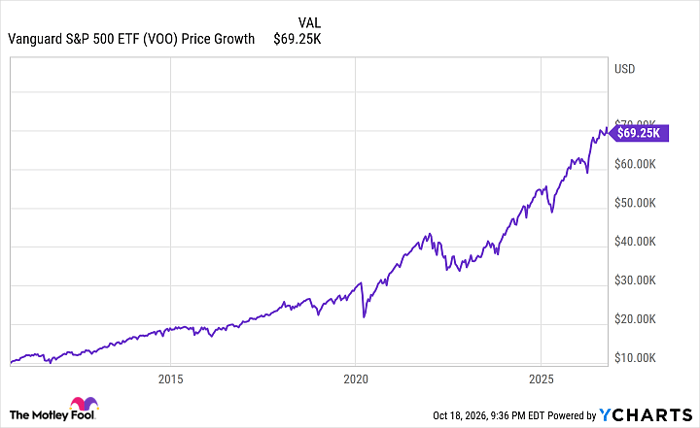
VOO data by YCharts
When making money in the stock market is this "easy" for this long, some investors get nervous. An economic downturn is bound to happen, right? What if the next recession is worse than we imagine? What if the stock market never goes up again?
At moments like these, it's important to take heart and look back at the lessons of stock market history. There's a big silver lining to recessions: stocks go on sale.
Let's look at what the next recession might mean for your investments, and how to prepare now.
Image source: Getty Images.
Recession silver lining: Stocks are "on sale" at lower prices
The silver lining is that downturns are smart opportunities to buy at lower prices. For example, if the S&P 500 declines by 18% (like it did in 2022), every $1,000 invested into an S&P 500 index fund buys an extra 19% of shares.
Or for individual stocks, recessions can be a great time to buy shares in excellent companies at a lower price per share. Let's say a stock's price was $100 before the recession, and its price fell to $75 per share during the recession. The same $1,000 investment that used to buy 10 shares would buy 13.33 shares at the recession "discount price."
Not every stock is a good buy "on sale," and not every investor will have extra cash on hand that they feel comfortable investing during a slow economy. But this is the kind of mindset to adopt before the next bear market hits: Stock market downturns don't have to be all bad news. For long-term investors, they mean stocks are "on sale."
The stock market grows in the long run -- despite short-term recessions and crashes
Every time you invest in the stock market, you're making a bet on a brighter future. You're sending money on a journey to some future date, and along the way, you hope that money will grow and multiply with compound interest.
Recessions don't last forever. Most of the time, in the long run, the stock market goes up. Not every individual company's stock will survive the next recession. Some economic downturns drive entire sectors into a major shakeout, causing industry disruption, corporate bankruptcies, and shareholder pain.
But the broad stock market, as shown by the S&P 500, has a 98-year track record of resilience -- even through the world's worst recessions, crashes, crises, and conflicts.
That's right: Ever since 1928, the S&P 500 (the largest 500 publicly traded stocks in America) has delivered an average annual return of 9.98%. That's a strong rate of return that can build real wealth. At that rate of return, every dollar you invest today would double in about 7.2 years. After 22 years, a $10,000 investment growing at 9.98% annualized returns would double three times and would be worth more than $80,000.
How to prepare to invest in stocks during the next recession
Nobody knows when the next recession or bear market will begin, but it's never too early to start preparing.
Check on your emergency cash savings. How secure is your job? Is your industry booming or struggling? You might want to build up some extra cash to invest during a recession by working extra hours or starting a side hustle today. Now could also be a good occasion to improve your earning power by gaining some new career skills or a new certification or credential.
If you feel like your stock portfolio is too risky, right now (before a recession hits) could be a good opportunity to diversify or rebalance. This doesn't mean stop buying stocks -- keep investing for the long term in a way that's appropriate for your income, risk tolerance, and life goals. But if you're losing sleep at night about share prices and your investment account balance, that could be a sign that you'd be better off adding some bond ETFs or other diversification.
Should you buy stock in Vanguard S&P 500 ETF right now?
Before you buy stock in Vanguard S&P 500 ETF, consider this:
The Motley Fool Stock Advisor analyst team just identified what they believe are the 10 best stocks for investors to buy now… and Vanguard S&P 500 ETF wasn’t one of them. The 10 stocks that made the cut could produce monster returns in the coming years.
Consider when Netflix made this list on December 17, 2004... if you invested $1,000 at the time of our recommendation, you’d have $370,440!* Or when Nvidia made this list on April 15, 2005... if you invested $1,000 at the time of our recommendation, you’d have $1,330,110!*
Now, it’s worth noting Stock Advisor’s total average return is 924% — a market-crushing outperformance compared to 212% for the S&P 500. Don't miss the latest top 10 list, available with Stock Advisor, and join an investing community built by individual investors for individual investors.
See the 10 stocks »
*Stock Advisor returns as of October 22, 2026.
Ben Gran has no position in any of the stocks mentioned. The Motley Fool has positions in and recommends Vanguard S&P 500 ETF. The Motley Fool has a disclosure policy.
Recommended Articles


