


History Says This Will Happen to Sandisk Stock Heading Into Its Oct. 29 Report
Key Points
Sandisk's NAND memory is a vital component for servers that handle AI training workloads, and the data center build-out has caused demand for NAND to soar beyond supply.
Sandisk stock dropped sharply after it reached expensive levels this summer, and while the momentum has shifted since then, it's still well below its peak.
Management is taking actions to make revenue more predictable and its higher margins more sustainable.
- Motley Fool Issues Rare "Total Conviction" Buy Alert ›
Sandisk (NASDAQ: SNDK) has been one of the hottest stocks of the year. Its memory products are in high demand for artificial intelligence (AI) data centers, and thanks to a shortage of those products, it's achieving extraordinary revenue and profit growth. As a result, the stock is up 478% so far in 2026.
The memory giant will report results for its fiscal 2027 first quarter on Oct. 29. Here's what history suggests might happen before it does.
Missed Nvidia in 2009? This Rare Signal Is Flashing Again. In 2009, a "Double Down" signal flashed for a little-known chipmaker called Nvidia. For the first time in years, that same "Total Conviction" signal is flashing for a company 1/100th the size of Nvidia. Continue »
Low supply for AI
As the artificial intelligence (AI) trend has progressed, the focus has shifted repeatedly. First, much of the interest was on the foundational models; then came demand for data centers and the AI accelerators and GPUs that provided compute for those models. There has been a concurrent boost to the energy sector as the tech players had to answer the question of where the electricity to power all of those new data centers was going to come from.
Now, getting enough memory for those data centers has become one of the most critical parts of the infrastructure build-out process.
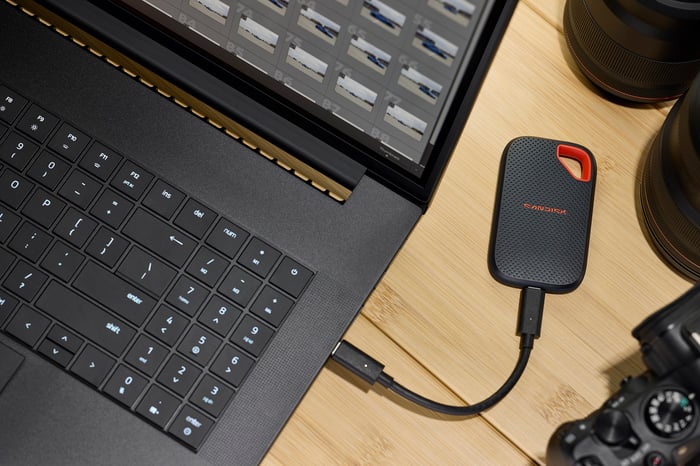
Image source: Sandisk.
Sandisk makes many kinds of memory products, from the memory cards in your smartphone to the dynamic random access memory (DRAM) in your laptop, but the recent frenzy is for its NAND flash memory, which can keep storing data even when it's not powered on, and is vital for AI training. Sandisk is one of the few makers of NAND, and data centers have become a huge part of Sandisk's business.
Scarcity is what's driving this rally -- demand from data centers far exceeds the supply of NAND that Sandisk and its peers can manufacture, so they've all been able to boost prices sharply, and all are experiencing rapid growth.
In Sandisk's fiscal 2026 fourth quarter (which ended July 3), revenue increased 372% year over year, and data center revenue doubled just from its fiscal Q3.
Is this the end of the cycle?
Despite its massive growth and soaring profits -- it booked $43.97 in earnings per share in its fiscal fourth quarter -- Sandisk stock is rather cheap, trading at a P/E ratio of under 19. That lack of a premium is tied to investors' worries that the end of this up phase of the memory cycle is inevitable.
Historically, memory companies have always gone through booms and busts based on the supply-and-demand cycle. When supplies are tight, prices rise, and manufacturers build new foundries to expand capacity. Then supply catches up to and exceeds demand (which often declines cyclically as well), and prices tumble again.
Right now, the AI build-out requires huge quantities of memory products, but data center construction and processor purchases are likely to taper off at some point. The question is when.
Anticipating this, Sandisk this year introduced its new business model (NBM) agreements, which lock in long-term sales deals with large customers, guaranteeing some price floors and purchase volumes for multiple years. It had eight NMBs as of the end of the fiscal fourth quarter. Management notes that it provides necessary infrastructure components to the biggest and most important tech companies, and those businesses are planning -- and purchasing -- several years in advance. It's also focusing on its highest-value products and markets, which management believes will lead to "more durable earnings power."
What might happen before Oct. 29
Western Digital spun off Sandisk in February 2025, and since its return to the market as an independent company, the stock has climbed prior to all previous earnings reports except the most recent one. By then, Sandisk stock had soared to an expensive level. It has started to rise again, but it's still not back to its previous high. So while history suggests it's going to climb again over the next few days, the trend has changed.
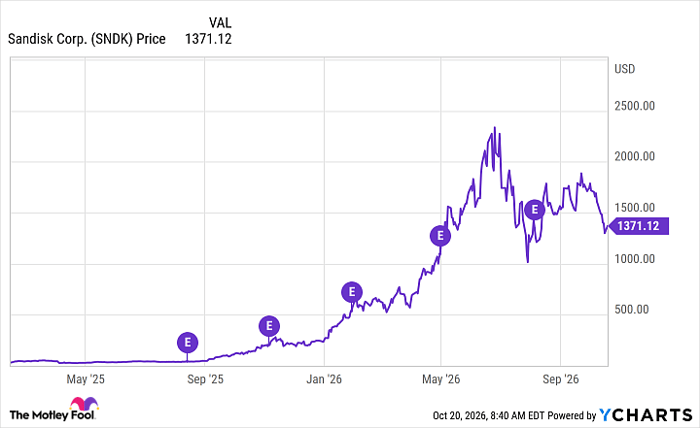
SNDK data by YCharts
Since the stock price is much lower today, there's room for it to rise in the coming days, and to keep heading higher after earnings if it meets or surpasses expectations. Management is guiding for $10.5 billion in revenue at the midpoint, a 357% increase over last year, and $45 in EPS. Wall Street is expecting a 363% increase and $46.27 in EPS. The market will also be looking for new business deals and guidance for continued high growth.
Should you buy stock in Sandisk right now?
Before you buy stock in Sandisk, consider this:
The Motley Fool Stock Advisor analyst team just identified what they believe are the 10 best stocks for investors to buy now… and Sandisk wasn’t one of them. The 10 stocks that made the cut could produce monster returns in the coming years.
Consider when Netflix made this list on December 17, 2004... if you invested $1,000 at the time of our recommendation, you’d have $370,440!* Or when Nvidia made this list on April 15, 2005... if you invested $1,000 at the time of our recommendation, you’d have $1,330,110!*
Now, it’s worth noting Stock Advisor’s total average return is 924% — a market-crushing outperformance compared to 212% for the S&P 500. Don't miss the latest top 10 list, available with Stock Advisor, and join an investing community built by individual investors for individual investors.
See the 10 stocks »
*Stock Advisor returns as of October 22, 2026.
Jennifer Saibil has no position in any of the stocks mentioned. The Motley Fool has no position in any of the stocks mentioned. The Motley Fool has a disclosure policy.
Recommended Articles


