


Nvidia Stock Hasn’t Been This Cheap in 7 Years. Only 1 Explanation Makes Sense.
Key Points
Nvidia's trailing earnings multiple is at its lowest level since June 2019.
This valuation decline reflects earnings growth outpacing share price appreciation.
Concerns about AI infrastructure spending and rising competition could slow Nvidia's growth, but not necessarily.
- 10 stocks we like better than Nvidia ›
In early 2024, the man known as the "Dean of Valuation" viewed Nvidia (NASDAQ:NVDA) as ridiculously overpriced. New York University finance professor and author Aswath Damodaran posted on X (the social media platform formerly known as Twitter) that the stock "is a bridge too far for me." He slashed his Nvidia position by half.
Since then, Nvidia has become the world's largest company by market cap. Its share price has nearly tripled. You might think that the chipmaker's valuation would be even more concerning now than it was in 2024. However, an interesting thing has happened with Nvidia along the way. Believe it or not, the stock hasn't been this cheap in seven years -- and only one explanation makes sense.
Missed AI’s "Act 1"? Act 2 Could Be 15x Bigger. Most investors think they missed the AI boat because they didn't buy Nvidia in 2005. But according to our analysts, we’re only at the end of "Act 1"—the R&D phase. "Act 2" is the global rollout. Continue »
Image source: Nvidia. Image source: Nvidia.
Historically cheap
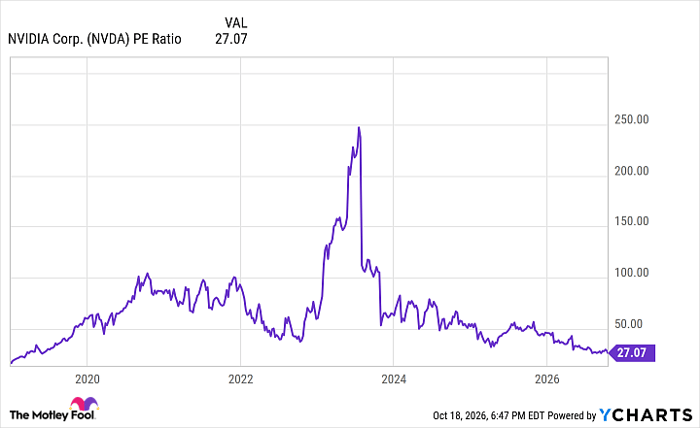
Nvidia's shares currently trade at slightly above 27 times trailing 12-month earnings, according to YCharts. The last time the stock's price-to-earnings (P/E) ratio was at that level was in June 2019.
NVDA PE Ratio data by YCharts
Over the last 10 years, Nvidia's average trailing P/E ratio was 61.3. Its earnings multiple today is less than half that amount.
To be sure, Nvidia still doesn't look cheap by most standards. The S&P 500 (SNPINDEX:^GSPC) sports a trailing P/E ratio of 24.9. Based on the S&P 500 Shiller CAPE (cyclically-adjusted price-to-earnings) ratio, the index is near its second-highest valuation ever.
Nvidia isn't even the least expensive among its "Magnificent Seven" peers. Google parent Alphabet (NASDAQ:GOOG) (NASDAQ:GOOGL), Amazon (NASDAQ:AMZN), and Facebook parent Meta Platforms (NASDAQ:META) All have lower trailing earnings multiples.
But none of these comparisons negate the fact that Nvidia is historically cheap. Importantly, the stock's forward P/E ratio (which is based on analysts' earnings projections) is lower than all of the other Magnificent Seven stocks.
The best (and only) explanation
There are several possible explanations for why a company's earnings multiple might be at the lowest level in years. For example, its business could be deteriorating. Competition could be intensifying to a worrisome extent. However, those clearly don't apply to Nvidia.
The GPU maker's sales in the second quarter of fiscal year 2027 soared 106% year over year to $92.6 billion. Its earnings skyrocketed 126%. Nvidia CEO Jensen Huang said in the Q2 earnings announcement, "Demand is accelerating."
So why is Nvidia's valuation at a seven-year low? The best explanation is that the company's earnings are growing faster than its share price. That's also the only mathematical explanation. A price-to-earnings ratio can only decrease when the denominator (earnings) increases at a faster rate than the numerator (price).
In 2024, Damodaran's valuation model for Nvidia assumed the company would increase its revenue at a compound annual growth rate of around 32% over the next five years. Roughly halfway through his projection period, Nvidia continues to blow past that growth rate in spectacular fashion.
What's more, the company shows no signs of slowing down. Huang said in Nvidia's Q2 earnings call, "I think the big picture is that we're going through this platform shift, and it affects every computer company. And every industry in the world uses computers. So, therefore, every industry is affected, every company is affected."
Is Nvidia stock a no-brainer buy?
Does all of this make Nvidia stock a slam-dunk pick for investors? Not necessarily.
Many Americans are already voicing concerns about data centers being built nearby. Wall Street is worried about the massive AI infrastructure spending, with some analysts wondering if the returns on investment will materialize. If these AI investments slow significantly, Nvidia won't be able to keep up its impressive growth trajectory.
And while competition isn't yet increasing at a worrisome level, it is increasing. Nvidia faces challenges from direct rivals such as AMD (NASDAQ:AMD) as well as from its customers, including Amazon, Google, and Microsoft.
Still, one of the world's most respected valuation experts seems to have been dead wrong about Nvidia. He acknowledged in 2024 that his valuation analysis could be off if AI provided a much greater tailwind than he expected. It has -- and the trend could continue. If so, Nvidia's stock is likely to keep beating the market.
Should you buy stock in Nvidia right now?
Before you buy stock in Nvidia, consider this:
The Motley Fool Stock Advisor analyst team just identified what they believe are the 10 best stocks for investors to buy now… and Nvidia wasn’t one of them. The 10 stocks that made the cut could produce monster returns in the coming years.
Consider when Netflix made this list on December 17, 2004... if you invested $1,000 at the time of our recommendation, you’d have $380,363!* Or when Nvidia made this list on April 15, 2005... if you invested $1,000 at the time of our recommendation, you’d have $1,315,732!*
Now, it’s worth noting Stock Advisor’s total average return is 919% — a market-crushing outperformance compared to 211% for the S&P 500. Don't miss the latest top 10 list, available with Stock Advisor, and join an investing community built by individual investors for individual investors.
See the 10 stocks »
*Stock Advisor returns as of October 20, 2026.
Keith Speights has positions in Alphabet, Amazon, and Meta Platforms. The Motley Fool has positions in and recommends Advanced Micro Devices, Alphabet, Amazon, Meta Platforms, and Nvidia. The Motley Fool has a disclosure policy.
Recommended Articles


