


A Bear Market Is Coming. History Says the Smartest Investors Are Already Making This 1 Move
Key Points
Nobody knows exactly when the next bear market will begin, but it's only a matter of time.
The market has survived countless downturns, and the next one will be no different.
Sometimes doing nothing is the best way to protect your investments.
- 10 stocks we like better than S&P 500 Index ›
The S&P 500 (SNPINDEX: ^GSPC), Nasdaq Composite (NASDAQINDEX: ^IXIC), and Dow Jones Industrial Average (DJINDICES: ^DJI) have all experienced monumental gains over the last few years, shattering records as the tech sector lifted the market to new heights.
But even the strongest bull runs will end eventually, so it's only a matter of time before a bear market begins. With unease over AI rattling Wall Street and bubble fears ramping up, it's not a bad time to start preparing for volatility. Here's what history says the smartest investors are already doing.
Missed AI’s "Act 1"? Act 2 Could Be 15x Bigger. Most investors think they missed the AI boat because they didn't buy Nvidia in 2005. But according to our analysts, we’re only at the end of "Act 1"—the R&D phase. "Act 2" is the global rollout. Continue »
Image source: Getty Images.
The safest strategy is simpler than you might think
When the headlines become daunting, it can sometimes feel safer to pull your money out of the market altogether. But if history can prove anything, it's that avoiding the market is far riskier than staying invested.
Nobody can predict the market's short-term movements. For every expert warning that an AI bubble is looming, there's another arguing against it. That uncertainty is exactly why trying to time the market can be so dangerous: The market can be unpredictable.
In 2023, for instance, economists at Deutsche Bank predicted a "near 100%" chance that a recession would begin in the U.S. in the next 12 months. Chief economist David Folkerts-Landau went a step further and warned in the research report The Clock is Ticking that "[a]voiding a hard landing would be historically unprecedented."
^SPX data by YCharts
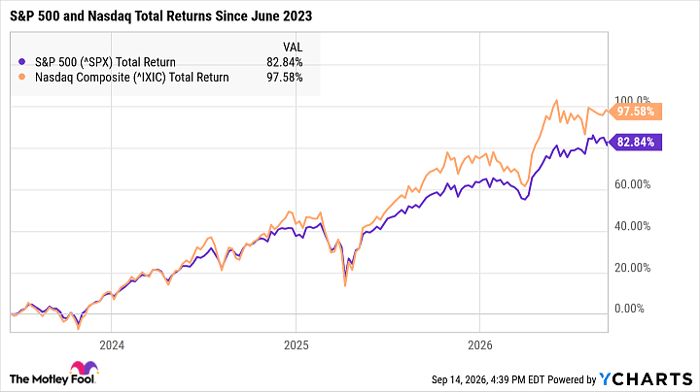
Since that report was published, however, the S&P 500 has surged by a staggering 82%. The Nasdaq has fared even better, up by nearly 100%. If you'd pulled your money out of the market in 2023 in fear of a recession, you'd have missed out on substantial gains.
To be clear, this doesn't mean that analysts warning about an AI bubble are necessarily wrong. It simply suggests that even if all the ingredients for a recession are in place, it's anyone's guess when the downturn will actually begin. The longer it takes to arrive, the more gains you miss by not investing.
The market's long-term future is incredibly promising
The single best move any investor can make right now is to simply stay invested for the long haul. A bear market is bound to hit at some point, and the following years may be rough. But history also proves that with enough time, quality stocks are all but unstoppable.
Since 1929, the S&P 500 has experienced 22 bear markets. On average, that's a decline of at least 20% every four years. Some of the most severe downturns in history have happened in the last two decades alone:
- 2000-2002 dot-com bubble: The S&P 500 and Nasdaq fell by 49% and 77%, respectively, during the longest bear market in history
- 2007-2009 Great Recession: The most severe economic downturn since the Great Depression, the S&P 500 lost around 57% of its value
- 2020 COVID-19 crash: The S&P 500 sank by nearly 34% in 22 trading days, marking the fastest market decline on record
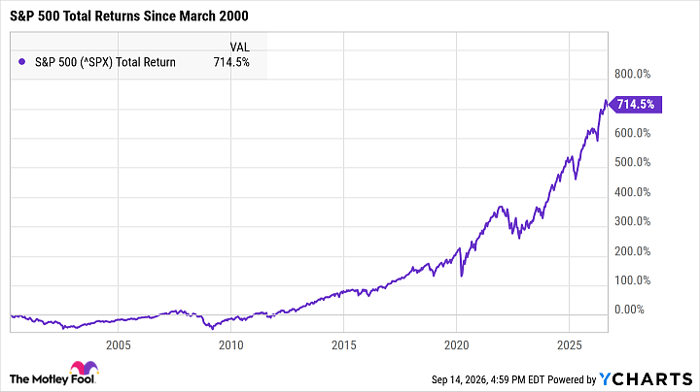
At the time, all of those bear markets were stomach-churning. Yet since March 2000 -- when the dot-com bubble officially popped -- the S&P 500 has earned total returns of more than 714%.
^SPX data by YCharts
For context, the average S&P 500 bear market has lasted 340 days with an average decline of around 37%, according to analysis from Yardeni Research. Even if we face yet another historic bear market, chances are the market's long-term gains will far outweigh the declines.
Nobody can say what the future holds for the market for the rest of 2026 or 2027. But if one thing is certain, it's that investors who buy quality stocks and hold them for decades will be the best positioned to build life-changing wealth.
Should you buy stock in S&P 500 Index right now?
Before you buy stock in S&P 500 Index, consider this:
The Motley Fool Stock Advisor analyst team just identified what they believe are the 10 best stocks for investors to buy now… and S&P 500 Index wasn’t one of them. The 10 stocks that made the cut could produce monster returns in the coming years.
Consider when Netflix made this list on December 17, 2004... if you invested $1,000 at the time of our recommendation, you’d have $433,160!* Or when Nvidia made this list on April 15, 2005... if you invested $1,000 at the time of our recommendation, you’d have $1,296,254!*
Now, it’s worth noting Stock Advisor’s total average return is 949% — a market-crushing outperformance compared to 212% for the S&P 500. Don't miss the latest top 10 list, available with Stock Advisor, and join an investing community built by individual investors for individual investors.
See the 10 stocks »
*Stock Advisor returns as of September 16, 2026.
Katie Brockman has no position in any of the stocks mentioned. The Motley Fool has no position in any of the stocks mentioned. The Motley Fool has a disclosure policy.
Recommended Articles


