


Top "Magnificent Seven" Picks for Patient Long-Term Investors
Key Points
Microsoft's cloud growth in its recent quarter was an encouraging sign that its high spending was paying off.
Amazon's business is becoming one of the most diversified in the tech world.
Microsoft and Amazon plan to spend $175 billion and $220 billion in their respective fiscal years.
- These 10 stocks could mint the next wave of millionaires ›
The "Magnificent Seven" stocks are Nvidia, Apple, Microsoft (NASDAQ: MSFT), Amazon (NASDAQ: AMZN), Alphabet, Meta Platforms, and Tesla. The group became known as the Magnificent Seven in 2023, when they drove much of the broader market's gains. Even today, they account for a third of the S&P 500, so their performance influences a lot.
Even though they're often discussed as a group, their performance over the past three years has varied widely. In that time, Microsoft and Amazon have been the second- and third-worst-performing Magnificent Seven stocks, up 48.6% and 73.8%, respectively (as of Sept. 14). Tesla has been the worst performer, up 31.9%, while the S&P 500 is up 70.4%.
Missed AI’s "Act 1"? Act 2 Could Be 15x Bigger. Most investors think they missed the AI boat because they didn't buy Nvidia in 2005. But according to our analysts, we’re only at the end of "Act 1"—the R&D phase. "Act 2" is the global rollout. Continue »
Despite the underwhelming performance over the past few years, Microsoft and Amazon are still great buys for patient long-term investors.
Image source: The Motley Fool.
Microsoft is putting key concerns to rest
Microsoft's stock has struggled this year, up only 3.5% as of this writing. Without the roughly 26% surge in the few days after its fourth-quarter fiscal 2026 earnings report, the stock would likely still be down in the double-digit percentage range.
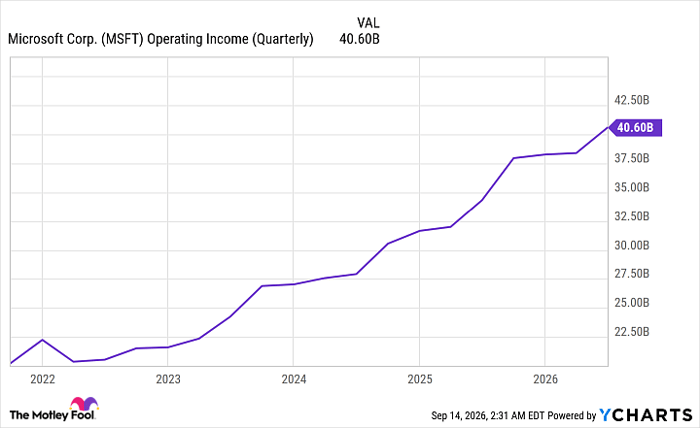
Much of Microsoft's early stock struggles this year stemmed from investors' reactions to its current and anticipated AI spending. But after an impressive quarter, many of those concerns were put to rest. It has always been a cash cow, but eyes were on its cloud business, Azure, because it's the most direct way to gauge the return on investment of its AI spending.
Azure's revenue increased 43% year over year (YoY). It had its first $100 billion fiscal year, and Microsoft's "Intelligent Cloud" segment accounted for over 39% of its operating income (profit from core operations). Whether that justifies the $175 billion Microsoft plans to spend in fiscal 2027 is still debated, but the results are tangible nonetheless.
MSFT Operating Income (Quarterly) data by YCharts.
AI aside, Microsoft is a great stock for long-term investors because it's as intertwined in the global corporate world as virtually any business. Across enterprise software, hardware, and cloud, Microsoft provides the infrastructure millions of businesses use daily. That alone doesn't automatically make the stock a buy, but it does give it a competitive moat conducive to longevity.
With Microsoft's stock, you're also getting an underrated dividend payer. With a yield of only around 0.7%, it isn't known as a dividend stock by any means. However, it has one of the most reliable dividends in the tech world. It has increased its annual dividend for 23 consecutive years, and I don't see that streak ending. With its growth potential, it can be a true two-for-one.
Amazon is still a fortress
Amazon has had a better year than Microsoft, but it's still underperforming the S&P 500. Still, the business is in as good a shape as we've seen recently.
Amazon currently generates more revenue than any other public company in the world. In the second quarter alone, it brought in $200.6 billion (up 20% YoY), with the bulk coming from its e-commerce business. AWS remains its profit driver, though. The cloud platform accounted for over 60% of Amazon's total operating income in Q2, but brought in only 21% of revenue.
AWS will remain Amazon's main growth driver for the foreseeable future. AWS's growth stalled for a while, but its impressive 36.7% jump in Q2 was the biggest in 18 quarters.
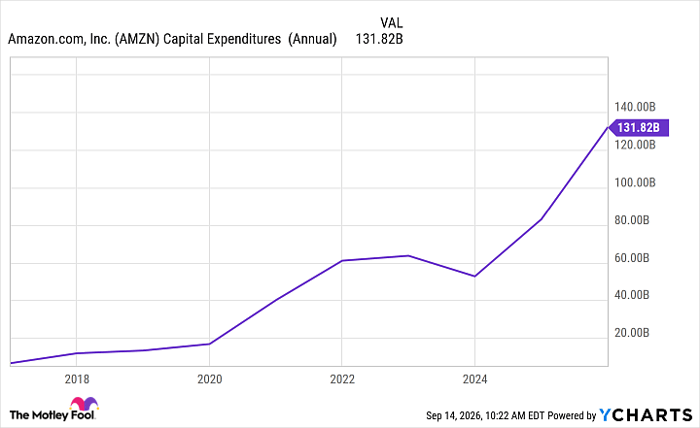
Like Microsoft and other AI hyperscalers (companies that operate large data centers), Amazon has been spending tons trying to build out its AI infrastructure. It has also faced the same spending criticism, with plans to spend $220 billion this year. That's expensive, to say the least, but AWS's reignited growth is a positive sign.
AMZN Capital Expenditures (Annual) data by YCharts.
When you invest in Amazon, you do so for its e-commerce business and AWS, no doubt, but its business is increasingly becoming more diversified. It has a fast-growing advertising business, a presence in the entertainment industry through Prime Video and Twitch, and an increasingly larger presence in the healthcare industry (such as with Amazon Pharmacy).
Amazon is currently trading at 20.1 times its earnings, the second-lowest among the Magnificent Seven stocks. For a company with its leadership position and growth potential, that's a good deal for long-term investors.
Don’t miss this second chance at a potentially lucrative opportunity
Ever feel like you missed the boat in buying the most successful stocks? Then you’ll want to hear this.
On rare occasions, our expert team of analysts issues a “Double Down” stock recommendation for companies that they think are about to pop. If you’re worried you’ve already missed your chance to invest, now is the best time to buy before it’s too late. And the numbers speak for themselves:
- Nvidia: if you invested $1,000 when we doubled down in 2009, you’d have $548,453!*
- Apple: if you invested $1,000 when we doubled down in 2008, you’d have $63,537!*
- Netflix: if you invested $1,000 when we doubled down in 2004, you’d have $433,160!*
Right now, we’re issuing “Double Down” alerts for three incredible companies, available when you join Stock Advisor, and there may not be another chance like this anytime soon.
See the 3 stocks »
*Stock Advisor returns as of September 16, 2026.
Stefon Walters has positions in Apple and Microsoft. The Motley Fool has positions in and recommends Alphabet, Amazon, Apple, Meta Platforms, Microsoft, Nvidia, and Tesla. The Motley Fool has a disclosure policy.
Recommended Articles


