


Palantir Trades at 74x Sales. History Says This Is What Happens to Software Stocks That Cross That Multiple After a Blowout Quarter.
Key Points
Demand for Palantir's artificial intelligence (AI) software is robust in both commercial and public sector markets.
Palantir's price-to-sales (P/S) ratio echoes what other high-profile SaaS names witnessed during the COVID-19-driven software boom.
History is crystal clear where software stocks trade after experiencing outsize momentum.
- 10 stocks we like better than Palantir Technologies ›
Palantir Technologies (NASDAQ: PLTR) has emerged as one of the biggest darlings of the artificial intelligence (AI) revolution. Demand for the company's Artificial Intelligence Platform (AIP), which features Palantir's Foundry, Gotham, and Apollo software suites, is off the charts from both the public sector and private commercial enterprises.
Currently, Palantir trades at a price-to-sales (P/S) ratio of 74. This valuation comes amid the company's rapid expansion, with recent quarterly revenue growth exceeding 90% year over year. The question smart investors are asking is what has happened in the past when software-as-a-service (SaaS) stocks reached comparable multiples, even while generating similarly aggressive growth.
Missed Nvidia in 2009? This Rare Signal Is Flashing Again. In 2009, a "Double Down" signal flashed for a little-known chipmaker called Nvidia. For the first time in years, that same "Total Conviction" signal is flashing for a company 1/100th the size of Nvidia. Continue »

Image source: Getty Images.
Analyzing high-valuation software stocks
Several high-profile SaaS companies have experienced trajectories similar to Palantir's. Between 2020 and 2021, shares of data warehousing specialist Snowflake surged to $401. This translated into a peak P/S multiple of roughly 221 during the stock's ascent. Cloudflare commanded a similar P/S multiple above 100 times during its late-2021 high. Meanwhile, Datadog exhibited a peak P/S near 70 during this same time frame.
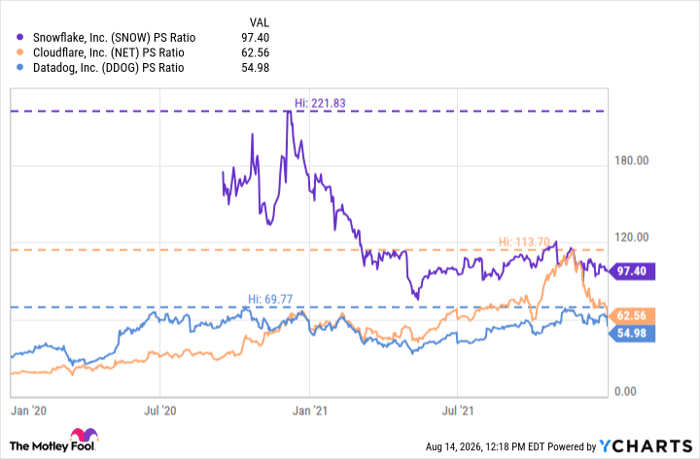
SNOW PS Ratio data by YCharts. PS Ratio = price-to-sales ratio.
While revenue continued to expand sharply for each of these SaaS leaders, their respective stock prices eventually normalized -- falling upwards of 70% from their peaks and remaining subdued for years. These outcomes demonstrate that extreme valuation expansion struggles to persist once growth expectations face friction or until a new catalyst emerges.
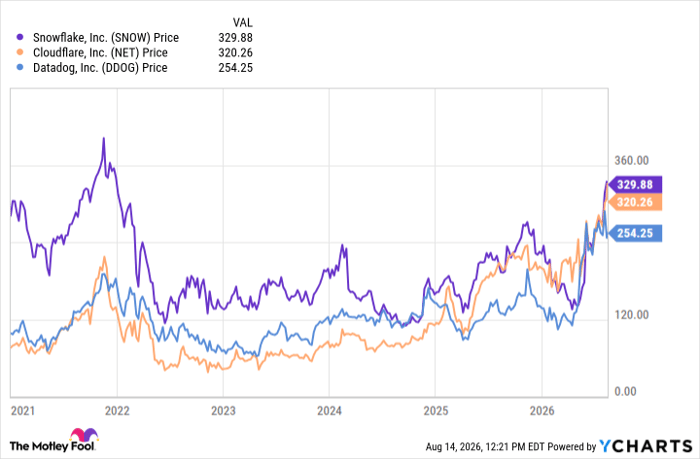
SNOW data by YCharts.
Why valuations tend to compress
It's important to acknowledge that the multiples witnessed throughout 2020 and 2021 stemmed directly from the pandemic. Remote-work environments fueled a surge in demand for collaboration software, cloud infrastructure, and digital productivity tools. These needs accelerated SaaS adoption beyond normal industry trends.
Yet even without these extraordinary tailwinds, each of the companies above continued to deliver impressive growth rates after peak pandemic-related concerns subsided. Nevertheless, none of these companies sustained their multiples. The mechanism is straightforward: An expanding P/S ratio assumes that revenue will compound at abnormally high rates for many years without interruption.
In reality, all businesses eventually encounter competition, saturating markets, or macroeconomic shifts. In turn, sales growth moderates toward more normalized levels. As a result, investors usually re-rate the stock downward.
The lesson here is to understand that growth rates do not immunize stock prices. Rather, they tend to delay the inevitable outcome until the market no longer prices in perfection. The examples above illustrate that once valuation multiples exceed comparable thresholds, subsequent returns often lag or turn negative, even while revenue and profits advance.
What does this mean for Palantir stock?
Palantir's current valuation profile mirrors the cases more closely than it diverges from them. Indeed, the company's commercial and government platforms are delivering exceptional growth, all while profit margins expand. Nevertheless, history suggests that Palantir's valuation assumes this trajectory will remain for an extended period. However, the precedents analyzed above prove that any deceleration, competitive response, or change in investor sentiment can swiftly trigger a rapid sell-off.
I think the actionable takeaway regarding an investment in Palantir can be found in the historical record above. At 74 times sales, Palantir may be positioned more for multiple compression than bulls realize. In turn, this could leave Palantir stock range-bound or even lower over the next couple of years, even if the company continues riding AI-driven tailwinds.
Investors with a concentrated position in Palantir may want to consider trimming exposure or reallocating to other software names with more moderate valuations. Meanwhile, long-term believers should prepare for a period of limited share price appreciation until sales catch up with the surging stock price.
Should you buy stock in Palantir Technologies right now?
Before you buy stock in Palantir Technologies, consider this:
The Motley Fool Stock Advisor analyst team just identified what they believe are the 10 best stocks for investors to buy now… and Palantir Technologies wasn’t one of them. The 10 stocks that made the cut could produce monster returns in the coming years.
Consider when Netflix made this list on December 17, 2004... if you invested $1,000 at the time of our recommendation, you’d have $421,511!* Or when Nvidia made this list on April 15, 2005... if you invested $1,000 at the time of our recommendation, you’d have $1,381,960!*
Now, it’s worth noting Stock Advisor’s total average return is 981% — a market-crushing outperformance compared to 216% for the S&P 500. Don't miss the latest top 10 list, available with Stock Advisor, and join an investing community built by individual investors for individual investors.
See the 10 stocks »
*Stock Advisor returns as of August 17, 2026.
Adam Spatacco has positions in Palantir Technologies. The Motley Fool has positions in and recommends Cloudflare, Datadog, Palantir Technologies, and Snowflake. The Motley Fool has a disclosure policy.
Recommended Articles


