


Veteran Tech Investor Dan Niles: Agentic AI Wave to Last at Least Another Year, Intel Is Top Chip Pick
TradingKey - Amid recent market volatility, Dan Niles, who lived through the dot-com bubble, remains bullish on the long-term prospects of AI infrastructure. Although factors such as high Treasury yields, rising oil prices, geopolitical conflicts, and election uncertainty may continue to disturb the market,
As co-founder of Investment Management and manager of the Satori Fund, Niles has deep experience in technology investing. Far from being buried solely in trading, he frequently appears on financial shows such as CNBC to clearly convey complex tech investment logic to the public, wielding influence across both industry and media.
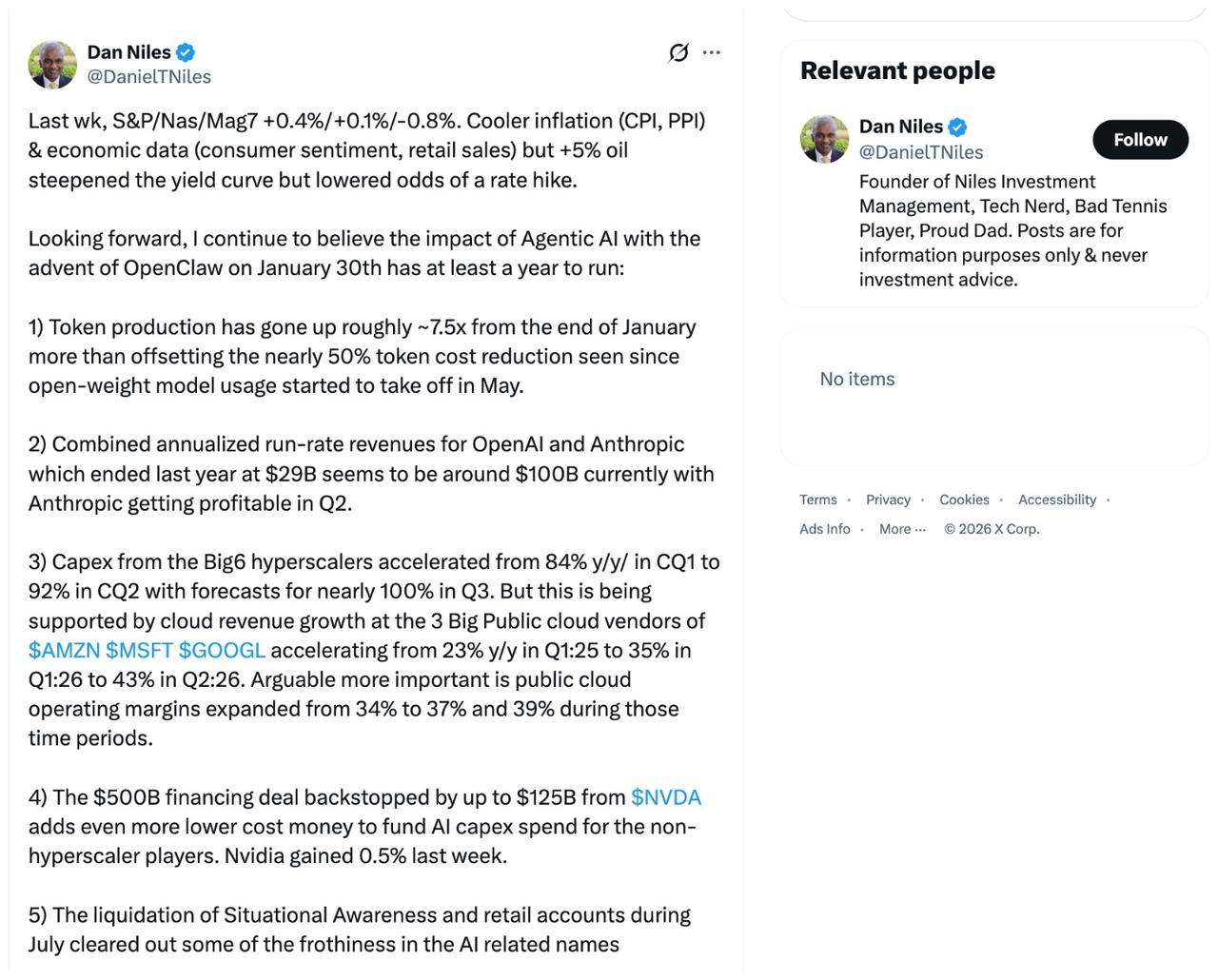
On August 16, Eastern Time, Niles posted that the fundamentals supporting the long-term investment logic for AI remain solid, and with the launch of the open-source AI agent project OpenClaw, the impact of AI agents will persist for at least another year.
After OpenClaw was released in late January, the developer community responded enthusiastically, driving a roughly 7.5-fold increase in AI agent-related token generation, which has fully offset the headwind of a nearly 50% cost reduction brought by open-source models since May.
He estimates that the combined annualized revenue of OpenAI and Anthropic has climbed from approximately $29 billion at the end of last year to around $100 billion, with Anthropic turning profitable in the second quarter.
[Source: X]
Niles pointed out that public cloud service providers and core semiconductor suppliers are currently at the center of AI investment. Benefiting from surging demand, capital expenditures by the top five hyperscalers grew by 92% year-over-year in the second quarter. This unprecedented scale of investment is gradually translating into earnings resilience for cloud businesses through economies of scale and resource reuse.
Despite facing uncertainties such as geopolitics, Amazon (AMZN), Microsoft (MSFT), and Google (GOOGL)'s cloud revenues and operating margins are both accelerating their expansion against headwinds, demonstrating robust profitability. Meanwhile, Nvidia (NVDA) provided capital support to non-hyperscale data centers through structured financing tools.
In addition, Niles listed Intel (INTC) as one of his top semiconductor stock picks. Although its $20 billion equity financing resulted in roughly 5% dilution, it completely eliminated market concerns regarding funding for its advanced capacity expansion, driving the stock up 0.8% against the market.
Niles also warned that the 30-year U.S. Treasury yield remains at a long-term high of 5.3%, and geopolitical disruptions from Iran regarding the Strait of Hormuz will persist past the election, meaning investors should still employ partial hedging strategies and be more prudent in selecting individual stocks.
Recommended Articles


