


SpaceX vs. MP Materials: 2 Very Different Ways to Bet on the Next Decade of Tech
Key Points
SpaceX's Starlink and Starship could dramatically expand global connectivity and reduce the cost of accessing space.
MP Materials is a U.S.-based rare-earth mining, processing, and magnet manufacturing company. It as a key supplier for EVs, motors, and other advanced technologies.
SpaceX represents orbital infrastructure and connectivity, while MP Materials represents the physical supply chain behind electrification and high-tech manufacturing.
- 10 stocks we like better than Space Exploration Technologies ›
Space Exploration Technologies Corp (NASDAQ: SPCX) and MP Materials (NYSE: MP) are wildly different companies, but they are both building core infrastructure for the next decade of technology: one in the sky, the other deep in the supply chain.
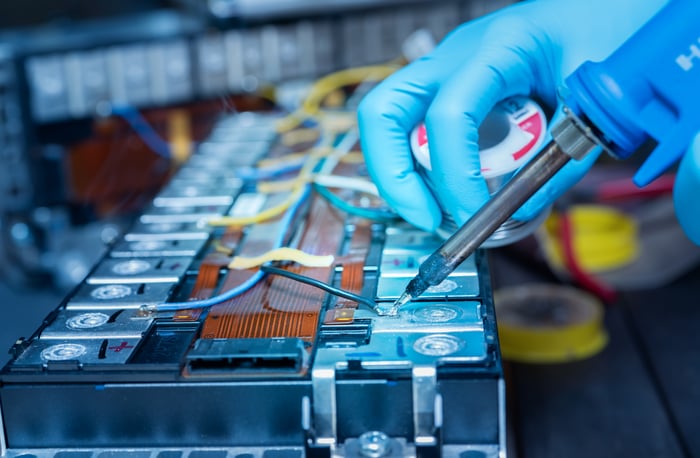
Image source: Getty Images.
Missed Nvidia in 2009? This Rare Signal Is Flashing Again. In 2009, a "Double Down" signal flashed for a little-known chipmaker called Nvidia. For the first time in years, that same "Total Conviction" signal is flashing for a company 1/100th the size of Nvidia. Continue »
SpaceX is the new attractive tech investment
On the SpaceX side, you are really betting on two intertwined technologies, Starlink and Starship. Starlink is already a mega‑constellation of more than ten thousand low Earth orbit satellites that use phased-array antennas and optical-fiber links to move data around the planet with much lower latency than traditional satellite internet. Each satellite carries multiple space lasers capable of up to 200 gigabits per second in aggregate, and newer mini lasers deliver 25 gigabits per second at distances up to 4,000 kilometers, creating a mesh in space that routes traffic without relying on a dense network of ground stations. The coming Starlink V3 hardware pushes that further, with each satellite designed for roughly 1 terabit per second of downlink capacity and 160 gigabits per second of uplink, optimized to ride on the heavy-lift Starship rocket and to support direct‑to‑device cellular service.
Starship itself is another big part of the tech thesis. It is a two-stage, fully reusable methane‑fueled launch system built from stainless steel, powered by Raptor engines that use a full‑flow staged combustion cycle, one of the most demanding designs in rocketry. The latest Raptor 3 engines target up to 300 tons of thrust each, use proprietary superalloys and 3D-printed cooling channels to withstand extreme pressures and temperatures, and are designed for rapid reuse without heavy engine heat shields. If SpaceX makes this system truly reliable, it could lower the cost of putting mass and bandwidth into orbit by an order of magnitude.
MP Materials is an EV and motor play
MP Materials offers a completely different angle. Instead of satellites and rockets, it produces the rare-earth materials and magnets that sit inside EV motors, wind turbines, data center equipment, and countless other devices. Its Mountain Pass site in California is currently the only commercial-scale rare earth mine and processing facility in the United States, producing high-purity neodymium and praseodymium that feed downstream manufacturing. In Texas, MP is building a 1.25 billion dollar magnet manufacturing campus called 10X that will eventually bring its total magnet output to around 10,000 metric tons per year, on top of an existing Fort Worth plant that can produce about 3,000 tons annually for customers like General Motors and Apple. The company also has a long-term agreement to supply U.S.-sourced rare earth materials, alloy, and finished magnets for GM's Ultium EV platform, making it a critical link in the domestic EV supply chain.
So SpaceX is a bet on orbital bandwidth and reusable launch hardware that could redefine connectivity and access to space, while MP Materials is a bet on the "picks and shovels" of electrification and high-performance motors. One is mostly about software‑defined networks riding on cutting-edge rockets, the other about physical materials and magnets that every advanced technology stack quietly depends on. If you want exposure to the next decade of tech, think about both of these companies.
Should you buy stock in Space Exploration Technologies right now?
Before you buy stock in Space Exploration Technologies, consider this:
The Motley Fool Stock Advisor analyst team just identified what they believe are the 10 best stocks for investors to buy now… and Space Exploration Technologies wasn’t one of them. The 10 stocks that made the cut could produce monster returns in the coming years.
Consider when Netflix made this list on December 17, 2004... if you invested $1,000 at the time of our recommendation, you’d have $400,209!* Or when Nvidia made this list on April 15, 2005... if you invested $1,000 at the time of our recommendation, you’d have $1,375,393!*
Now, it’s worth noting Stock Advisor’s total average return is 964% — a market-crushing outperformance compared to 215% for the S&P 500. Don't miss the latest top 10 list, available with Stock Advisor, and join an investing community built by individual investors for individual investors.
See the 10 stocks »
*Stock Advisor returns as of August 13, 2026.
Micah Zimmerman has no position in any of the stocks mentioned. The Motley Fool has positions in and recommends Apple and MP Materials. The Motley Fool recommends General Motors. The Motley Fool has a disclosure policy.
Recommended Articles


