


SpaceX Stock Just Closed Above Its IPO Price. Here's What History Says Happens Next.
Key Points
SpaceX stock popped on its debut, but sank more than 50% at its recent low.
SpaceX's stock performance is not atypical for IPOs.
Here's what history says investors can expect from the stock over the long run.
- 10 stocks we like better than Space Exploration Technologies ›
Shares of Space Exploration Technologies (NASDAQ: SPCX), better known as SpaceX, have been on a wild ride during their first two months since the stock's initial public offering (IPO). The company saw its value touch $3 trillion at its peak just a few days after its market debut, but the market cut that price by more than half at one point, sending the stock price below its IPO price last month.
After its second-quarter earnings report and the first of several lockup expirations, letting early SpaceX investors and employees sell their shares, the stock climbed back above its IPO price. Some investors may see that strong performance in the face of potential selling pressure as a sign that the stock can keep climbing. Here's what history has to say.
Missed Nvidia in 2009? This Rare Signal Is Flashing Again. In 2009, a "Double Down" signal flashed for a little-known chipmaker called Nvidia. For the first time in years, that same "Total Conviction" signal is flashing for a company 1/100th the size of Nvidia. Continue »
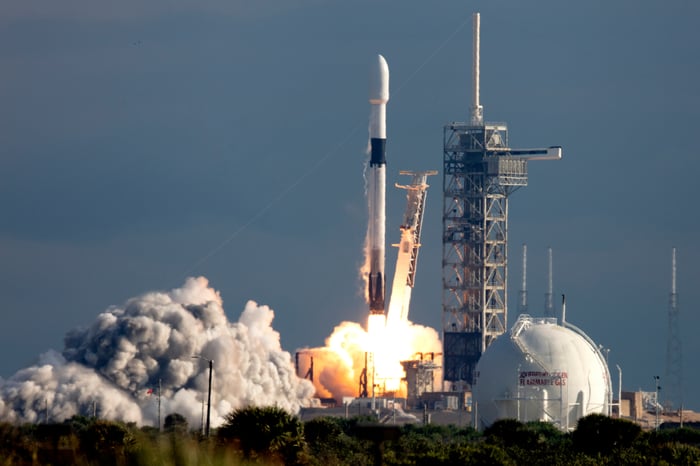
Image source: Getty Images.
Can SpaceX rocket higher?
It's important to note that SpaceX's trajectory since its IPO isn't uncommon.
Most stocks experience a pop on their first day of trading, just as SpaceX did. SpaceX saw its shares close 19% above its IPO price of $135 per share on its first day of trading.
Most stocks hit a relative high in their first few days of trading before moving lower. SpaceX peaked at about $225 per share on its third day of trading.
Most stocks also eventually trade below their IPO price. SpaceX breached its $135 IPO price on July 15, about a month after its debut.
In fact, 90% of IPOs eventually trade for less than their offer price, with the median stock taking about six weeks to do so, according to an analysis from Banyan Lane Research. Most stocks quickly recover to their IPO price. It took SpaceX 18 trading days to do so. Only 15% of IPOs remain below their offer price one year after breaching it.
Investors expecting a rapid recovery in the stock price and a push toward SpaceX's all-time high may be over-optimistic. Only 60% of IPOs ever get back to the early peak they reached after their debut, and those that do take nearly a year to get there.
How do typical IPO stocks perform?
Since SpaceX stock is mostly behaving as expected for an IPO stock, it's worth remembering that the track record for IPOs, in general, isn't spectacular.
The average IPO since 1980 (excluding the dot-com bubble) produces a total return of 44.2% in its first three years as a publicly traded company. That might sound like an excellent result, with an average compound return of about 13%, but it actually trails the overall market return by 1.6%, according to data compiled by Jay Ritter, a finance professor at the University of Florida. Remember, companies typically go public when stock prices are rising.
The outlook is significantly better for large tech companies. Tech stocks with more than $100 million in annual sales before their IPOs produced average returns that outperformed the market average by 43.1% during their first three years of trading. But averages can mask the fact that 45% of IPOs with more than $100 million in sales still traded below their IPO price after three years.
One last thing to consider is how IPOs with very high expectations perform. We can use price-to-sales as a proxy for expectations. A company with a high price-to-sales ratio is expected to have rapid revenue growth. SpaceX's price-to-sales ratio of 88 is extremely high. IPOs for companies with more than $100 million in revenue with a price-to-sales ratio above 40 produce average three-year returns that trail the market by 15.4%.
SpaceX could defy the odds and perform better than the average IPO. But with expectations already high for the company and continued share lockup expirations weighing on the stock price for at least another year, it will be hard for the stock to keep climbing back toward its all-time high of around $225. In fact, it might struggle to keep pace with the overall market average.
Should you buy stock in Space Exploration Technologies right now?
Before you buy stock in Space Exploration Technologies, consider this:
The Motley Fool Stock Advisor analyst team just identified what they believe are the 10 best stocks for investors to buy now… and Space Exploration Technologies wasn’t one of them. The 10 stocks that made the cut could produce monster returns in the coming years.
Consider when Netflix made this list on December 17, 2004... if you invested $1,000 at the time of our recommendation, you’d have $403,337!* Or when Nvidia made this list on April 15, 2005... if you invested $1,000 at the time of our recommendation, you’d have $1,334,946!*
Now, it’s worth noting Stock Advisor’s total average return is 958% — a market-crushing outperformance compared to 214% for the S&P 500. Don't miss the latest top 10 list, available with Stock Advisor, and join an investing community built by individual investors for individual investors.
See the 10 stocks »
*Stock Advisor returns as of August 13, 2026.
Adam Levy has no position in any of the stocks mentioned. The Motley Fool has no position in any of the stocks mentioned. The Motley Fool has a disclosure policy.
Recommended Articles


