


Jensen Huang Just Signed 7 Japanese Industrial Giants Into Nvidia's Physical AI Coalition. Here's Why $1 Trillion in Confirmed Demand Should Matter to Investors.
Key Points
Japan’s biggest industrial companies are building their AI and robotics future around Nvidia, which could create a steady stream of demand for years.
Nvidia isn’t just selling GPUs; it’s becoming part of the infrastructure behind Japan’s next generation of factories and robots.
- 10 stocks we like better than Nvidia ›
When Jensen Huang flew to Tokyo last month and signed seven Japanese industrial giants into Nvidia's (NASDAQ: NVDA) new physical AI coalition, he was locking in a massive, long-lived stream of demand for Nvidia's chips and software, and that is something I think investors should really pay attention to.
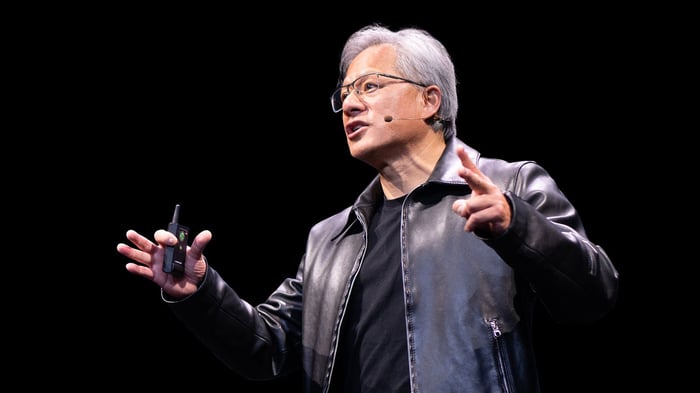
Nvidia CEO Jensen Huang. Image source: Nvidia.
Missed Nvidia in 2009? This Rare Signal Is Flashing Again. In 2009, a "Double Down" signal flashed for a little-known chipmaker called Nvidia. For the first time in years, that same "Total Conviction" signal is flashing for a company 1/100th the size of Nvidia. Continue »
"Physical AI" refers to AI that controls robots, factory lines, and machines in the real world instead of just chatbots on a screen. In mid-July, Nvidia announced that companies like Fujitsu, FANUC, Yaskawa Electric, and Kawasaki Heavy Industries, along with Hitachi, NEC, SoftBank, Sony, and Kubota, intend to build on its Cosmos, Isaac, Metropolis, and Jetson platforms as part of a "Cosmos Coalition" focused on physical AI. Put simply, these are some of Japan's biggest names in robotics, manufacturing, and communications agreeing to standardize on Nvidia's stack as they build the brains for next-generation industrial automation.
Behind the coalition sits an even larger national project. Nvidia is partnering with Noetra, a Japanese AI consortium backed by Sony, SoftBank, Honda, and dozens of other firms, to build what it calls the world's first national infrastructure for physical AI. The centerpiece of that effort will be a Vera Rubin AI factory that will feature 13,750 Vera CPUs and 27,500 Rubin GPUs, delivering about 140 megawatts of compute capacity to train and deploy physical AI models. Japan's industry ministry has framed this as the computing backbone for its FRONTia program, and expects that it will help the country hit its goal of capturing 30% of the global AI robotics market by 2040.
What about Nvidia shareholders?
On top of that, Prime Minister Sanae Takaichi's government has laid out a plan to mobilize more than 370 trillion yen ($2.3 trillion) in combined public and private investment by 2040 across physical AI, semiconductors, and data centers. Noetra's own roadmap calls for roughly 1 trillion yen ($6.3 billion) of sovereign AI spending over five years to develop domestic foundation models for robots and industrial AI. When you add up the national AI factory, the robot makers building on Cosmos, and Japan's broader tech investment targets, you are talking about demand that lives comfortably in the trillion-dollar range over the coming decades.
For Nvidia shareholders, the important part is not just that these orders exist. It is that they represent multiyear infrastructure-level commitments that are hard to unwind. FANUC and Yaskawa are not going to rip out their control platforms every cycle. A sovereign AI factory is not built for a single experiment. By turning physical AI into a coalition and tying it to Japan's long-term industrial strategy, Huang is trying to make Nvidia's chips and tools the default choice for robots and factories in one of the world's most advanced manufacturing economies.
That is what confirmed demand really means here. It is not a one-off spike in GPU sales. It is governments and industrial giants literally planning their futures around Nvidia's hardware and software, which gives its shareholders much more visibility into where revenue and profit margins might come from years down the line.
Should you buy stock in Nvidia right now?
Before you buy stock in Nvidia, consider this:
The Motley Fool Stock Advisor analyst team just identified what they believe are the 10 best stocks for investors to buy now… and Nvidia wasn’t one of them. The 10 stocks that made the cut could produce monster returns in the coming years.
Consider when Netflix made this list on December 17, 2004... if you invested $1,000 at the time of our recommendation, you’d have $403,337!* Or when Nvidia made this list on April 15, 2005... if you invested $1,000 at the time of our recommendation, you’d have $1,334,946!*
Now, it’s worth noting Stock Advisor’s total average return is 958% — a market-crushing outperformance compared to 214% for the S&P 500. Don't miss the latest top 10 list, available with Stock Advisor, and join an investing community built by individual investors for individual investors.
See the 10 stocks »
*Stock Advisor returns as of August 13, 2026.
Micah Zimmerman has no position in any of the stocks mentioned. The Motley Fool has positions in and recommends Nvidia. The Motley Fool recommends Fanuc and Hitachi. The Motley Fool has a disclosure policy.
Recommended Articles


