


Should You Buy SoundHound AI Stock After Its 67% Plunge? The Answer Might Surprise You.
Key Points
SoundHound AI just launched a new platform called OASYS, which allows businesses to build voice-activated artificial intelligence (AI) agents.
The company just raised its full-year revenue forecast for 2026, and 2027 is shaping up to be even bigger.
SoundHound stock isn't cheap despite its recent decline, so it's a tricky investment right now.
- 10 stocks we like better than SoundHound AI ›
The artificial intelligence (AI) boom has created a tremendous amount of value for investors over the last few years, but not every stock in this space has been a winner. SoundHound AI (NASDAQ: SOUN) stock, for example, soared to an all-time closing high of $24.23 in late 2024 but has since plummeted 67% to close at just $8 last Friday, Aug. 7.
The company is a leading developer of conversational AI software, with a growing list of customers that includes some of the biggest names in hospitality, automotive manufacturing, financial services, and more. SoundHound stock is still trading at an elevated valuation despite its sharp decline, but that could change after the company completes a major strategic acquisition later this year, which will provide a substantial boost to its revenue.
Missed Nvidia in 2009? This Rare Signal Is Flashing Again. In 2009, a "Double Down" signal flashed for a little-known chipmaker called Nvidia. For the first time in years, that same "Total Conviction" signal is flashing for a company 1/100th the size of Nvidia. Continue »
Should investors buy the stock today, or is there more downside ahead?

Image source: The Motley Fool.
Conversational AI is transformative for businesses
Over the last few years, SoundHound's out-of-the-box products have helped businesses deploy voice-activated AI systems into their daily operations. Restaurant chains like White Castle and Panda Express use them to accept orders autonomously in-store, over the phone, and at the drive-thru, while car companies like Hyundai and Stellantis use them to power intuitive voice assistants in their latest vehicles.
But in May, SoundHound launched an entirely new platform called the Orchestrated Agent System (OASYS), which enables its customers to build custom AI voice agents to handle customer inquiries, process transactions, and assist human employees in solving complex problems.
OASYS is built on SoundHound's proprietary foundational speech recognition model, unlike many other AI software products that simply use models from third parties such as OpenAI and Anthropic. Agents built on OASYS also continually learn and improve as they become more familiar with a particular enterprise. These features are appealing to businesses seeking to differentiate their AI products from those of competitors.
SoundHound just increased its 2026 revenue forecast
SoundHound generated $61.9 million in revenue during the second quarter of 2026 (ended June 30), a 45% increase from the year-ago period. It was also 10 times the revenue the company generated in the same quarter four years ago, which was its first quarter as a public company. Simply put, it has come a long way.
The second-quarter result was so strong that SoundHound increased its full-year revenue guidance for 2026 to $245 million, up from $242.5 million in its previous forecast (at the midpoint of the respective ranges).
But SoundHound's revenue could receive a significant boost once it completes its acquisition of another AI enterprise, LivePerson, which is expected to close before the end of this year. Management is targeting revenue of $350 million to $400 million in 2027 due to the deal, representing a 53% increase (at the midpoint) from the company's projected 2026 result.
SoundHound's main challenge is balancing growth and profitability, because scaling an AI software business isn't cheap. The company suffered a generally accepted accounting principles (GAAP) net loss of $42.8 million during the second quarter. While that was a strong improvement from its year-ago loss of $74.7 million, there is still a lot of work to do before the business trades in the black.
SoundHound even lost $9.6 million by its preferred measure of profitability, adjusted (non-GAAP) earnings before interest, tax, depreciation, and amortization (EBITDA), which excludes one-off and noncash expenses such as stock-based compensation. Fortunately, the company had $203 million in cash on hand and no debt at the end of the second quarter, allowing it to sustain these losses for the foreseeable future. But it will have to reach profitability in the next few years if it wants to avoid asking investors for more money.
SoundHound's stock is pricey, despite its decline
SoundHound stock currently trades at a price-to-sales (P/S) ratio of 16.7, so despite its 67% decline, it's still notably more expensive than many other AI software stocks. Moreover, the Nasdaq-100 has a P/S ratio of just 6.3, so SoundHound is more than twice as expensive as a basket of America's top technology stocks.
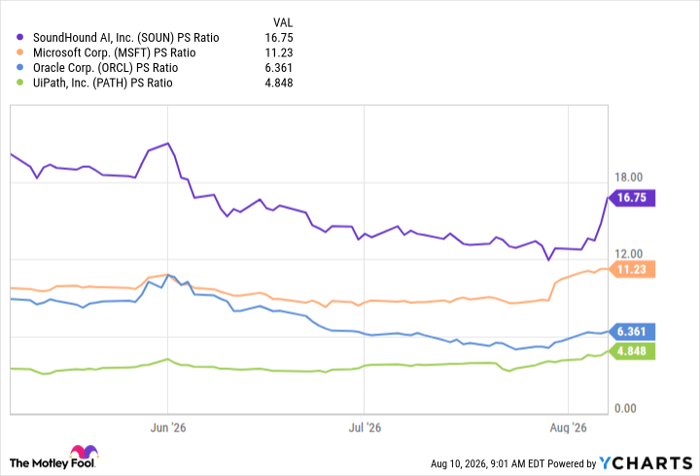
SOUN PS Ratio data by YCharts
Even if we assume SoundHound will generate $400 million in revenue during 2027, its forward P/S ratio would still be 8.7. That makes it a tough investment right now, given the small risk that the LivePerson deal won't officially close due to regulatory issues. There is also execution risk, meaning we don't know if LivePerson's business will be as synergistic with SoundHound's existing operations as expected.
For those reasons, I think investors might be better off waiting on the sidelines for a better opportunity. If there is a correction in the broader market, SoundHound stock could decline even further, which might be a good opportunity to pounce.
Should you buy stock in SoundHound AI right now?
Before you buy stock in SoundHound AI, consider this:
The Motley Fool Stock Advisor analyst team just identified what they believe are the 10 best stocks for investors to buy now… and SoundHound AI wasn’t one of them. The 10 stocks that made the cut could produce monster returns in the coming years.
Consider when Netflix made this list on December 17, 2004... if you invested $1,000 at the time of our recommendation, you’d have $411,427!* Or when Nvidia made this list on April 15, 2005... if you invested $1,000 at the time of our recommendation, you’d have $1,335,252!*
Now, it’s worth noting Stock Advisor’s total average return is 965% — a market-crushing outperformance compared to 215% for the S&P 500. Don't miss the latest top 10 list, available with Stock Advisor, and join an investing community built by individual investors for individual investors.
See the 10 stocks »
*Stock Advisor returns as of August 12, 2026.
Anthony Di Pizio has no position in any of the stocks mentioned. The Motley Fool has positions in and recommends Microsoft, Oracle, SoundHound AI, and UiPath. The Motley Fool recommends Stellantis. The Motley Fool has a disclosure policy.
Recommended Articles


