


The Odds of a September Rate Hike Have Plunged, but the Federal Reserve's Job Just Became Infinitely More Challenging
Key Points
As of the end of July, there was a strong probability that the Federal Reserve would raise interest rates in September.
However, one of the weakest jobs reports of the decade has shifted the narrative.
With Trumpflation broadening and inflation well above the FOMC's comfort level, the Fed may be left with a difficult decision on interest rates in five weeks.
- 10 stocks we like better than S&P 500 Index ›
Despite the Dow Jones Industrial Average (DJINDICES: ^DJI), S&P 500 (SNPINDEX: ^GSPC), and Nasdaq Composite (NASDAQINDEX: ^IXIC) rallying to several all-time highs in 2026, the fate of the U.S. economy and stock market is far from certain.
Trumpflation (i.e., inflation driven by President Donald Trump's policies) has lifted inflation to multiyear highs and led to a historically divided Federal Reserve. The July Federal Open Market Committee (FOMC) meeting featured three dissents in favor of a quarter-point rate hike -- the first time we've witnessed three dissents in the same policy direction in a decade.
Missed Nvidia in 2009? This Rare Signal Is Flashing Again. In 2009, a "Double Down" signal flashed for a little-known chipmaker called Nvidia. For the first time in years, that same "Total Conviction" signal is flashing for a company 1/100th the size of Nvidia. Continue »
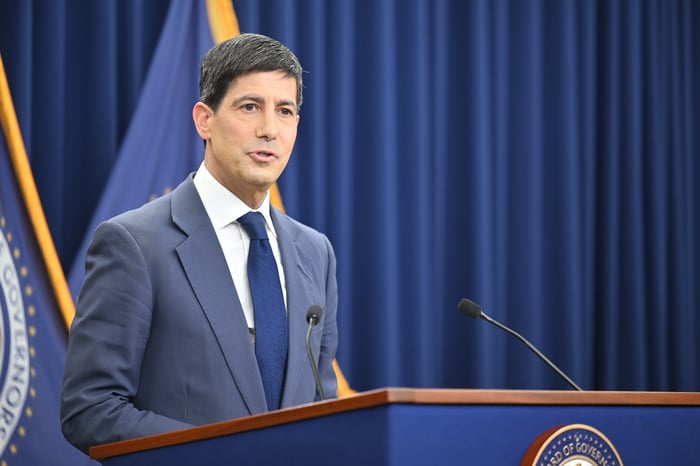
Fed Chair Kevin Warsh and the FOMC are at a precarious crossroads with interest rates. Image source: Official Federal Reserve Photo.
While the odds of a September rate hike seemed likely as recently as the end of July, economic data has a way of moving markets at the drop of a dime.
The likelihood of a September interest rate hike has plummeted
According to the CME Group's FedWatch Tool, which relies on 30-day Fed funds futures prices to project the likelihood of rate hikes/cuts at upcoming FOMC meetings, there was a 67% chance of a 25-basis-point rate hike in September, as of July 31. By Aug. 7, this probability had dipped to 44.4%.
It's a similar story on prediction market platform, Polymarket. Over the same timeline, the odds of a rate hike in September fell from roughly 60% to 40%.
BREAKING: The odds of a September rate hike fall to 40% after the US economy unexpectedly posts its 3rd biggest monthly job loss since the pandemic in 2020.
-- The Kobeissi Letter (@KobeissiLetter) August 7, 2026
Just days ago, markets saw at 70%+ chance of a September rate hike.
Gold prices are surging above $4,400/oz on the news. https://t.co/4zGaqMwgU8 pic.twitter.com/6YWWqmmEJV
The catalyst for this shift is the July jobs report. Whereas estimates called for the creation of 85,000 jobs, nonfarm payroll employment fell by 23,000 jobs. This marked the third-largest monthly decline in jobs since the COVID-19 pandemic.
Arguably, even more frightening than the unexpected job losses was the reported trailing 12-month (TTM) wage growth of 3.2%. With June's TTM inflation clocking in at 3.5%, wage growth isn't even sufficient to keep pace with rising prices.
If the FOMC were to hike rates, it would be akin to pressing the brakes on a subpar jobs market with disappointing wage growth.

Image source: Getty Images.
A dud of a jobs report just made the Fed's task more difficult
While one of the worst jobs reports of the decade has lit a fire under the Dow, S&P 500, and Nasdaq Composite, it's also made the September FOMC decision on interest rates far more challenging for Fed Chair Kevin Warsh and his colleagues.
Although maximum employment is one-half of the dual mandate, price stability appears to be the far more pressing issue for policymakers. The price stickiness of Core Personal Consumption Expenditures (PCE) forecasts, which exclude volatile food and energy costs, points to Trumpflation expanding well beyond the energy sector.
64.
-- Charlie Bilello (@charliebilello) July 30, 2026
As in 64 consecutive months with US core inflation above the Fed's 2% target.
The Fed has lost all credibility when it comes to fighting inflation.
Kevin Warsh talks a big game, but talk is cheap. The Fed should have hiked rates yesterday and ended QE. pic.twitter.com/HvimqfW6WW
If the inflationary effects of the Iran war become entrenched in the broader economy, it'll be more difficult for Warsh and his peers to deliver price stability.
This leaves the Federal Reserve at a crossroads. If it stands pat on interest rates, it'll be subtly promoting job growth and hoping that Trump-driven inflation doesn't worsen. But if the FOMC does raise rates in September in an effort to suppress inflation, it'll run the risk of worsening a somewhat fragile job market.
The decision that Warsh and his colleagues make in five weeks could send the stock market to new heights or knock it completely off its pedestal.
Should you buy stock in S&P 500 Index right now?
Before you buy stock in S&P 500 Index, consider this:
The Motley Fool Stock Advisor analyst team just identified what they believe are the 10 best stocks for investors to buy now… and S&P 500 Index wasn’t one of them. The 10 stocks that made the cut could produce monster returns in the coming years.
Consider when Netflix made this list on December 17, 2004... if you invested $1,000 at the time of our recommendation, you’d have $411,427!* Or when Nvidia made this list on April 15, 2005... if you invested $1,000 at the time of our recommendation, you’d have $1,335,252!*
Now, it’s worth noting Stock Advisor’s total average return is 965% — a market-crushing outperformance compared to 215% for the S&P 500. Don't miss the latest top 10 list, available with Stock Advisor, and join an investing community built by individual investors for individual investors.
See the 10 stocks »
*Stock Advisor returns as of August 12, 2026.
Sean Williams has no position in any of the stocks mentioned. The Motley Fool has positions in and recommends CME Group. The Motley Fool has a disclosure policy.
Recommended Articles


