


The S&P 500 Is at Record Highs and Hasn't Been This Expensive in Decades. History Says This Could Happen Next
Key Points
The S&P 500 is at a Shiller PE ratio of 42 -- the highest it's been since the dotcom crash.
Many top stocks crashed the last time the market was this overpriced.
Now may be a crucial time for investors to be a bit more fearful than greedy.
- 10 stocks we like better than S&P 500 Index ›
At one point this year, the S&P 500 (SNPINDEX: ^GSPC) looked like it was in trouble, falling below 6,400. The war in Iran spooked investors, in what at the time appeared to be the catalyst that could bring the broad index back down to more reasonable levels, after three straight years of impressive gains.
Instead, the index has not only made up for those early declines but also soared to new heights. Currently, it's around 7,800. There's just no denying that the index is expensive these days. It hasn't been this pricey in decades -- and that may not be what investors want to hear.
Missed Nvidia in 2009? This Rare Signal Is Flashing Again. In 2009, a "Double Down" signal flashed for a little-known chipmaker called Nvidia. For the first time in years, that same "Total Conviction" signal is flashing for a company 1/100th the size of Nvidia. Continue »

Image source: Getty Images.
History suggests a crash may be inevitable
The Shiller price-to-earnings ratio is based on inflation-adjusted earnings over the past decade and suggests that the S&P 500 is incredibly expensive right now, trading at a multiple of more than 42. That's the highest it's been since the dotcom crash of the early 2000s. Back in 2021, before the crash that took place the following year, it reached a multiple of around 39.
It's a concerning sign that stocks are overpriced. And not unlike the dotcom bubble, tech is a driving force. Back then, it was internet stocks surging to obscene valuations. Today, it's stocks involved with artificial intelligence (AI).
What the optimists will say is that, unlike internet stocks that made no profits, AI companies are generating significant growth. However, many top tech companies are buying and selling among themselves, and the rest of the market isn't doing nearly as well. Plus, it wasn't just risky internet stocks that crashed during the dotcom bubble. Between 2000 and 2002, Microsoft, Apple, and Cisco all crashed by more than 50%. It's a myth that only risky, unprofitable tech companies nosedived. Heightened valuations and expectations can cripple any stock.
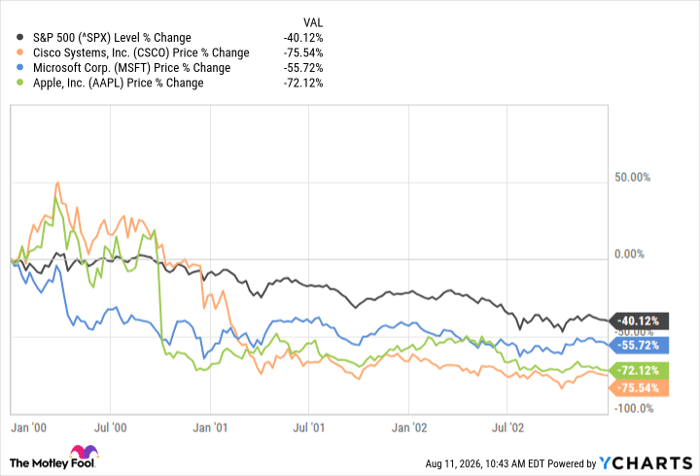
^SPX data by YCharts
Investors don't need to get out of the market, but it may be worth thinking twice about high-priced stocks
The tech sector is ripe with expensive stocks that could be due for significant sell-offs if the market crashes, whether it's this year or later in the future. But rather than trying to time the market, which is difficult and risky, a more effective option for investors may be to simply get out of expensive stocks that are trading at high valuations and into more reasonably priced investments and perhaps dividend stocks, whose payouts can help boost returns and be highly valuable amid market turmoil.
As Warren Buffett's famous saying goes, investors should "be fearful when others are greedy."
Should you buy stock in S&P 500 Index right now?
Before you buy stock in S&P 500 Index, consider this:
The Motley Fool Stock Advisor analyst team just identified what they believe are the 10 best stocks for investors to buy now… and S&P 500 Index wasn’t one of them. The 10 stocks that made the cut could produce monster returns in the coming years.
Consider when Netflix made this list on December 17, 2004... if you invested $1,000 at the time of our recommendation, you’d have $411,427!* Or when Nvidia made this list on April 15, 2005... if you invested $1,000 at the time of our recommendation, you’d have $1,335,252!*
Now, it’s worth noting Stock Advisor’s total average return is 965% — a market-crushing outperformance compared to 215% for the S&P 500. Don't miss the latest top 10 list, available with Stock Advisor, and join an investing community built by individual investors for individual investors.
See the 10 stocks »
*Stock Advisor returns as of August 11, 2026.
David Jagielski, CPA has no position in any of the stocks mentioned. The Motley Fool has positions in and recommends Apple, Cisco Systems, and Microsoft. The Motley Fool has a disclosure policy.
Recommended Articles


