


AMD Beat Revenue at $11.5B and Data Center +107% — So Why Is the Stock Breaking $475 Support?
TradingKey - AMD (AMD) 's second quarter 2026 should have been bullish for the stock, but the company lost money instead. Revenue for the quarter was an astounding $11.536 billion, a 50% increase year-over-year, and crushed the consensus estimate. For the segment, the Data Center brought in $6.7 billion, an incredible 107% increase, and represented 58% of the company's overall revenue, highlighting the success of AMD's push into the AI infrastructure over Intel's foundry issues. Gross margins were maintained at 56%, non-GAAP. Even with the beat, the stock initially dropped 3% on the earnings release and by August 10, it had fallen even further down and decisively broke the $475.81 support level.
Investors should note that with an RSI of 39, firmly in sell territory, and downward momentum, AMD stock should be an easy sell. From a bears perspective, the direction of the market and AMDs recent performance signal a bearish market with a strong case for investors to sell. From a bull's perspective, how patently strong AMD's operational results are, investors need to decide whether they agree that the market fundamentally values AMD's performance, and thus provides a solid sellopportunity, or if the valuation of the stock does not justify AMD's recent decline.
The Operational Story Is Unambiguously Strong
The first thing to address is that AMD's business is performing extremely well. Contrary to popular opinion, Q2 results say otherwise. With revenue of $11.536 billion, a 50% increase over the year and exceeding the consensus target, $11.3 billion, AMD crossed the finish line with a victory in all segments. The Data Center was responsible for $6.7 billion in revenue, a 107% year over year increase, with hyperscalers building out AI infrastructure, and Client segment revenue climbed 23% from the year prior to $3.1 billion illustrating an upswing in the enterprise demand for PCs.
Profitability surged. GAAP gross margin came in at 54% and non-GAAP gross margin stayed at 56%. GAAP operating income amounted to $2.0 billion (17% margin), and non-GAAP operating income was $3.1 billion (27% margin). GAAP diluted EPS climbed to $1.38, up 156% from the previous year. Non-GAAP EPS came in at $1.66, exceeding the $1.62 consensus. Free cash flow was positive at $1.56 billion. The company closed the quarter with $13.1 billion in cash.
Data Center Is the Engine, and It Is Accelerating
When describing AMD, data centers are the most compelling of the three primary markets. Revenue at $6.7 billion is up 107% year-over-year and 16% sequentially. This is not a slowdown, this is an acceleration. The primary driving force behind this is the hyperscaler adoption of AMD EPYC CPUs combined with NVIDIA accelerators. Coupled with that, AMD is establishing a strategic partnership with NVIDIA, and customers are starting to standardize on AMD for the CPU orchestration layer of NVIDIA's GPUs.
Management has also stated that with the shipping of the Helios rack-scale system in Q3, they are laying the foundation for another major architectural shift. With a price tag of $5 to $5.5 million per rack, a rack of Helios will include AMD EPYC CPUs as well as the interconnects and memory, and they will be shipped with optimization software. In the 2030 timeframe, the total addressable market for AI accelerators is estimated at $1.4 trillion. With Helios, AMD has a significant opportunity stake in this market. Management has also stated that they have a $51.3 billion customer backlog for AI, indicating that they have revenue visibility out to 2027.
Gross Margins Are Holding, Not Expanding — That's the Problem
Gross margins holding steady at 56% non-GAAP is a problem. Investors evaluate gross margins for companies showing revenue growth of over 50%. Non-GAAP gross margins are expected to increase with revenue growth as the high fixed costs of revenue growth become absorbed. That expansion is not happening with AMD. Why? Mix. Scaling data center revenue (which has modest margins) impacts the margins of legacy revenue channels even more. AMD's CPU gross margins may also be negatively impacted by Intel's aggressive pricing due to Intel's foundry constraints.
When gross margins begin to flatten and revenue growth begins to exceed 50% there will be significant margin compression as revenue growth and gross profit growth no longer match. That is not a crisis. It is, however, a warning of increasing competitive pressure in the industry.
Valuation Is Stretched at Current Prices
As of $475 (before the latest drop), AMD was trading at around 48x Street consensus forward earnings for FY2027 EPS. Given where these gross margins and the increasingly competitive data center environment are headed with Intel continuing to improve and NVIDIA growing outside of GPUs and RISC-V beginning to show up in some workloads, I think 50% revenue growth is impressive, but it’s not translating to substantial earnings growth.
Technical Setup: Support Breaking, Momentum Negative
Taking a look at the charts, AMD has fallen below strong support at $475.81 and is currently around $469.54. The 50-day EMA at $491.56 and the 100-day EMA at $499.72 sit overhead, creating a large zone of supply in the area between $492 and $500. The RSI has fallen below 50, and even the neutral zone, and now sits below its own moving average, showing that this selling pressure is only going to continue.
AMD's bounce from the $530.21 level has failed to hold, along with the creation of a new lower high, along the descending resistance line. We have also seen a series of lower highs on the stock. Without pushing back above $475.81, the next major level of support is located at $455.81. A break below there would open $441.41 and $424.04, which are our recent lows from late July.
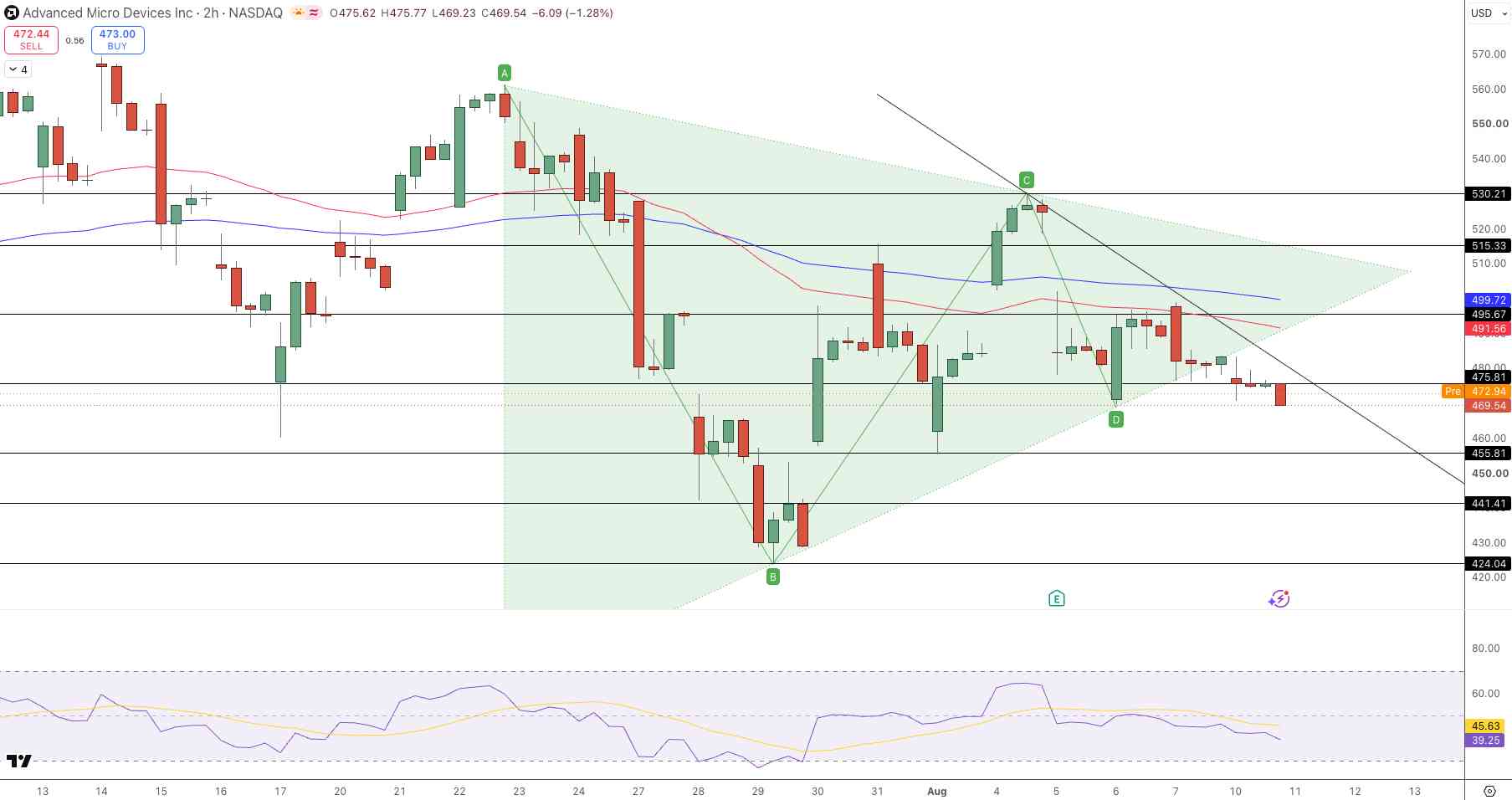
AMD Price Chart - Source: Tradingview
For buyers to step in and support the market, we would need to push above the $475.81 area. However, while there may be ongoing support above this level, we would need to clear the $491.56 to $499.72 zone in order to consider this a bona fide bullish scenario. The next levels of resistance would be set at $515.33 and $530.21
Key Levels (Asian Session Aug 11)
- Immediate resistance: $475.81 (broken support, must reclaim)
- Major resistance: $491.56 (50 EMA), $499.72 (100 EMA)
- Extended targets: $515.33, $530.21 (if breakout extends)
- Critical support: $455.81 (next downside level)
- Secondary support: $441.41, $424.04 (recent lows)
- Current price: $469.54 (below all EMAs)
- RSI: 39 (negative momentum, not yet oversold)
Why Is the Stock Falling Despite an Exceptional Quarter?
There are three reasons. First, valuations at $475+ (48x Fwd Earnings) were already high and the market did not price in the 50% revenue growth, yet. Second, the stagnating gross margin is a bad sign that the competition is intensifying. Investors favor a stock that grows at 40% with a gross margin of 60%, versus a stock that grows at 50% with gross margins at 56% that flatline. Third, the stock was already up significantly in the preceding weeks leading to the earnings, resulting in some natural profit-taking.
The Bottom Line
From an operations perspective, Q2 2026 was an exceptional quarter for AMD with a 50% year-over-year increase in revenue at $11.5B, with $6.7B coming from the Data Center which grew 107% year-over-year, as well as a strong gross margins at 56%, and cash generation at $1.56B. The Data Center Data is valid, as there is a $51.3B backlog that provides visibility.
Recommended Articles


