


The Stock Market Is Doing Something Observed Only Once Before. History Is Clear About What Comes Next.
Key Points
Although the market is surging right now, one metric is sounding the alarm.
While nobody can predict the future, there are some parallels to the dot-com bubble burst.
It's simpler than you might think to prepare your investments for volatility.
- 10 stocks we like better than S&P 500 Index ›
After months of stagnating growth, major market indexes have rallied. The S&P 500 (SNPINDEX: ^GSPC), Nasdaq Composite (NASDAQINDEX: ^IXIC), and Dow Jones Industrial Average (DJINDICES: ^DJI) have surged by 6%, 9%, and 5%, respectively, since late July alone, as of this writing.
That doesn't necessarily mean investors are in the clear, however. An unexpectedly dismal jobs report last week suggests that the economy may not be as robust as previously thought. The market is also becoming increasingly concentrated in tech, with chip stocks alone making up roughly 14% of the S&P 500.
Missed Nvidia in 2009? This Rare Signal Is Flashing Again. In 2009, a "Double Down" signal flashed for a little-known chipmaker called Nvidia. For the first time in years, that same "Total Conviction" signal is flashing for a company 1/100th the size of Nvidia. Continue »
This diminishing diversification could lead to greater risk during the next downturn, as a relatively small sector could have an outsize impact on the broader market. And right now, the market is sounding a warning sign that has occurred only once before -- during the lead-up to the dot-com bubble burst.

Image source: Getty Images.
Is a stock market crash coming?
To be clear, it's impossible to predict exactly when the next bear market or recession might begin. However, downturns are a normal part of the market's cycle, so it's a matter of when -- not if -- we face a pullback.
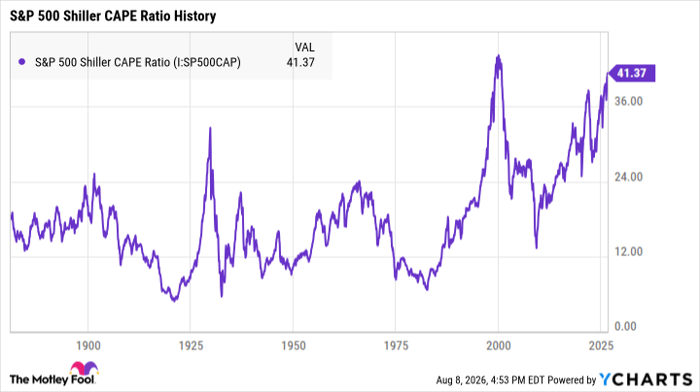
The S&P 500 Shiller Cyclically Adjusted Price-to-Earnings (CAPE) ratio is a metric that tracks the S&P 500's valuation over time, helping gauge whether the index is overvalued or undervalued. Higher figures suggest that the S&P 500 is trading at a premium, and historically, stock prices tend to fall in the years following peaks.
In the late 1990s, internet companies were soaring. The CAPE ratio surpassed 40 for the first time in history in January 1999, and a little over a year later, in March 2000, the dot-com bear market officially began.
S&P 500 Shiller CAPE Ratio data by YCharts
Fast-forward to more recent market activity, and the CAPE ratio is climbing yet again. It's remained consistently above 40 since May of this year, which is only the second time in history that it's stayed above this threshold.
Now, this doesn't necessarily mean a market crash is around the corner. After all, 40 is not a magic number that automatically triggers a bear market. But when the CAPE ratio is this high, it suggests that stocks are unusually richly valued -- and investors may want to exercise caution.
Is it still safe to invest right now?
It's a tricky time to be an investor. If we are in an AI bubble, it may feel safer to avoid the market. But even if a downturn is looming, we may still have months or even years of growth still ahead before it begins. By sitting out of the market now, investors risk forgoing substantial gains.
The good news is that history proves there's never a bad time to invest -- as long as you keep a long-term outlook.
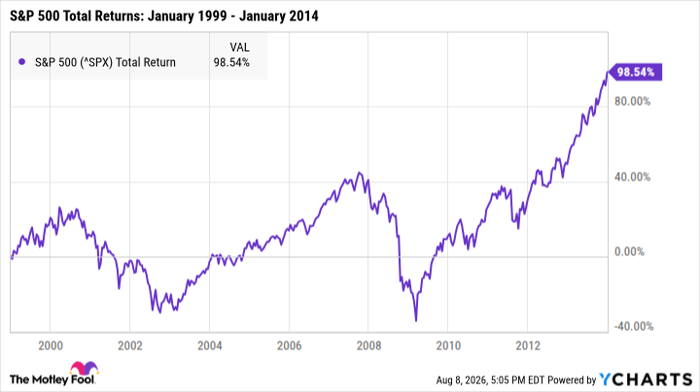
Say, for instance, you invested in an S&P 500 ETF in January 1999, when the CAPE ratio first hit 40. In hindsight, that would have been a less-than-ideal time to buy, as both the dot-com bubble and the Great Recession were on the horizon. But if you'd simply held your investment for 15 years, you'd have doubled your money. By today, you'd have earned total returns of around 940%.
^SPX data by YCharts
This trend is repeated throughout history, too. Since 1919, the S&P 500 has ended every single one of its 20-year periods in positive total returns, according to analysis from Crestmont Research. The short term may be shaky, but the market's long-term future is incredibly bright.
However, investing in quality stocks with long-term growth potential is key. Even the unhealthiest companies can appear successful during good economic times, but recessions and bear markets will test these stocks. In the words of Warren Buffett, "only when the tide goes out do you discover who's been swimming naked."
Volatility can be daunting, but a little preparation can go a long way. With a portfolio full of strong stocks and a long-term outlook, history says you'll be well-positioned to ride out even severe stock market storms.
Should you buy stock in S&P 500 Index right now?
Before you buy stock in S&P 500 Index, consider this:
The Motley Fool Stock Advisor analyst team just identified what they believe are the 10 best stocks for investors to buy now… and S&P 500 Index wasn’t one of them. The 10 stocks that made the cut could produce monster returns in the coming years.
Consider when Netflix made this list on December 17, 2004... if you invested $1,000 at the time of our recommendation, you’d have $399,832!* Or when Nvidia made this list on April 15, 2005... if you invested $1,000 at the time of our recommendation, you’d have $1,374,595!*
Now, it’s worth noting Stock Advisor’s total average return is 968% — a market-crushing outperformance compared to 215% for the S&P 500. Don't miss the latest top 10 list, available with Stock Advisor, and join an investing community built by individual investors for individual investors.
See the 10 stocks »
*Stock Advisor returns as of August 11, 2026.
Katie Brockman has no position in any of the stocks mentioned. The Motley Fool has no position in any of the stocks mentioned. The Motley Fool has a disclosure policy.
Recommended Articles


