


Micron Price Forecast: Mizuho Raises to $1,375, Citi Lowers to $1,150; Can Micron Still Rise?
TradingKey - As of pre-market on August 10 Eastern Time, Micron Technology ( MU) last traded at $877.57, with its pre-market share price down nearly 1%. Wall Street institutions have recently diverged on their stock price forecasts for Micron, with Mizuho Securities recently raising Micron's price target to $1,375, while Citi lowered its target price from $1,400 to $1,150.
Mizuho Raises Micron Price Target to $1,375 as Memory Price Cycle Remains Supported
Mizuho remains relatively optimistic on Micron, as the core investment thesis continues to stem from tight supply-demand conditions in DRAM and HBM.
This cycle in the memory market differs from traditional cycles driven by consumer electronics. AI servers are consuming vast amounts of HBM and high-end DRAM capacity, while memory manufacturers are shifting more wafer capacity to HBM, which also indirectly limits the supply of traditional DRAM. Consequently, even without a significant breakout in PC and smartphone demand, AI data centers are likely to maintain a relatively tight supply-demand environment for the overall DRAM market.
Mizuho had previously raised Micron's price target based on strong price expectations for DRAM and NAND from the second half of 2026 through 2027, and has now further raised it to $1,375, continuing its positive assessment of memory prices and Micron's profitability.
Micron's own business realignment also reinforces this thesis. The company is further concentrating its resources on the data center and AI markets, and locking in more memory demand through long-term customer agreements. If HBM and DRAM supply remains tight, Micron will not only be able to maintain high shipment volumes, but rising product prices could also further drive gross margin and EPS growth.
Citi Cuts Micron Target to $150 as DRAM Price Gains Start to Slow
Compared with Mizuho, Citi's assessment is more cautious.
According to Citi's latest report, as supply and demand dynamics in the memory market shift, DRAM and NAND price growth is expected to gradually slow over the next four quarters and peak in the second quarter of next year. Based on this assessment, Citi lowered its price target for Micron from $1,400 to $1,150, but maintained its 'Buy' rating.
The market's current focus is on how fast memory prices can continue to rise. Micron's previous share price surge has largely reflected the HBM supply shortage, DRAM price hikes, and rapid earnings growth. If DRAM price growth shifts from rapid gains to moderate increases, even if Micron's revenue continues to grow, the pace of its earnings upward revisions may slow.
In addition, the capacity expansion of Chinese memory manufacturer ChangXin Memory Technologies (CXMT) has also become a medium-to-long-term variable of market concern. Recent market reports indicate that CXMT is rapidly expanding its DRAM market share, and its potential entry into the HBM market in the future could increase industry supply. SemiAnalysis projects that CXMT's share of global HBM wafer supply could rise from approximately 1% in 2025 to 12% by 2028.
Micron Stock Technical Analysis
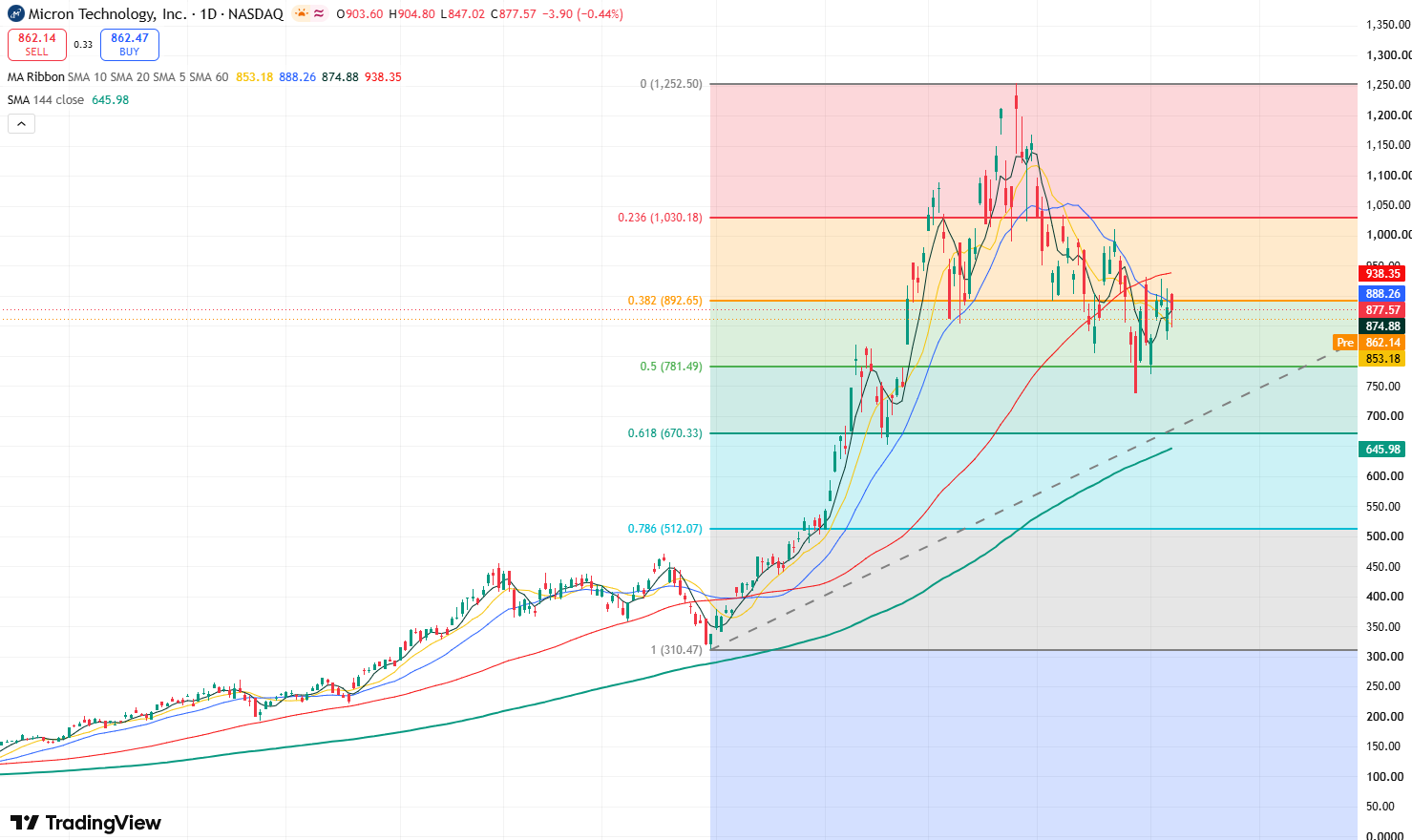
Daily chart of Micron's stock price, Source: TradingView
Looking at the daily chart of Micron's stock price, the recent price trend exhibits a clear pattern of lower highs and lower lows, indicating that the short-term trend remains downward. Meanwhile, as the stock price broke below the 60-day moving average, despite a recent rebound, it remains under pressure below the 60-day moving average. Bearish momentum in the market has strengthened significantly, and the possibility of further short-term declines in the stock price remains.
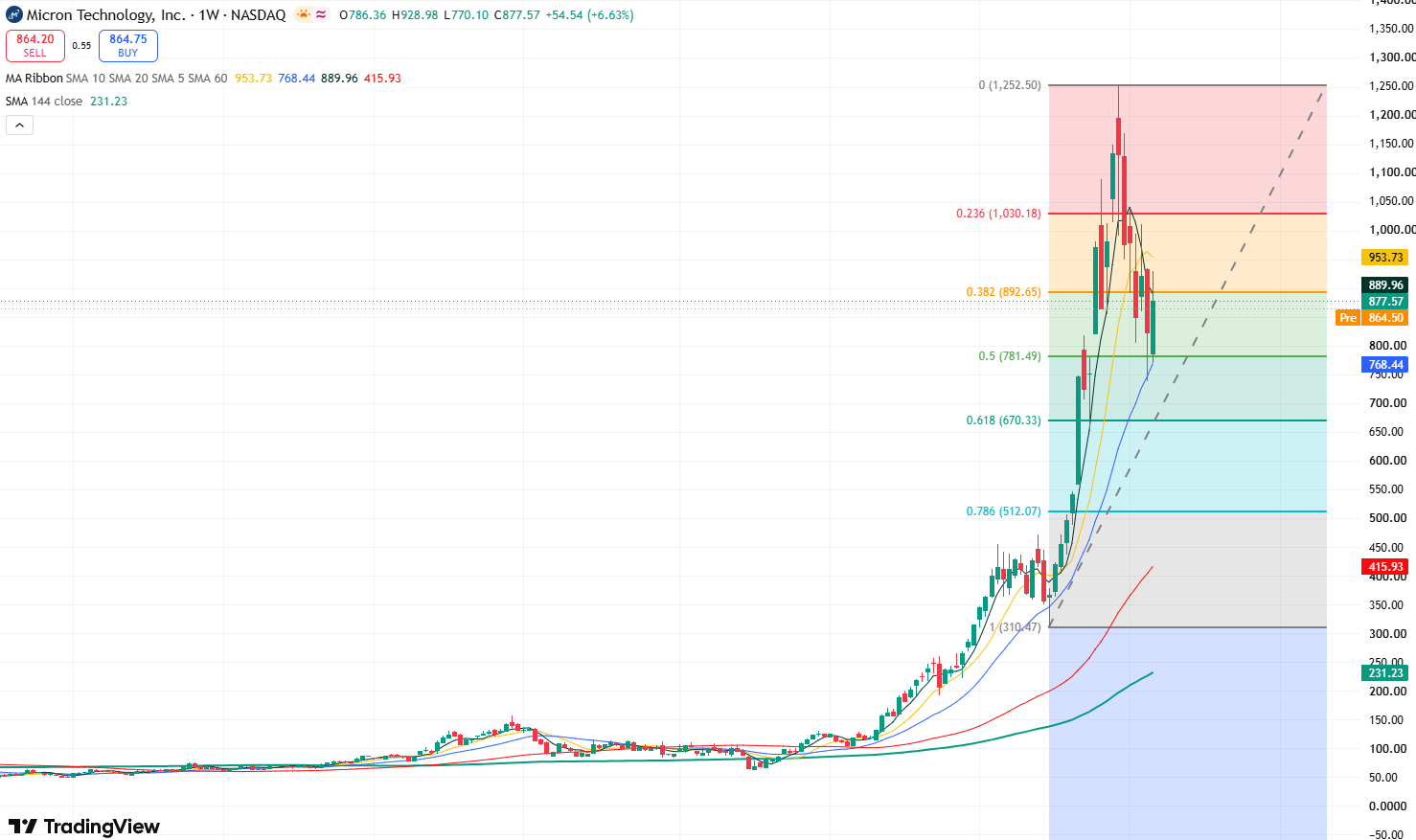
Weekly chart of Micron's stock price, Source: TradingView
Looking at the weekly chart of Micron's stock price, although the stock price retraced to the 20-week moving average last week, it did not break below it. At the same time, it formed a candlestick pattern with a long lower shadow, indicating that the 20-week moving average provides strong support. Furthermore, the 20-week moving average and the 0.5 Fibonacci retracement level at $780 have formed a support confluence, further strengthening the support.
Currently, as the stock price retraces to the 20-week moving average again this week, if it breaks below the 20-week moving average support and $780, the stock price may enter deeper correction territory. The initial downside target could be to test the $700 mark, and further down, attention should be paid to the support level at $670.
Conversely, if the stock price shows signs of stabilizing above $780, it may stage a rebound. The primary target for the rebound would be to test the $1,000 mark. If the stock price consolidates above $1,000, the market's bullish momentum will be significantly enhanced, and the stock is expected to open up upside potential towards its historical high of $1,255.
Recommended Articles


