


2 Reasons Tesla Could Monopolize the U.S. Robotaxi Market
Key Points
The robotaxi market could be worth $10 trillion globally.
Tesla could gain a stranglehold on the U.S. market.
- These 10 stocks could mint the next wave of millionaires ›
The robotaxi industry is currently tiny. But in the coming years, the market should scale significantly in size. Tesla (NASDAQ: TSLA) has quickly emerged as a serious competitor. And looking at various market forecasts, it's not hard to see why the market is so excited about this opportunity.
Goldman Sachs estimates the global robotaxi market will reach $415 billion by 2035. The U.S. portion represents just $48 billion of that entire pie, but autonomous trucking could add even more upside to that figure. "Autonomous trucking is expected to become cheaper per mile than human-driven trucks in 2028 in the U.S.," the bank predicts, "with the global AV trucking market potentially reaching $560 billion in 2035."
Missed Nvidia in 2009? This Rare Signal Is Flashing Again. In 2009, a "Double Down" signal flashed for a little-known chipmaker called Nvidia. For the first time in years, that same "Total Conviction" signal is flashing for a company 1/100th the size of Nvidia. Continue »
In my experience, plenty of bullish research on lucrative multidecade opportunities tends to overestimate near-term growth. But the opposite is happening with Goldman Sachs and its robotaxi forecasts. Previously, the bank estimated that the robotaxi market would reach $7 billion by 2030. More recently, it has been forced to up that figure to $19 billion -- not an insignificant change.
Many Wall Street analysts are highly optimistic about Tesla's ability to capture a disproportionate amount of value from the robotaxi opportunity. Wedbush analyst Dan Ives, for example, believes Tesla will ultimately control 80% of the market. Yet Tesla has repeatedly faced challenges scaling its robotaxi business. These struggles have weighed heavily on its stock price, which has fallen nearly 30% year to date.
Looking beyond the next couple of months, however, it's not hard to see Tesla dominating this market domestically. In fact, there are two reasons to believe Tesla may end up with a pseudo-monopoly in the U.S. robotaxi market.
1. Tesla controls its means of production
Most robotaxi competitors don't fully control their means of production. This means they need to rely on a long list of third-party suppliers to build the cars needed to deploy a fleet of robotaxis.
This presents a couple of challenges. First, the growth of their fleets will be constrained by suppliers' production capacities. Second, their self-driving technology may have certain implementation challenges compared to a company with full control over the production process. Alphabet's Waymo robotaxi service, for example, has reportedly faced challenges integrating its technology with suppliers simply due to the highly confidential nature of some of its software. Finally, it typically raises costs, indirectly reducing their ability to scale and compete.
Vertical integration minimizes these challenges for Tesla. Some early data suggest this. This year, Tesla has been undercutting the competition by charging significantly less for its robotaxi rides.
"Tesla's autonomous service averages just $8.17 per ride in San Francisco -- nearly half Lyft's $15.47 average and drastically cheaper than Waymo's premium rates," observes one report. Other research has estimated that Tesla enjoys significantly lower operating costs per mile for its robotaxi fleet versus its main competitors.
Aggressive pricing may currently have more to with gathering data versus a clear structural cost advantage. But it's still somewhat reflective of Tesla's ability to keep its own costs low while stomaching short-term losses for better long-term competitiveness. Some estimates, for example, peg the cost of a Waymo autonomous vehicle at several hundred thousand apiece. Tesla, for comparison, hopes to produce Cybercabs at a price below $30,000.
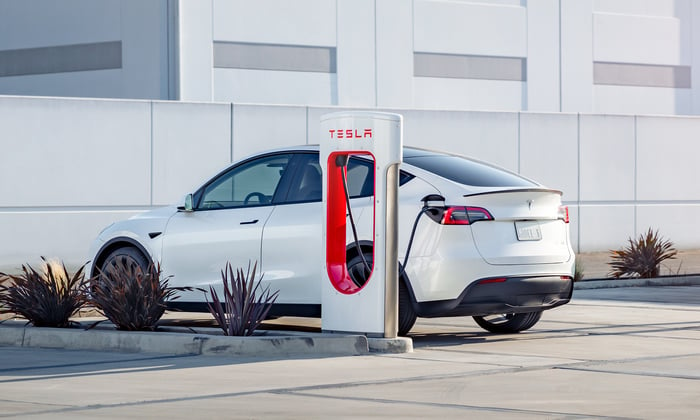
Image source: Tesla.
2. AI will rule robotaxi scaling
Some of Tesla's robotaxi competitors have deep budgets and highly developed AI divisions. Alphabet's Waymo division, for example, is well funded and armed with advanced AI technology. Other competitors, however, such as Uber Technologies, have far less direct access to next-gen AI.
Given how critical AI has become for advancing self-driving technologies, Tesla's heavy AI investments and direct co-ownership of xAI, the AI division of Space Exploration Technologies, become a real advantage. Many experts believe AI is critical for achieving full autonomy, and thus operating an autonomous robotaxi fleet.
"AI is essential for autonomous driving," stresses Valeo, a global automotive technology supplier. "Without artificial intelligence, vehicles cannot detect, classify, and predict the intentions of other road users in real time, capabilities that are fundamental to safe self-driving technology."
In many ways, Tesla can be considered one of the largest AI stocks on the planet. And soon, it may merge with SpaceX, another AI giant. From a standpoint of funding and access to technology, these factors weigh heavily in Tesla's favor when it comes to its potential domination of the robotaxi market.
Where to invest $1,000 right now
When our analyst team has a stock tip, it can pay to listen. After all, Stock Advisor’s total average return is 953%* — a market-crushing outperformance compared to 214% for the S&P 500.
They just revealed what they believe are the 10 best stocks for investors to buy right now, available when you join Stock Advisor.
See the stocks »
*Stock Advisor returns as of August 7, 2026.
Ryan Vanzo has no position in any of the stocks mentioned. The Motley Fool has positions in and recommends Alphabet, Goldman Sachs Group, Lyft, and Tesla. The Motley Fool recommends Uber Technologies. The Motley Fool has a disclosure policy.
Recommended Articles


