


SpaceX Signed $14.1 Billion of Cloud Contracts in a Single Quarter. Its AI Segment Revenue Hit $2.56 Billion.
Key Points
SpaceX signed Cloud Services Agreements totaling $14.1 billion in contracted sales during the second quarter.
AI segment revenue rose 247% year over year to $2.6 billion, driven by the new compute agreements.
The AI build-out consumed $15.8 billion of capital spending in the quarter, more than the company's total revenue.
- 10 stocks we like better than Space Exploration Technologies ›
SpaceX (NASDAQ: SPCX) is still best known for rockets and for Starlink, its satellite internet service. But the second-quarter report it delivered Tuesday (its first as a public company) was largely about something else: selling artificial intelligence (AI) computing capacity.
During the quarter, SpaceX signed Cloud Services Agreements totaling $14.1 billion in contracted sales, nearly twice the $7.8 billion of revenue the entire company produced in the period.
Missed Nvidia in 2009? This Rare Signal Is Flashing Again. In 2009, a "Double Down" signal flashed for a little-known chipmaker called Nvidia. For the first time in years, that same "Total Conviction" signal is flashing for a company 1/100th the size of Nvidia. Continue »
And the buying hasn't stopped. On the earnings call, chief financial officer Bret Johnsen said the company contracted an additional $6.7 billion of cloud services revenue in the first weeks of the current quarter, covering a six-month stretch that starts ramping in October.
The market sold the report anyway. Shares fell about 14% the next day, then rebounded about 6% Thursday to about $115 as of this writing. To me, the drop was less about the quarter than about the stock's price tag. A first slice of the initial-public-offering (IPO) lock-up also expired Thursday, freeing up to 911.5 million shares for sale.
So, at what point does a launch company become a compute company -- and what should investors pay for one in the middle of that change?
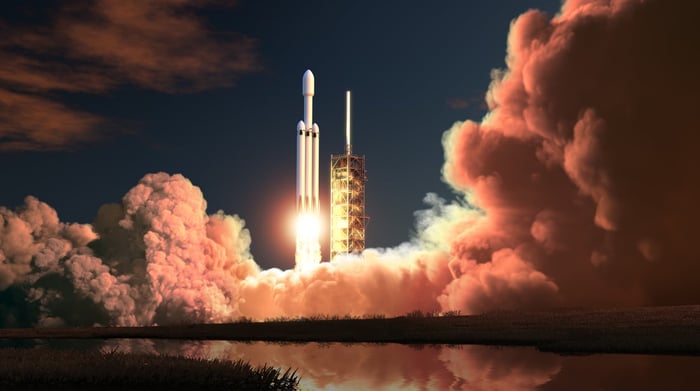
Image source: Getty Images.
What the contracts are, and what they aren't
The AI segment is where the shift shows up. Its revenue reached $2.6 billion in the second quarter, up 247% year over year. The piece doing the work is the AI solutions and infrastructure line, which jumped to $2.2 billion from $311 million a year earlier -- a sevenfold increase. SpaceX said the new cloud agreements contributed $1.6 billion of incremental infrastructure revenue in the quarter alone.
The segment was at $818 million as recently as the first quarter. Then the contracts started landing, and the figure more than tripled sequentially.
But contracted sales are not revenue. SpaceX defines the $14.1 billion as the value of contracts signed for their non-cancellable period -- dollars to be recognized over time, not dollars already earned.
The release didn't name customers, either. But deals announced around the June IPO give a sense of who's buying. Google, part of Alphabet, agreed to pay $920 million a month for compute from October 2026 through June 2029. And Anthropic agreed to use compute capacity across the company's Colossus and Colossus II data centers.
"Revenue growth accelerated across all our business segments and we delivered strong operating leverage, with significant margin expansion led by our new AI compute agreements," Johnsen said in the release.
What it costs to become a cloud company
The build-out behind those contracts is enormous. Capital expenditures for the AI segment were $15.8 billion in the second quarter (more than the entire company's revenue), up from $7.7 billion in the first quarter and just $749 million a year ago.
Computing capacity has more than tripled year over year, to 1.4 gigawatts.
However, the segment still loses money. Its operating loss was $1.3 billion in the quarter, cut nearly in half from the first quarter. Its adjusted earnings before interest, taxes, depreciation, and amortization (EBITDA) even turned positive for the first time, at $1.1 billion. But depreciation is the unavoidable cost of a compute business, and $15.8 billion a quarter of spending becomes a very large bill later.
SpaceX can fund it. It ended the quarter with $100 billion of cash and marketable securities, helped by $85.7 billion of IPO proceeds and a $25 billion June bond sale.
Starlink, meanwhile, still pays the bills. The connectivity segment grew revenue 66% year over year to $4.3 billion and produced $1.7 billion of operating income, the only segment at an operating profit.
The ambitions reach further still. Alongside the report, SpaceX announced a partnership with Nvidia to design the Starmind AI1 satellite compute payload, data-center-class computing meant to operate in orbit. Nobody has yet proven a data center in space can work at commercial scale.
Then there's the price. At about $115 per share, SpaceX is worth about $1.5 trillion, or about 65 times its trailing 12-month revenue of $23 billion. Even against the $100 billion annualized run rate Johnsen said the company is on pace to reach by year-end, that's about 15 times a figure the business hasn't reached yet.
So, is the sell-off a buying opportunity? Not for me. I'll stay on the sidelines.
Sure, the contracted dollars are hard commitments, and the balance sheet can probably carry the spending for a long time. But at about 65 times trailing revenue, the stock arguably prices the compute transformation as a success already, while the segment delivering it still loses money on an operating basis.
The line I'll watch is the AI segment's operating loss. If the new contracts swing it to a profit over the next few quarters, the compute business will have started to prove itself. For now, I'd rather wait.
Should you buy stock in Space Exploration Technologies right now?
Before you buy stock in Space Exploration Technologies, consider this:
The Motley Fool Stock Advisor analyst team just identified what they believe are the 10 best stocks for investors to buy now… and Space Exploration Technologies wasn’t one of them. The 10 stocks that made the cut could produce monster returns in the coming years.
Consider when Netflix made this list on December 17, 2004... if you invested $1,000 at the time of our recommendation, you’d have $397,405!* Or when Nvidia made this list on April 15, 2005... if you invested $1,000 at the time of our recommendation, you’d have $1,344,091!*
Now, it’s worth noting Stock Advisor’s total average return is 953% — a market-crushing outperformance compared to 214% for the S&P 500. Don't miss the latest top 10 list, available with Stock Advisor, and join an investing community built by individual investors for individual investors.
See the 10 stocks »
*Stock Advisor returns as of August 7, 2026.
Daniel Sparks and his clients do not have positions in any of the stocks mentioned. The Motley Fool has positions in and recommends Alphabet and Nvidia. The Motley Fool has a disclosure policy.
Recommended Articles


