


All But 2 "Magnificent Seven" Stocks Are Underperforming the Market This Year. Here's 1 Company I'd Load Up On and 1 I'd Avoid
Key Points
Microsoft's increased spending is beginning to yield meaningful cloud and AI milestones.
The company's presence in the global corporate world helps ensure its consistent long-term success.
Tesla's price-to-sales ratio is nearly 7 times higher than the next closest "Magnificent Seven" stock.
- 10 stocks we like better than Microsoft ›
The "Magnificent Seven" stocks are some of the world's most influential, successful companies, but all hasn't been peachy-keen with this bunch so far this year. The only two companies outperforming the S&P 500 as of market close on July 29 are Apple and Alphabet, up 24.8% and 6.8%, respectively, compared to the S&P 500's 6.7%.
Part of the down year is investors looking for value in more niche industries (like memory hardware), and part of it is investors looking for value in other sectors because of worries about inflated big tech stock valuations.
Missed Nvidia in 2009? This Rare Signal Is Flashing Again. In 2009, a "Double Down" signal flashed for a little-known chipmaker called Nvidia. For the first time in years, that same "Total Conviction" signal is flashing for a company 1/100th the size of Nvidia. Continue »
In either case, if I had to choose one to load up on right now, it'd be Microsoft (NASDAQ: MSFT), but in that same breath, Tesla (NASDAQ: TSLA) is a stock I'm currently avoiding. Here's why.
Image source: The Motley Fool.
A staple that's here to stay
As of market close on July 29, Microsoft's stock was down 17.4% year to date. However, after reporting its fiscal 2026 fourth-quarter (Q4) results, the stock surged 9.5% in after-hours trading. The reason mainly comes down to Microsoft's AI investments showing signs of paying off.
Microsoft took a lot of heat for its spending, but it has progress to show for it. Its cloud platform Azure surpassed $100 billion in revenue for the first time, total Microsoft Cloud revenue increased 27% year over year (YOY) to $214 billion, and Microsoft 365 Copilot (Microsoft's AI assistant) doubled its paid seats from the previous quarter to 30 million.
Even when Microsoft's stock is having a rough patch, I never second-guess whether it'll bounce back because the company is too important to the global business world. It's the marquee enterprise business-to-business company, with millions of businesses relying on various software and hardware for their daily operations.
That doesn't make the company or stock invincible by any means, but it's a competitive moat few can match. As the company continues to invest in cloud computing and AI infrastructure, it should continue its stronghold on the industry.
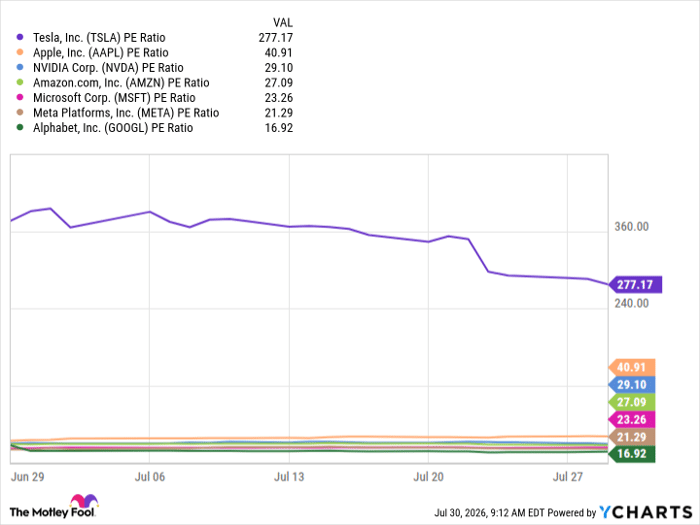
Microsoft isn't completely off the hook with its high capital expenditure (capex) plans, but some AI progress is enough to buy it some more time with investors. And with the stock trading at around 23.7 times its earnings (the third-cheapest of the Magnificent Seven), the upside far outweighs the potential downside.
TSLA PE Ratio data by YCharts
Are the red flags worth the price?
I'll start with the good news about Tesla. In Q2, it increased its revenue by 26% YOY to $28.2 billion and set a company vehicle delivery record, with deliveries up 25% YOY to 480,216. That's commendable, but the one issue is how Tesla managed to do it.
Tesla essentially swapped out profit for volume. Its operating income (profit from core operations) dropped 57% YOY; its operating margin was 1.4%; and its free cash flow turned negative, coming in at -$1.09 billion.
The decline in profits and free cash flow isn't ideal, but it's not the end of the world. The main issue is when you couple it with Tesla's capital expenditures. To be fair, Tesla's $5.79 billion in capex in Q2 is nowhere near the $43 billion Microsoft spent, but it was 142% more than Q2 last year. It expects its 2026 capex to be around $25 billion.
The spending itself would be easier to justify if Tesla had a clearer roadmap for its non-car sales segments. Its two long-term growth projects -- robotaxis and humanoid robots -- are likely many years from commercial use and even more years away from making worthwhile contributions to Tesla's earnings.
Tesla's car business isn't enough to justify its valuation. Investors are buying into the company because of its ambitious plans, but at some point, there has to be enough tangible progress. This is especially true for a stock trading at 277 times its earnings. There's expensive, and then there's that.
It has a lot of grey area to clear up before I'd feel comfortable buying the stock.
Should you buy stock in Microsoft right now?
Before you buy stock in Microsoft, consider this:
The Motley Fool Stock Advisor analyst team just identified what they believe are the 10 best stocks for investors to buy now… and Microsoft wasn’t one of them. The 10 stocks that made the cut could produce monster returns in the coming years.
Consider when Netflix made this list on December 17, 2004... if you invested $1,000 at the time of our recommendation, you’d have $386,727!* Or when Nvidia made this list on April 15, 2005... if you invested $1,000 at the time of our recommendation, you’d have $1,232,139!*
Now, it’s worth noting Stock Advisor’s total average return is 906% — a market-crushing outperformance compared to 208% for the S&P 500. Don't miss the latest top 10 list, available with Stock Advisor, and join an investing community built by individual investors for individual investors.
See the 10 stocks »
*Stock Advisor returns as of August 3, 2026.
Stefon Walters has positions in Apple and Microsoft. The Motley Fool has positions in and recommends Alphabet, Amazon, Apple, Meta Platforms, Microsoft, Nvidia, and Tesla. The Motley Fool has a disclosure policy.
Recommended Articles


