


Top JPMorgan Strategist Michael Cembalest Is "Cautious" on AI Stocks. Should You Change Your Investments?
Key Points
In the past year, semiconductor stocks have outperformed the major tech names that are building (and paying for) AI tools.
A recent research report from JPMorgan strategist Michael Cembalest notes that a similar trend played out 25 years ago at the height of the dot-com bubble.
If you want to diversify away from U.S. AI stocks, international stock ETFs could be a good choice -- but some are more diversified than others.
- 10 stocks we like better than Vanguard International Equity Index Funds - Vanguard Ftse All-World ex-US ETF ›
In his July 22 "Eye on the Market" report, influential JPMorgan (NYSE: JPM) strategist Michael Cembalest writes that he is turning "cautious" on U.S. equity market technicals by looking at recent trends in the artificial intelligence (AI) trade.
Cembalest notes in his research that semiconductor stocks have recently made big gains while hyperscalers have stagnated. As he writes, "The worrisome part of a boom cycle is when companies closest to final demand roll over, even as capital spending beneficiaries of the cycle keep on thriving."
Missed Nvidia in 2009? This Rare Signal Is Flashing Again. In 2009, a "Double Down" signal flashed for a little-known chipmaker called Nvidia. For the first time in years, that same "Total Conviction" signal is flashing for a company 1/100th the size of Nvidia. Continue »
For example, in the past year, the iShares Semiconductor ETF has delivered a return of 89.75%, strongly outperforming AI hyperscaler stocks like Alphabet, Amazon, Meta, Microsoft, and Oracle.
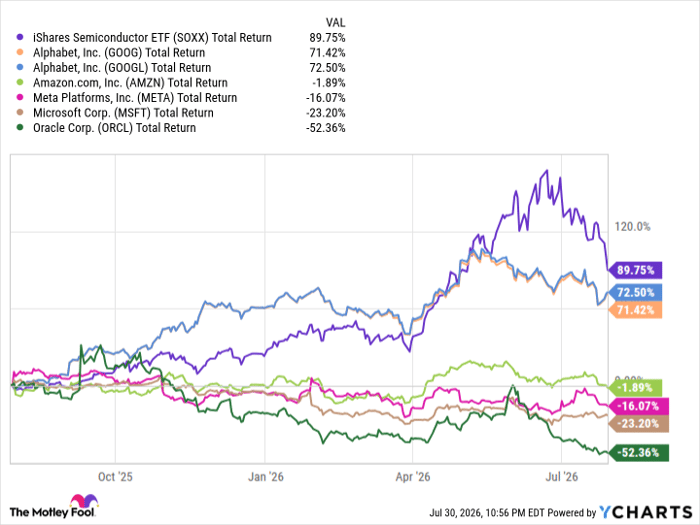
SOXX Total Return Level data by YCharts
This is similar to what happened in 1999-2000 during the dot-com boom -- right before it turned into the dot-com bust. In that era, communications services stocks (which Cembalest compares to the hyperscalers of today) slowed their growth even while communications equipment stocks (which Cembalest compares to semiconductor stocks today) kept climbing. This ultimately turned out to be a bad sign for the entire dot-com-era stock market.
None of this means that AI is a bubble that will burst or that history will precisely repeat itself. AI stocks might keep growing. And even if there's a prolonged tech sell-off, other U.S. stocks might keep making gains. But if you're worried about high valuations of AI stocks and uncertain returns for AI capex, you might want to diversify beyond the U.S. stock market and the AI trade.
Let's look at two international exchange-traded funds (ETFs) that could be a good fit for this strategy.

Image source: Getty Images.
1. Vanguard FTSE All-World ex-US ETF: 3,858 stocks, 5 years of 9.1% returns
The Vanguard FTSE All-World ex-US ETF (NYSEMKT: VEU) offers a portfolio of 3,858 global stocks from 43 countries outside the U.S. market, including a mix of emerging market and developed market economies. It charges an ultra-low expense ratio of 0.04%. The top holdings are in stocks from Japan (15.5% of the fund), Taiwan (9%), the United Kingdom (8.1%), South Korea (7.7%), and Canada (7.5%).
This international ETF has delivered annualized returns (by net asset value) of about 28.3% in the past year, 19.04% for the past three years, and 9.1% for the past five years.
Unfortunately, if you want to diversify away from the AI trade, this global ETF might not help enough. The top four stocks held by this fund are all semiconductor stocks and memory chip stocks that are closely involved with the AI boom:
- Taiwan Semiconductor Manufacturing: 4.63% of the fund
- Samsung Electronics: 2.48%
- SK Hynix: 37%
- ASML Holding: 1.85%
Those four stocks make up about 11.33% of the fund's assets. But this international ETF still owns thousands of other companies that are less exposed to AI-related volatility. And it probably offers better diversification than U.S. large-cap stocks. In June, Bloomberg research found that the S&P 500 index consisted of about 53% AI-related stocks by weighting.
2. State Street SPDR Portfolio Developed World ex-US ETF: 2,439 stocks, 5 years of 9.81% annualized returns
The State Street SPDR Portfolio Developed World ex-US ETF (NYSEMKT: SPDW) holds 2,439 stocks from 25 developed-market economies. It charges an even lower expense ratio than the Vanguard fund: 0.03%.
This global ETF has delivered annualized returns (by net asset value) of about 28.3% in the past year, 19.21% for the past three years, and 9.81% for the past five years.
The top five countries represented in this fund are:
- Japan: 21.6% of the fund
- United Kingdom: 11.7%
- Canada: 10.9%
- France: 7.2%
- South Korea: 7.2%
This fund does not count Taiwan as a "developed market," so Taiwan Semiconductor Manufacturing stock is not part of its portfolio. But the top three stocks in this State Street SPDR fund, just like in the Vanguard fund, are all semiconductors and memory chips:
- Samsung Electronics: 2.09% of the fund
- ASML Holding: 1.84%
- SK Hynix: 1.62%
However, those AI-related stocks make up only about 5.55% of the fund's assets. That makes this ETF less top-heavy with the AI trade. It could be a better choice for investors who want to diversify away from AI.
Why buy VEU or SPDW?
I don't own either of these funds, and neither made the list of best international ETFs. But if I had to choose one, I would go with the State Street SPDR Portfolio Developed World ex-US ETF (SPDW). It feels a little less top-heavy with AI-related stocks.
But if you don't want to diversify away from the AI trade so much, the Vanguard FTSE All-World ex-US ETF could give you some exposure to emerging markets like Taiwan, which are not included in the SPDW fund.
Should you buy stock in Vanguard International Equity Index Funds - Vanguard Ftse All-World ex-US ETF right now?
Before you buy stock in Vanguard International Equity Index Funds - Vanguard Ftse All-World ex-US ETF, consider this:
The Motley Fool Stock Advisor analyst team just identified what they believe are the 10 best stocks for investors to buy now… and Vanguard International Equity Index Funds - Vanguard Ftse All-World ex-US ETF wasn’t one of them. The 10 stocks that made the cut could produce monster returns in the coming years.
Consider when Netflix made this list on December 17, 2004... if you invested $1,000 at the time of our recommendation, you’d have $386,727!* Or when Nvidia made this list on April 15, 2005... if you invested $1,000 at the time of our recommendation, you’d have $1,232,139!*
Now, it’s worth noting Stock Advisor’s total average return is 906% — a market-crushing outperformance compared to 208% for the S&P 500. Don't miss the latest top 10 list, available with Stock Advisor, and join an investing community built by individual investors for individual investors.
See the 10 stocks »
*Stock Advisor returns as of August 3, 2026.
JPMorgan Chase is an advertising partner of Motley Fool Money. Ben Gran has no position in any of the stocks mentioned. The Motley Fool has positions in and recommends ASML, Alphabet, Amazon, JPMorgan Chase, Meta Platforms, Microsoft, Oracle, Taiwan Semiconductor Manufacturing, Vanguard International Equity Index Funds-Vanguard Ftse All-World ex-US ETF, and iShares Trust-iShares Semiconductor ETF. The Motley Fool has a disclosure policy.
Recommended Articles


