


Nvidia Launches New AI Infrastructure Collaboration Model: Providing GPU Financial Guarantees, Tapping Into Cloud Service Revenue Sharing
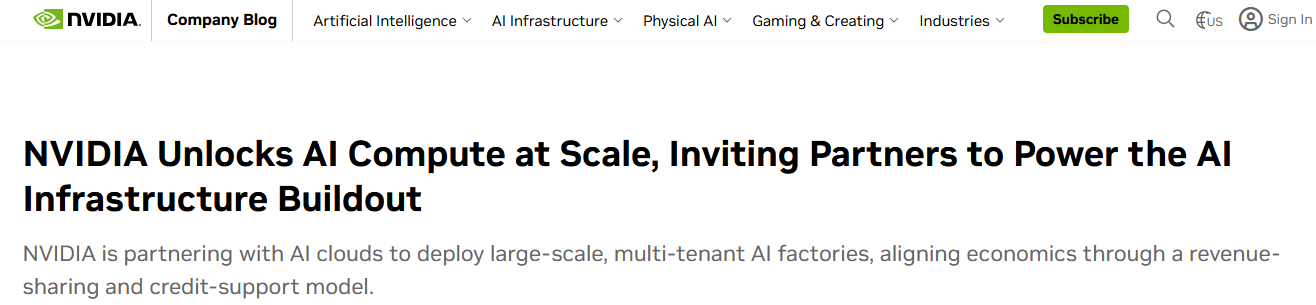
TradingKey - On July 1, local time, NVIDIA ( NVDA) officially announced the launch of a new business model that integrates revenue sharing and credit support, allowing AI cloud service providers to deploy NVIDIA infrastructure at scale and offer computing power services without having to fully bear upfront capital expenditures.
Source: NVIDIA
The core of NVIDIA's newly launched "DSX AI Factory" partnership model is to break through the financing bottlenecks that have long constrained AI startups from acquiring computing power. According to the official plan, participating cloud service providers will deploy AI factories based on the NVIDIA DSX architecture, providing cross-regional, high-utilization multi-tenant accelerated computing services to AI-native enterprises, model developers, and scientific research institutions.
NVIDIA not only provides a full suite of hardware infrastructure support, but also innovatively introduces a credit endorsement mechanism—if a partner cloud service provider cannot find enough computing power tenants, NVIDIA will buy back the unsold GPU capacity at an agreed price.
In exchange, in addition to generating chip sales revenue, NVIDIA will take a percentage of revenue from the cloud service providers, with the revenue-sharing ratio gradually decreasing over the course of the contract.
The first projects to adopt this model are already substantial in scale: Sharon AI plans to deploy up to 40,000 NVIDIA Grace Blackwell GB300 GPUs, while Firmus is building a 360-megawatt AI factory campus in Batam, Indonesia, which will ultimately house 170,000 NVIDIA GPUs.
For emerging cloud service providers that lack credit backing, NVIDIA's backstop guarantee is nothing short of a major boost.
Nvidia Backs Emerging GPU Cloud Providers to Reduce Reliance on Tech Giants
Currently, Amazon ( AMZN ), Microsoft ( MSFT ), Google ( GOOGL ), Meta ( META ), and a few other large cloud service providers account for most of Nvidia's chip capacity. However, several of these tech giants are already developing their own AI chips, posing a potential threat to Nvidia's market share.
To reduce its reliance on major customers, Nvidia has spent the past several years supporting emerging GPU cloud service providers, led by CoreWeave ( CRWV ). The current "AI Computing Collaboration Initiative" is a continuation and deepening of this strategy.
In fact, Nvidia's positioning in this direction has been underway for some time. As early as September 2024, Nvidia committed to purchasing all of CoreWeave's unsold capacity through 2032 if the company could not find tenants. The contract, valued at $6.3 billion, directly drove CoreWeave's stock price up nearly 30% within a week.
According to regulatory filings in May this year, Nvidia added another $3.5 billion to guarantee customer data center leases in exchange for stock purchase rights.
To date, Nvidia has invested billions of dollars in multiple emerging cloud service providers through equity investments, capacity leasebacks, and lease guarantees, establishing a multi-layered alignment-of-interests mechanism.
Recently, reports surfaced that Nvidia is also providing financial guarantees for a mega data center OpenAI is building in Ohio, a project with an estimated cost of up to $500 billion.
From Hardware Supplier to Ecosystem Core: Nvidia Embarks on a New Earnings Cycle
Through this series of initiatives, Nvidia is reshaping its revenue model. In the past, Nvidia primarily relied on chip sales for one-time revenue; now, through a revenue-sharing mechanism, Nvidia will secure a recurring stream of income tied to computing power usage, thereby deeply participating in the profit distribution across the entire commercialization chain of AI computing power.
This model not only expands Nvidia's customer base but also strengthens the dependence of downstream cloud service providers on Nvidia's ecosystem—from hardware architecture to software platforms, and now to financing support, Nvidia has become an irreplaceable core player in the AI computing power sector.
From a broader industry perspective, Nvidia's layout is accelerating the popularization of AI computing power. For a long time, high infrastructure costs and lengthy construction cycles have limited the development of many AI startups.
By providing credit support and business model innovation, Nvidia enables these enterprises to gain faster access to full-stack accelerated computing capabilities without waiting for traditional data center construction cycles to complete. This will further stimulate innovation and vitality within the AI industry, drive the implementation of more application scenarios, and allow Nvidia, as the core of the ecosystem, to continuously benefit from it.
Recommended Articles


