


United States Dollar Index advances above 99.50 due to Middle East risks
- US Dollar gains on strong safe-haven demand amid uncertainty around the Hormuz reopening.
- July's surprise 23,000 US payroll drop and past revision signal a cooling labor market, dampening Fed rate expectations.
- CME FedWatch Tool suggests a 46% chance of a September rate hike, down from 67%.
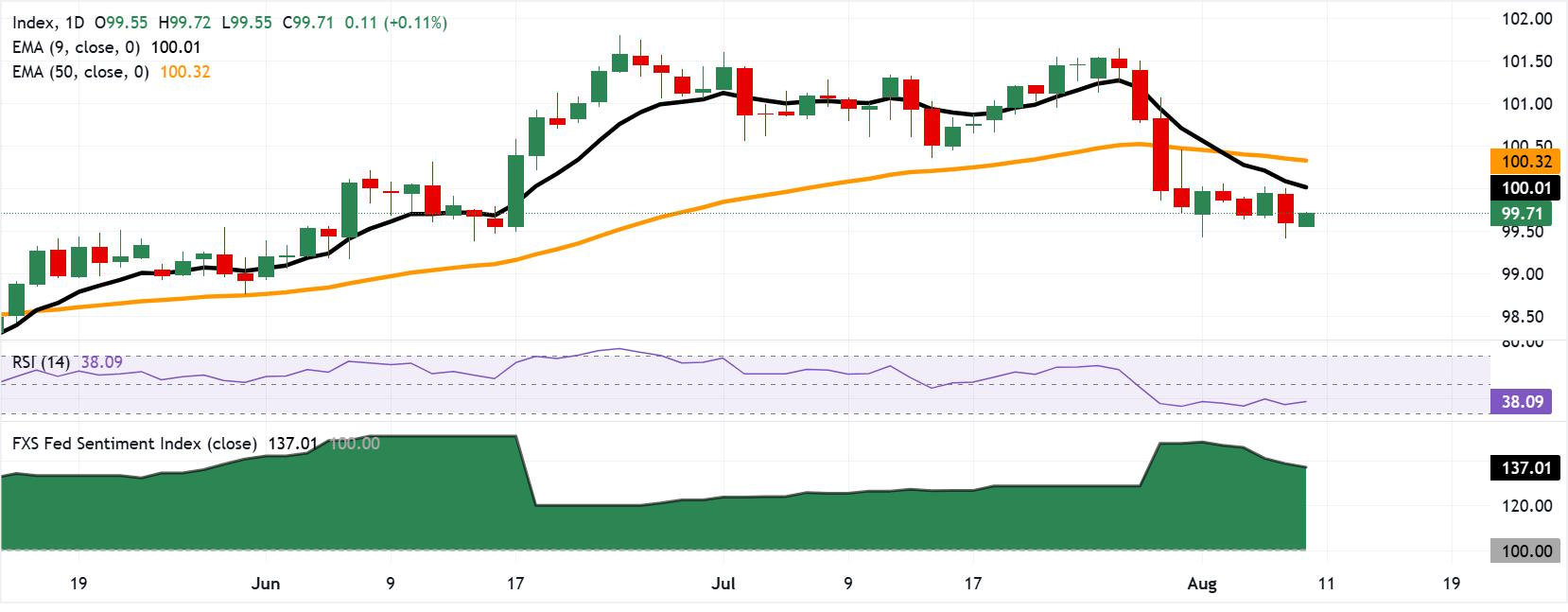
The US Dollar Index (DXY), which measures the value of the US Dollar (USD) against six major currencies, is gaining ground after registering modest losses in the previous day and trading around 99.70 during the Asian hours on Monday.
The Greenback receives support from broad risk aversion amid geopolitical tensions remaining high as the ongoing United States (US)-Iran conflict enters a critical diplomatic phase, with intense military engagements and strategic pressure surrounding the Strait of Hormuz driving market caution. Although Iranian officials noted on Sunday that Oman-mediated negotiations regarding the management of the strait are making progress, safe-haven demand for the Greenback remains firmly intact.
Weaker-than-expected US employment data has dampened expectations for a near-term Federal Reserve (Fed) rate hike. Nonfarm Payrolls (NFP) unexpectedly dropped by 23,000 in July, while sharp downward revisions to 20,000 from the previous 57,000 in June highlighted weakening labor market conditions.
CME FedWatch Tool suggests that markets now see around a 46% probability of a 25 basis point rate hike in September, down from 67% a week earlier. Investors are now focused on upcoming inflation reports for further clues on monetary policy.
Markets bull steepen as Fed hike expectations are pared back
According to TD Securities, the rates market "bull steepened on the negative headline print despite a drop in the UE rate to 4.1%." The softer data "eased concerns over a reaccelerating labor market," prompting investors to "price out hikes," with the bank noting that "September's pricing [declined] by 3bp to 12bp of hikes."
Barkin flags weak labour balance despite solid corporate earnings
Fed's Barkin delivered a slightly softer tone, with a 5.4/10 FXS Speechtracker score coming in below the 5.8/10 historical average, underscoring a modestly more cautious stance. The emphasis on job data being “very consistent with a sector in weak balance” and characterized by “low hire, low fire” highlights a labour market that is stagnant rather than collapsing, tempering any aggressive policy bias. At the same time, Barkin’s focus on “quite strong” and growing corporate earnings, and the explicit watch for linkages to the job market, signals that resilient profits could limit how dovish policy can become if labour softness does not spill over more broadly.
The FXS Fed Sentiment Index fell by 1.68 points to 137.01, indicating a pullback in perceived hawkishness even as the index remains firmly above the neutral 100 mark. This configuration suggests that, despite a softer tone in the latest remarks captured by the FXS Speechtracker, overall Fed communication is still anchored in hawkish territory, with markets expecting policy to stay relatively restrictive.
Recommended Articles


