


Can EIP-8363 save Ethereum's ultrasound money thesis, or is the damage already done?
Over the past two years, Ethereum (ETH) has faced one of its biggest challenges — its circulating supply has been in an uptrend, a direct stab at its ultrasound money thesis.
Since April 2024, ETH's supply has risen from 120.064 million ETH to 121.943 million ETH, representing a 0.67% annual inflation rate — far higher than figures cited by several ETH treasuries, including BitMine, which measures its stash against a 120.7 million ETH supply.
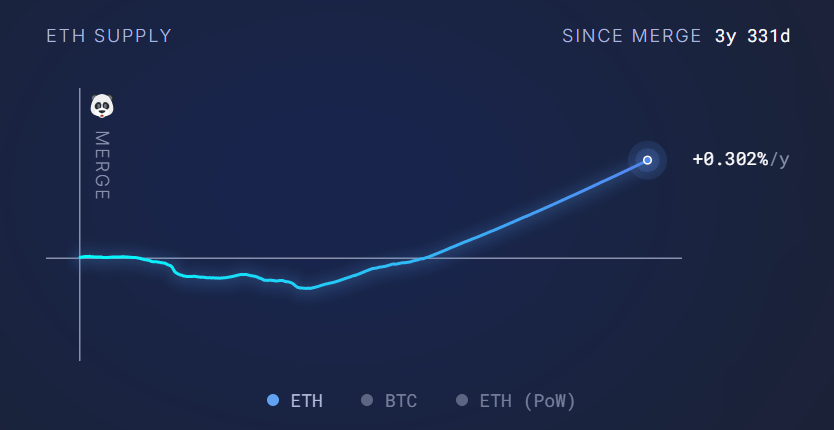
That rising supply is one of the several reasons ETH has largely underperformed crypto majors Bitcoin (BTC), BNB and XRP. Compared to ETH's -46% return since April 2024, BTC, XRP and BNB have posted -7%, 65% and 5% returns, respectively. But how did ETH find itself in this position?
The ultrasound money thesis
Unlike Bitcoin, which has a 21 million BTC supply cap, ETH's inflation was set to increase infinitely as validators received newly issued coins for processing transactions.
However, the London hard fork and The Merge changed the game between 2021 and 2022, introducing mechanisms that burned the base fee of all Ethereum transactions and dropped new issuance to validators by nearly 90%.
Due to the large fees for processing Ethereum transactions at the time plus the reduced new issuance, the mechanisms were able to keep ETH's supply stable and partially deflationary. That gave birth to the ultrasound money thesis, which became one of the major selling points for ETH.
Ethereum proponents sold the idea that if Bitcoin is "sound money" because of its hard cap, ETH is "ultrasound money" as its decreasing supply makes it a superior store of value. Investors pounced on this thesis, increasing their allocations to ETH based on the network's new changes.
However, while Ethereum was on the verge of winning one battle against Bitcoin through its high fee structure, the same feature was putting it at risk of losing another against alternative Layer 1s (L1s).
The cost of the L2-centric roadmap
The high-speed and low-fee structure of these alternative L1s proved attractive for builders and consumers, causing Ethereum to lose market share rapidly. Between January 2023 and March 2024, Ethereum's share of DeFi trading activity dropped from 69% to 29%.
-1786479661050.png)
In an attempt to solve this problem, developers introduced blobspace in the Dencun upgrade of March 2024, dropping fees on Layer 2 networks to a fraction of the usual cost. The move shifted a significant chunk of network activity to L2s, keeping the mainnet less crowded with a predictable fee structure.
Developers doubled down in the subsequent Pectra and Fusaka upgrades by increasing blob capacity, further pushing down fees on L2s. However, this L2-centric roadmap created another problem for ETH.
By constantly designing for reduced L2 fees and pushing activity toward them, Ethereum has been seeing lower and lower fees, reducing the amount of ETH burnt while issuance to validators remained stable.
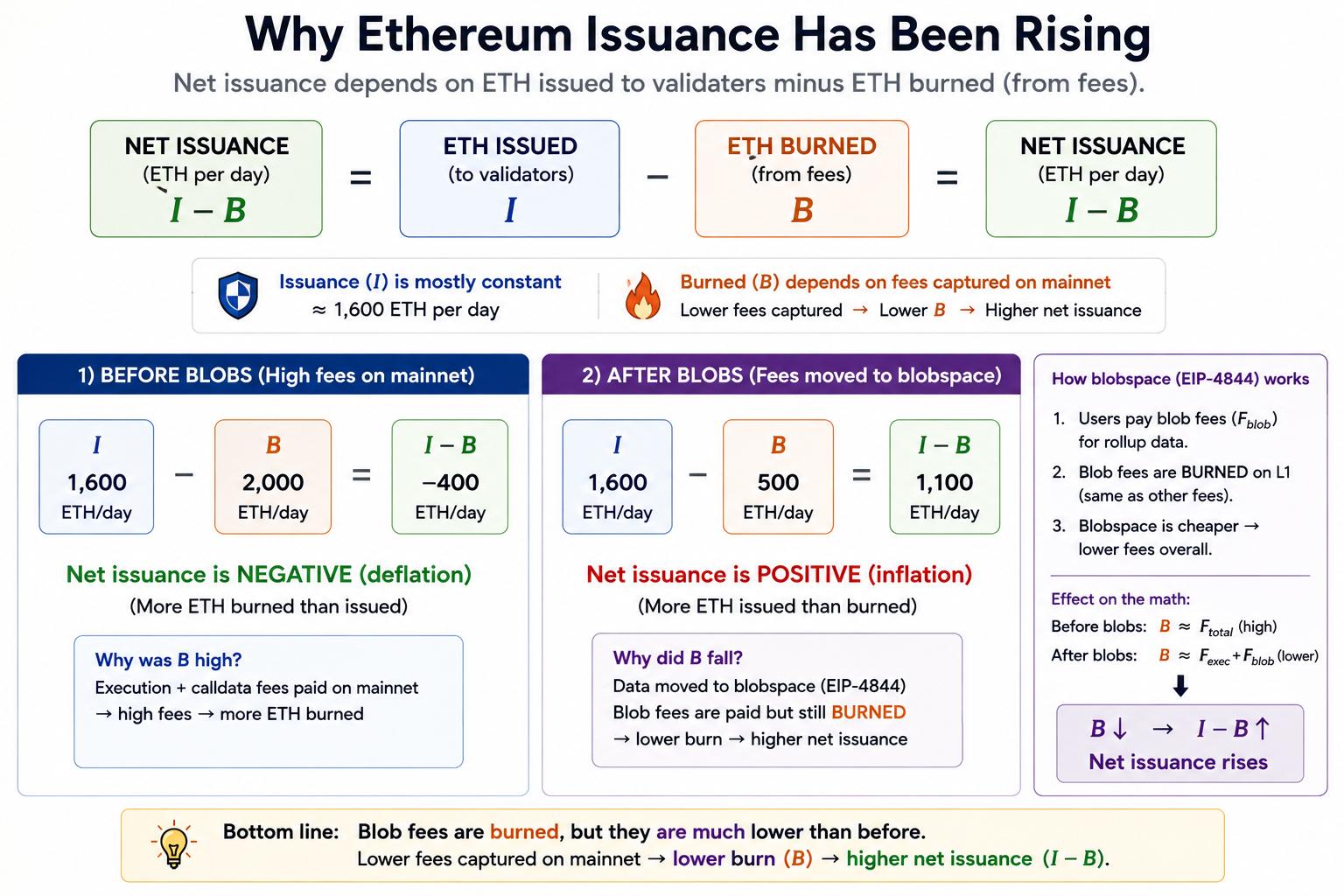
That math leads one way for net issuance/ETH inflation — upward — making Bitcoin the winner in the sound money or store-of-value race. Store-of-value-focused investors realized this change and have been pivoting back toward Bitcoin, which partly explains its outperformance against Ethereum over the past two years.
The big question now is: Can ETH make a comeback? Can it beat Bitcoin in the store-of-value race while maintaining a low-fee, scalable environment to compete with alternative Layer 1 chains?
To partly address that challenge, developers have proposed a new solution, which is causing one of the biggest divisions seen across the Ethereum community since The Merge. Enter EIP-8363.
How to solve the ETH inflationary crisis: EIP-8363 (Tapered Issuance Burn)
Championed by Jerome de Tychey, Justin Drake, Dankrad Feist and Ansgar Dietrichs, EIP-8363 aims to drastically reduce and eventually cap staking yield.
The proposal suggests a proof-of-burn mechanism that automatically burns a growing share of validator rewards as the global staking ratio approaches a threshold. The burn rate hits 100% when the staking ratio climbs above 50%, dropping new issuance to zero and leaving validators with 0% base staking rewards apart from priority fees and Maximal Extractable Value (MEV).
One of the key motives behind the proposal is to strengthen ETH's monetary status, potentially reviving its ultrasound money argument.
In the current environment, holders face dilution from growing net issuance, creating a "stake or be diluted" scenario, according to Jerome de Tychey, President of Ethereum France. He added that higher staking ratios make liquid staking tokens (LSTs) the go-to working ecosystem money for Ethereum.
"Maximal neutrality & minimal dilution: those are the two fundamentals of a store of value. This EIP not only hardens both, it sets a bar no other blockchain clears," Tychey wrote in an X post on August 4.
Apart from the monetary benefits, proponents argue that higher staking ratios could force solo stakers out of the network due to dilution and taxes on nominal yield. As a result, it concentrates supply with staking providers, large institutions and custodians, leaving the community handicapped in a worst-case scenario of a captured validator set.
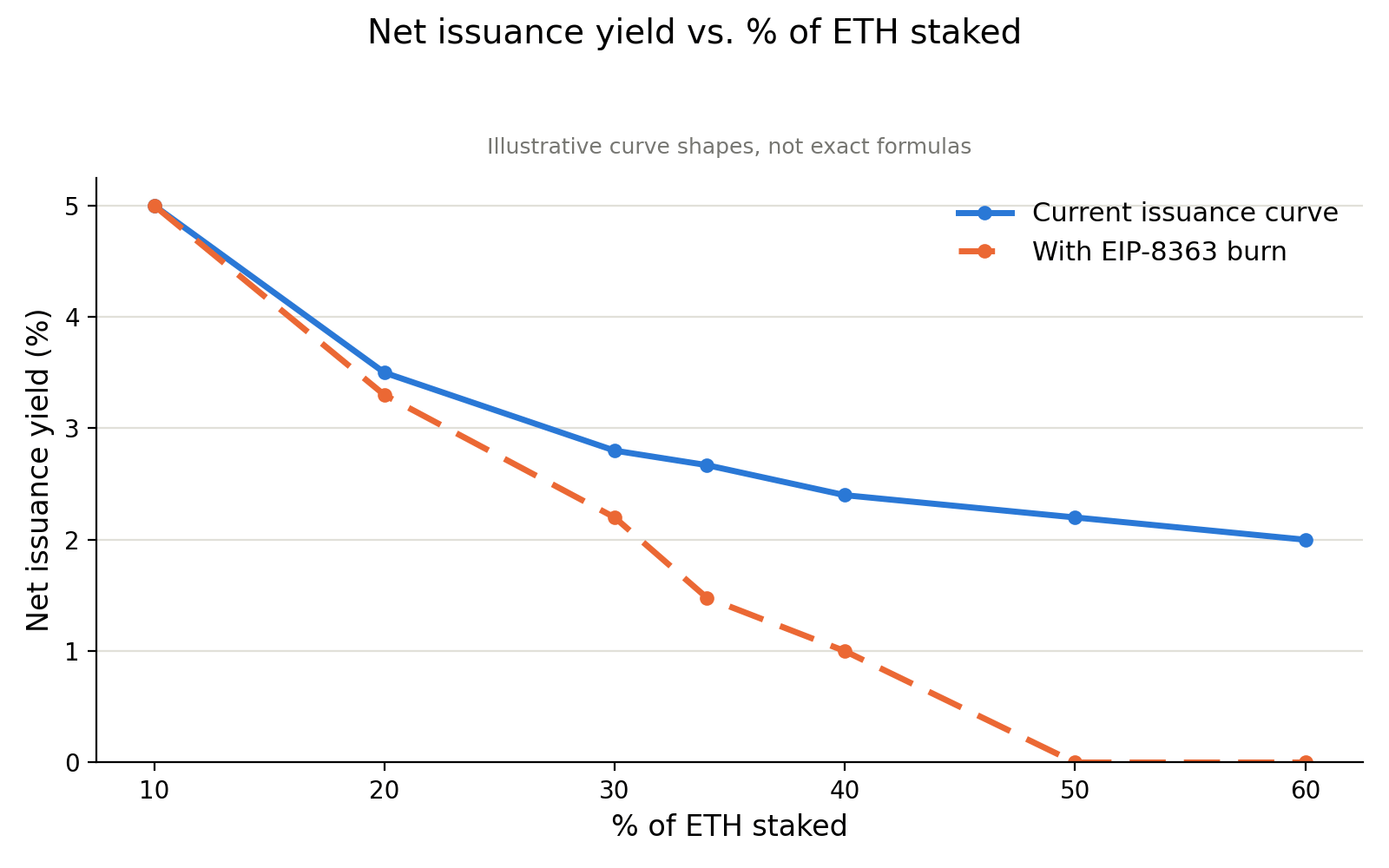
However, the proposal has caused a sharp division in the Ethereum community. Critics argue that it would destabilize decentralized finance (DeFi) — Ethereum's core use case — as a large percentage of total value locked is based on lending and restaking LSTs.
As a result, it reduces institutional demand for ETH and pushes liquidity toward alternative L1s offering higher uninterrupted staking returns.
Another source of criticism stems from the proposal's potential to hurt solo stakers. Since electricity and hardware costs are fixed, critics argue that solo stakers are likely to be priced out long before large institutions with economies of scale feel the impact.
Others faulted the timing, highlighting that such a proposal, published two days (on August 4) before the submission deadline (August 6) for Ethereum's upcoming Hegota upgrade, denies validators and the broader community months of thorough debate such a massive shift requires. It also hampers the "ETH is productive capital" narrative at a time when institutions and ETF issuers are embracing it, potentially destabilizing institutional pricing models and investor trust, critics argued.
The proposal remains in the draft stage as the community continues to debate its viability.
Conclusion
For now, issuance continues to trend upward with no immediate solution in sight.
In the long term, a few other arguments suggest that if Ethereum continues to attract demand and becomes the main settlement layer for traditional finance, overall total fees — from increased blob usage and execution layer — could push up the burn mechanism to potentially offset issuance while blobs keep average fee per user low.
Another argument is that as traditional finance moves on-chain, institutions have to ensure demand for ETH stays high to incentivize validators to continue to maintain robust security for the network, which could underpin trillions of dollars worth of TradFi products. As a result, that higher-priced ETH could offset new issuance from increased staking rewards.
But these are all based on the assumption that Ethereum will become the dominant settlement layer for TradFi. Until ETH solves its inflation crisis, it could continue remaining second best behind Bitcoin as the preferred digital asset store-of-value.
Ethereum technical outlook: ETH could bounce at $1,810 after rejection near 20-week EMA
On the weekly chart, ETH is keeping a bearish near-term bias as it remains capped beneath the 20-week Exponential Moving Average (EMA) at $1,995 and well below the 50-week and 100-week EMAs at $2,365 and $2,564, respectively.
The cluster of overhead moving averages suggests the broader trend stays under pressure. At the same time, the 14-day Relative Strength Index (RSI) and Stochastic Oscillator (Stoch) at 41 both sit in mid-range territory, hinting at weak but not extreme downside momentum as price consolidates below these trend proxies.
On the downside, immediate support emerges at the horizontal level near $1,810, ahead of a deeper floor at $1,701 and a more distant base at $1,507.
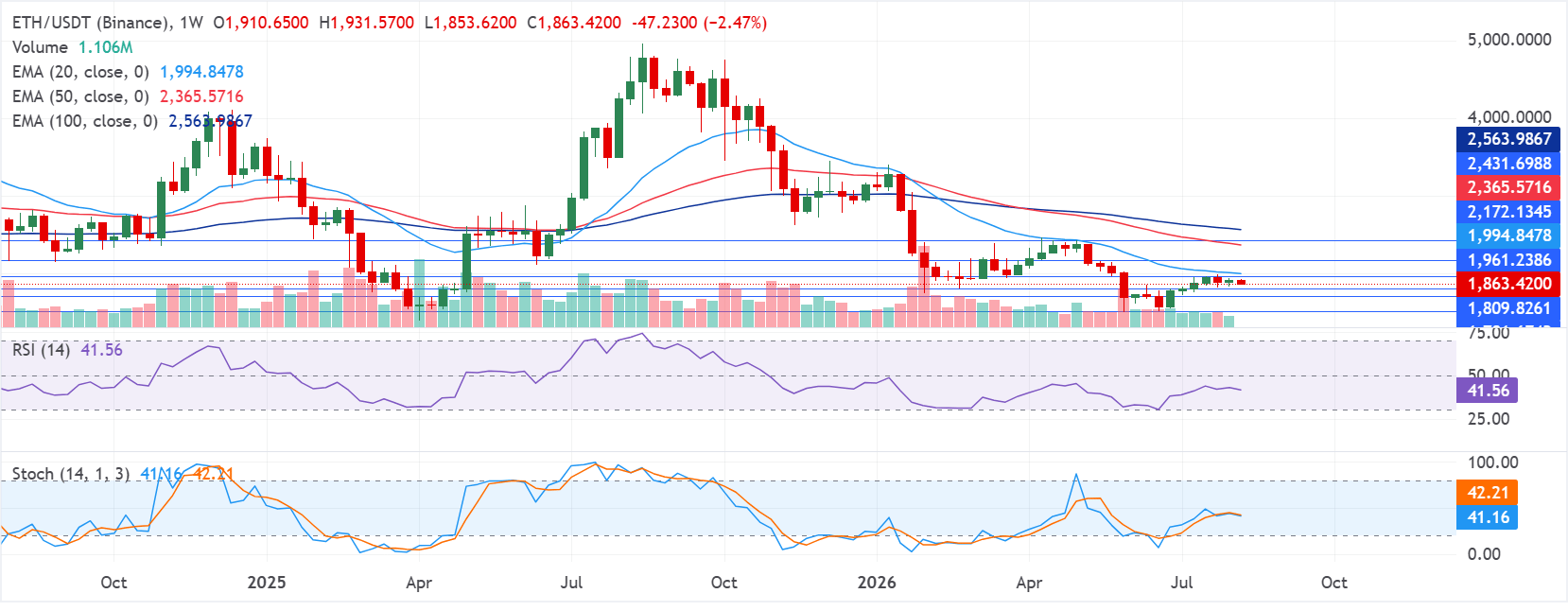
On the topside, initial resistance is seen at $1,961, followed by the 20-week EMA at $1,994. A sustained break above this area would be needed to ease selling pressure and open the way toward the next barriers at $2,172, the 50-week EMA at $2,365 and the higher horizontal cap at $2,431.
Meanwhile, the 100-week EMA at $2,564 marks a more strategic bullish threshold.
(The technical analysis of this story was written with the help of an AI tool. Know more.)
Recommended Articles


