


XRP Price Forecast: Sell-off persists, bears aim for $1.00 as Ripple eyes on-chain multi-signature upgrade
- XRP falls for a fourth consecutive day toward the crucial $1.00 level as ETF outflows weigh.
- Ripple developers propose an upgrade to target multi-signature approvals for institutions and custodians.
- XRP faces a weakening technical structure defined by overhead major moving averages and downtrending momentum indicators.
Ripple (XRP) remains pressured, trading below $1.05 at the time of writing on Thursday. The token has declined for the fourth consecutive day this week, reflecting lethargic sentiment in the broader cryptocurrency market despite the possibility of easing geopolitical tensions in the Middle East.
XRP Ledger developers propose on-chain multi-signature upgrade
The XRP Ledger (XRPL) supports multi-signature transactions that allow multiple people to authorize an account. According to Ayo Akinyele, Engineering head at RippleX, the current process ensures that a transaction is executed only when enough approvals have been collected.
Akinyele highlights a point of failure in the current process when “Someone creates the transaction, shares it with every signer, collects signatures, assembles them, and submits the final transaction.”
If that person goes offline, loses a signature, or makes a mistake, the entire process can still fail or force a do-over.
The On-Chain Cosigner proposal moves the coordination process onto the XRPL. Once the proposal has been submitted on the ledger, signers can add their approval, which is then validated by the protocol. Once the required quorum of approvals is reached, anyone can submit it.
Ripple is targeting institutions, custodians and treasury teams or even multiple organizations that may need to authorize a similar transaction.
“The proposal is also designed to complement other work in progress, including batched transactions and lending flows that require approvals from multiple parties,” Akinyele added.
XRP ETF outflows return
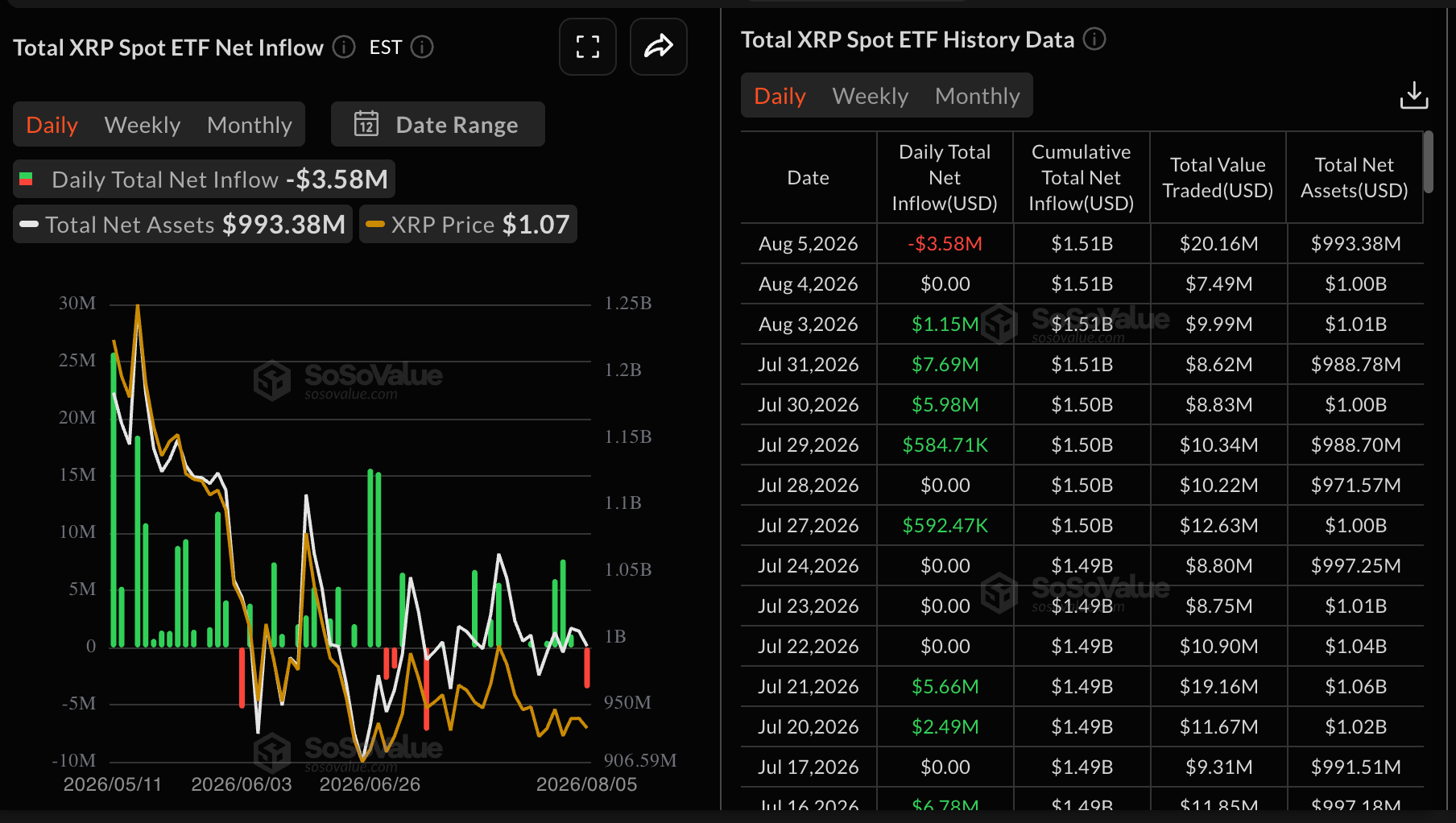
XRP spot Exchange-Traded Funds (ETFs) experienced outflows totaling $3.58 million on Wednesday, following muted activity the day before. This shows that interest in the remittance token is fading, aligning with a weakening technical outlook. In other words, investors are struggling to stay bullish as the price falls incessantly.
XRP approaches lifeline support
XRP trades around $1.05, keeping a bearish near-term tone as it remains below all key Exponential Moving Averages. The 50-day EMA at $1.11, the 100-day EMA at $1.20, and the 200-day EMA at $1.39 stack overhead as a layered resistance complex, while price also trades under the Bollinger Bands’ middle line at $1.088, reinforcing a capped structure.
Momentum stays soft, with the Relative Strength Index (RSI) hovering near 39 and the Moving Average Convergence Divergence (MACD) in negative territory, which together suggest downside pressure remains in play despite the pair approaching modest oversold conditions.
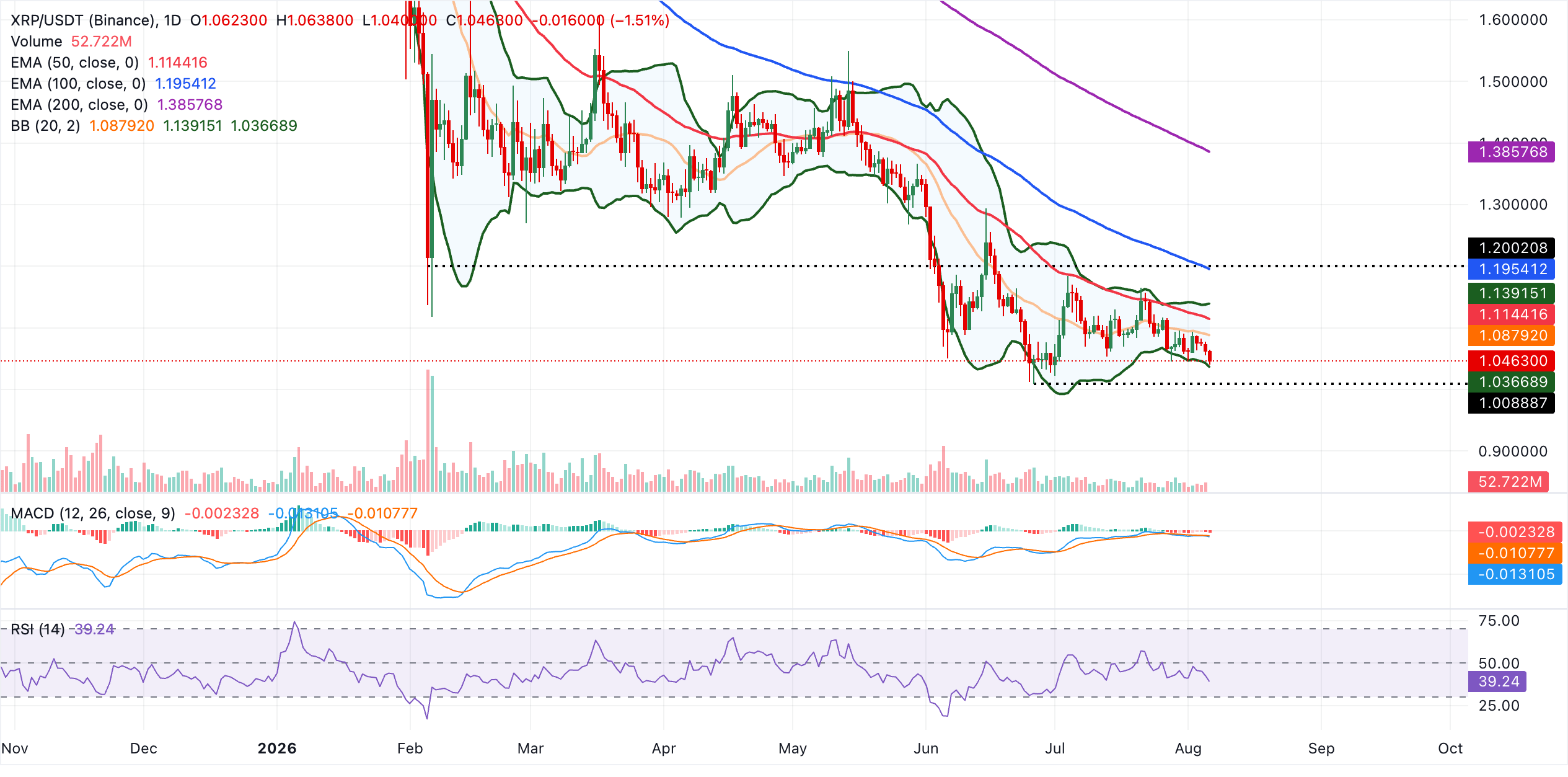
Initial resistance is seen at the Bollinger middle boundary near $1.09, followed by the 50-day EMA at $1.11 and the Bollinger upper band at $1.14, before a more substantial barrier emerges at the 100-day EMA around $1.20 and the 200-day EMA near $1.39. On the downside, immediate support appears at the Bollinger lower band around $1.04.
A decisive break below this floor would open the door for a deeper correction, while holding above it could allow the pair to attempt another test of the $1.08-$1.11 resistance cluster overhead.
(The technical analysis of this story was written with the help of an AI tool. Know more.)
Ripple FAQs
Ripple is a payments company that specializes in cross-border remittance. The company does this by leveraging blockchain technology. RippleNet is a network used for payments transfer created by Ripple Labs Inc. and is open to financial institutions worldwide. The company also leverages the XRP token.
XRP is the native token of the decentralized blockchain XRPLedger. The token is used by Ripple Labs to facilitate transactions on the XRPLedger, helping financial institutions transfer value in a borderless manner. XRP therefore facilitates trustless and instant payments on the XRPLedger chain, helping financial firms save on the cost of transacting worldwide.
XRPLedger is based on a distributed ledger technology and the blockchain using XRP to power transactions. The ledger is different from other blockchains as it has a built-in inflammatory protocol that helps fight spam and distributed denial-of-service (DDOS) attacks. The XRPL is maintained by a peer-to-peer network known as the global XRP Ledger community.
XRP uses the interledger standard. This is a blockchain protocol that aids payments across different networks. For instance, XRP’s blockchain can connect the ledgers of two or more banks. This effectively removes intermediaries and the need for centralization in the system. XRP acts as the native token of the XRPLedger blockchain engineered by Jed McCaleb, Arthur Britto and David Schwartz.
Recommended Articles


