


Aave to sunset Sonic, Aptos, zkSync, Scroll reserves, affecting $98 million in supply
- Aave plans to wind down 75 reserves across multiple deployments, affecting approximately $98.1 million in supply and $15.6 million in debt.
- Six smaller deployments, including Sonic, Scroll, Aptos and zkSync, will be fully deprecated as activities dropped below sustainable support levels.
- Aave Labs CEO Stani Kulechov says the wind-down aims to reduce operational, technical and economic risks.
Aave is planning to sunset 75 low-activity reserves across its decentralized finance (DeFi) protocol as part of a broader effort to reduce operational, technical and economic risks across its network of deployments.
In a proposal submitted on Thursday by risk service provider LlamaRisk in collaboration with Aave service providers, the firms pointed to 50 individual Aave V3 reserves and 21 matured Pendle Principal Tokens (PTs) across 11 deployments. These reserves currently hold approximately $85.3 million in supplied assets and $11.5 million in debt.
Aave to deprecate deployments across Sonic, Aptos, zkSync and Metis
The proposal also recommends the full deprecation of six smaller deployments, including Sonic (S), Scroll (SCR), zkSync (ZK), Metis (METIS), Soneium and Aptos (APT).
These markets contain another 25 reserves with approximately $12.8 million in supply and $4.1 million in debt. Sonic leads the pack with $7.6 million, followed by Scroll with $2.2 million, Aptos with $1.7 million, zkSync with $800,000, Metis with $300,000 and Soneium with $200,000.
Combined, the deprecations across Aave's reserves affect roughly $98.1 million in supply and $15.6 million in debt.
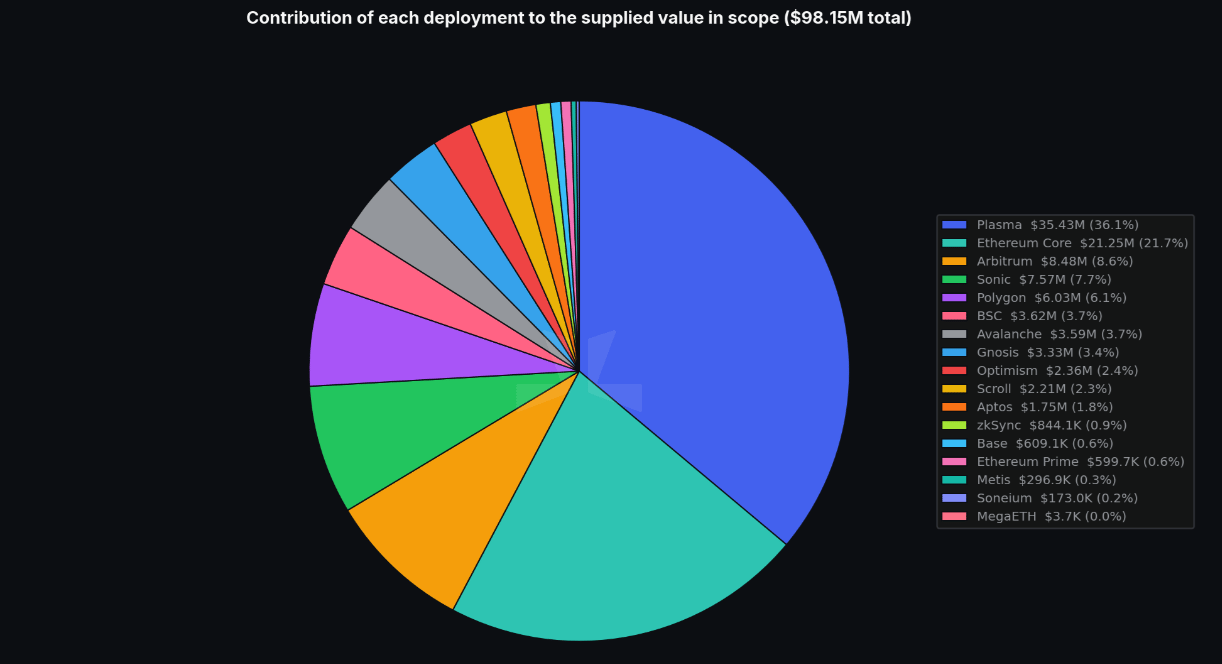
Aave noted that the aggregate activity on the six networks had declined to a point where the revenue generated no longer justified the cost of supporting them.
The proposal targets a range of assets across Aave's deployments, including USDC.e, DAI, UNI and CRV, alongside assets on Polygon and other networks. The removals are part of Aave's broader effort to streamline its reserve portfolio and reduce the operational costs and risks associated with supporting low-adoption assets.
The wind-down process will allow users to exit positions in an orderly manner while reducing the risk of liquidations. The approach involves freezing each reserve, which prevents new supply, borrowing and the use of the assets as fresh collateral. Supply and borrow caps will also be reduced to one.
For reserves with outstanding borrowing, the reserve factor is increased to encourage borrowers to repay their positions and suppliers to withdraw their assets. As liquidity leaves the market, utilization is expected to rise, creating additional incentives for borrowers to close their positions.
Kulechov says wind-down is not a negative view of affected chains
Aave CEO Stani Kulechov stated that the decision should not be viewed as a negative assessment of any individual Layer 1 or Layer 2 network.
“The goal is simply to reduce Aave's operational, technical, and economic risk surface so we can focus on higher-impact priorities such as growing existing high-value markets and expanding to securities finance,” Kulechov wrote on X.
He added that Layer 2 networks remain important to Ethereum's user experience, while networks such as Avalanche continue to support the growth of real-world assets on-chain.
AAVE is trading at $99.2, up 1% over the past 24 hours at the time of writing.
Recommended Articles


