


Gold eases amid firm US Dollar as CPI and Hormuz risks loom
- Gold edges lower as a firm US Dollar caps upside momentum.
- US CPI and PPI data could reshape Fed hike bets.
- Hormuz uncertainty keeps energy prices elevated, limiting bullion gains.
Gold (XAU/USD) price registers modest losses on Tuesday, driven by a firm US Dollar as traders await the release of crucial US inflation data and the potential reopening of the Strait of Hormuz. The rise in energy prices is also capping the yellow metal´s advance. At the time of writing, the XAU/USD pair trades at $4,381, down 0.18% in the day after hitting a daily high of $4,435.
XAU/USD eases near $4,380 as traders await US inflation data and monitor elevated energy-price risks
So far, the economic docket has remained scarce, despite the release of the ADP Employment Change 4-week average, which showed that the labor market is decelerating, coming at 8.25K jobs created, while the previous print was downward revised by 4K to 11K.
Other data, mostly ignored by markets awaiting US inflation, showed that Existing Home Sales fell further in July, by 1.7%, from 4.13 million to 4.06 million. The report stated that higher mortgage rates due to the Middle East conflict and higher house prices are capping home sales. 30-year fixed-rate mortgage rates have risen by over 71 basis points since the beginning of the US-Iran conflict, and are now at 6.69%.
On Wednesday, the US economic schedule will feature the release of the US Consumer Price Index (CPI), with analysts expecting July's headline inflation to be 3.4% YoY, a tenth lower than June. Core CPI is also projected to decrease by the same margin to 2.5% YoY.
A day after the US CPI, traders will turn to the release of the US Producer Price Index (PPI) and jobless claims, the first of which follows a disappointing July Nonfarm Payrolls report.
Chicago Federal Reserve (Fed) President Austan Goolsbee said the economy's biggest problem is inflation, not the collapse of industry and jobs. He reiterated that “prices have been rising too fast, we have an inflation problem, and people hate inflation.”
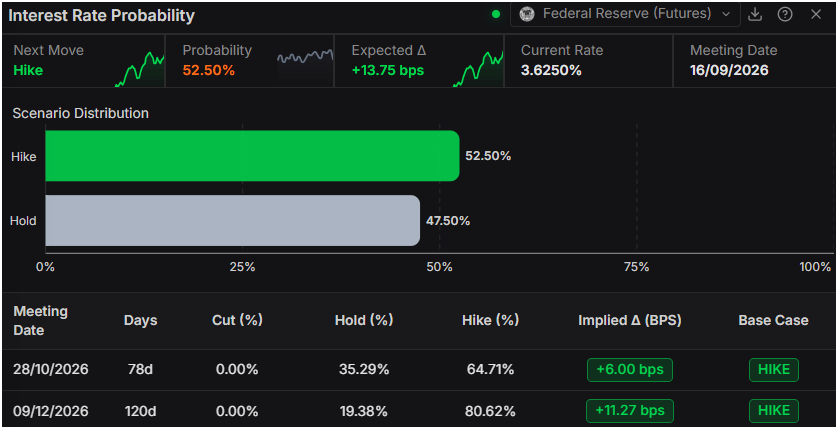
Money markets are still adjusting their forecasts for a Fed rate hike in September, with a 52% probability of a 25-basis-point increase, based on Prime Terminal data.
In the meantime, the US Dollar Index (DXY), which tracks the performance of the buck’s value against a basket of six currencies, holds steady at 99.82, unchanged. So far, US Treasury yields, which usually correlate inversely to Gold prices, are also down two basis points, at 4.687%.
Regarding geopolitics, the Secretary of the Supreme National Security Council of Iran commented that the Strait of Hormuz will not open until the US changes its behaviour and accepts Tehran’s conditions.
XAU/USD price forecast: Gold struggles as 100-day SMA, poised for sideways trading
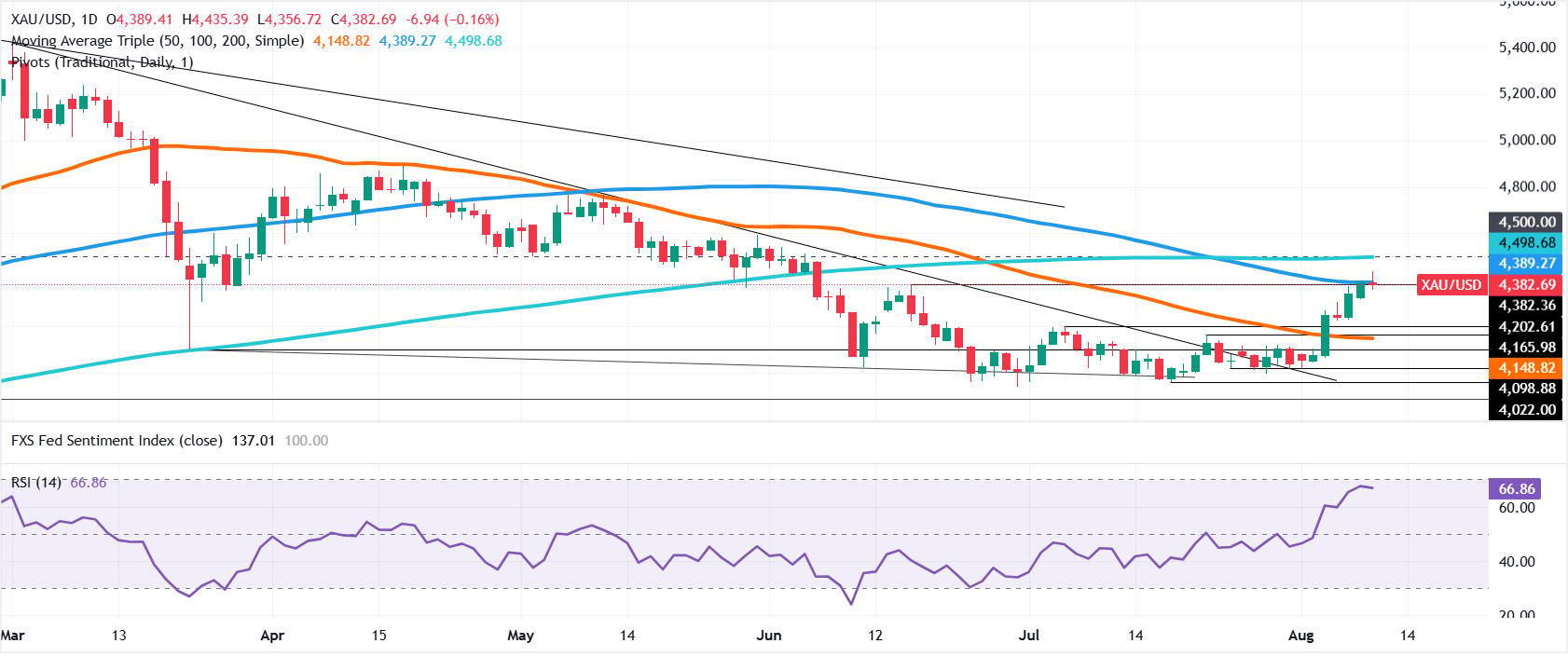
Gold price seems to be consolidating after two bullish days, pushing the yellow metal above the $4,350 area. Momentum, although bullish as indicated by the Relative Strength Index (RSI), has stalled somewhat, suggesting XAU might trade sideways in the short term.
For a bullish resumption, Gold must clear the 100-day Simple Moving Average (SMA) at $4,389. Once done, the next stop is the $4,400 psychological level, followed by the 200-day SMA at $4,498 and the $4,500 milestone.
On the downside, initial support is at the July 6 high, now at $4,202. If this level fails, the next support levels are the 50-day SMA at $4,150 and $4,100
Gold FAQs
Gold has played a key role in human’s history as it has been widely used as a store of value and medium of exchange. Currently, apart from its shine and usage for jewelry, the precious metal is widely seen as a safe-haven asset, meaning that it is considered a good investment during turbulent times. Gold is also widely seen as a hedge against inflation and against depreciating currencies as it doesn’t rely on any specific issuer or government.
Central banks are the biggest Gold holders. In their aim to support their currencies in turbulent times, central banks tend to diversify their reserves and buy Gold to improve the perceived strength of the economy and the currency. High Gold reserves can be a source of trust for a country’s solvency. Central banks added 1,136 tonnes of Gold worth around $70 billion to their reserves in 2022, according to data from the World Gold Council. This is the highest yearly purchase since records began. Central banks from emerging economies such as China, India and Turkey are quickly increasing their Gold reserves.
Gold has an inverse correlation with the US Dollar and US Treasuries, which are both major reserve and safe-haven assets. When the Dollar depreciates, Gold tends to rise, enabling investors and central banks to diversify their assets in turbulent times. Gold is also inversely correlated with risk assets. A rally in the stock market tends to weaken Gold price, while sell-offs in riskier markets tend to favor the precious metal.
The price can move due to a wide range of factors. Geopolitical instability or fears of a deep recession can quickly make Gold price escalate due to its safe-haven status. As a yield-less asset, Gold tends to rise with lower interest rates, while higher cost of money usually weighs down on the yellow metal. Still, most moves depend on how the US Dollar (USD) behaves as the asset is priced in dollars (XAU/USD). A strong Dollar tends to keep the price of Gold controlled, whereas a weaker Dollar is likely to push Gold prices up.
Recommended Articles


