


Australian Dollar pulls back as inflation expectations loom
- AUD/USD slips as softer US CPI fails to sustain gains
- Fed hold bets rise, but energy risks threaten disinflation
- RBA inflation expectations could reshape September rate outlook.
The Aussie Dollar ended Wednesday’s session with losses against the Greenback as US inflation data matched estimates, in both headline and core. Consequently, traders pushed back against rate hikes, though the AUD/USD faded the initial move and traded at 0.7061, down 0.07%.
AUD/USD slips as traders digest US CPI, RBA guidance and inflation-expectations data
The US annual inflation rate in July eased from 3.5% to 3.4%, with the underlying figures also easing. The core print came at 2.5%, a tenth below June’s number, an indication that the disinflation process continued for two straight readings.
After the data, money markets adjusted quickly, increasing dovish bets for the September meeting and shifting from a 60% rate-hike expectation to a 60% hold, according to Prime Terminal. Nevertheless, Fed dovish members are not out of the woods. A prolonged US-Iran war could reignite a rally in energy prices, exerting upward pressure on inflation.
In Australia, the economic docket will feature the release of Consumer Inflation Expectations for August, with the previous print being 4.7%. A reading above could put pressure on the Reserve Bank of Australia to increase rates, which held rates unchanged at 4.40% at the August 11 meeting.
The RBA struck markets with a mixed tone in its statement, with inflation projections seen lower, near the RBA’s goal, while recognizing that “inflation remains elevated and risks are skewed to the upside.”
At the press conference, RBA’s Governor Michelle Bullock said that “the board discussed raising interest rates.”
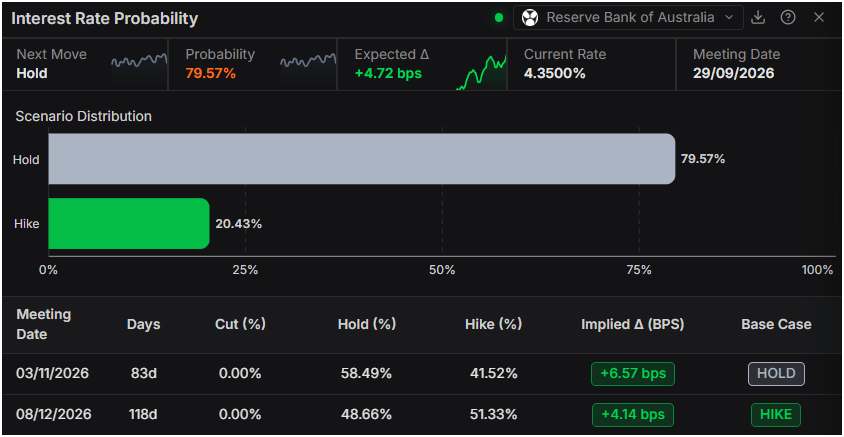
Despite this, for the September 29 meeting, the RBA is expected to hold rates unchanged, with odds at 79%, while a 25-basis-point hike is at 21%, according to Prime Terminal.
AUD/USD Price Forecast: Technical outlook
In the daily chart, AUD/USD trades at 0.7061, holding a mildly bullish near-term bias as it remains above the latest simple moving average in the Moving Average Triple at 0.6992 and over short-term trend-line support near 0.6953. Price also sits comfortably above the older break level at 0.6403, while the Relative Strength Index (14) at about 59 leans positively without yet reaching overbought territory, suggesting constructive but not euphoric upside momentum.
On the downside, initial support is seen at the recent breakout area around 0.6992, followed by firmer protection at the short-term rising trend-line break near 0.6953 and then deeper structural support toward 0.6403. On the topside, bulls face progressive resistance from clustered rising trend-line breaks, with the first barrier emerging around 0.7274, ahead of 0.7294, while more distant upside targets align with higher trend-line projections near 0.8377 and 0.9068.
(The technical analysis of this story was written with the help of an AI tool. Know more.)
Australian Dollar FAQs
One of the most significant factors for the Australian Dollar (AUD) is the level of interest rates set by the Reserve Bank of Australia (RBA). Because Australia is a resource-rich country another key driver is the price of its biggest export, Iron Ore. The health of the Chinese economy, its largest trading partner, is a factor, as well as inflation in Australia, its growth rate and Trade Balance. Market sentiment – whether investors are taking on more risky assets (risk-on) or seeking safe-havens (risk-off) – is also a factor, with risk-on positive for AUD.
The Reserve Bank of Australia (RBA) influences the Australian Dollar (AUD) by setting the level of interest rates that Australian banks can lend to each other. This influences the level of interest rates in the economy as a whole. The main goal of the RBA is to maintain a stable inflation rate of 2-3% by adjusting interest rates up or down. Relatively high interest rates compared to other major central banks support the AUD, and the opposite for relatively low. The RBA can also use quantitative easing and tightening to influence credit conditions, with the former AUD-negative and the latter AUD-positive.
China is Australia’s largest trading partner so the health of the Chinese economy is a major influence on the value of the Australian Dollar (AUD). When the Chinese economy is doing well it purchases more raw materials, goods and services from Australia, lifting demand for the AUD, and pushing up its value. The opposite is the case when the Chinese economy is not growing as fast as expected. Positive or negative surprises in Chinese growth data, therefore, often have a direct impact on the Australian Dollar and its pairs.
Iron Ore is Australia’s largest export, accounting for $118 billion a year according to data from 2021, with China as its primary destination. The price of Iron Ore, therefore, can be a driver of the Australian Dollar. Generally, if the price of Iron Ore rises, AUD also goes up, as aggregate demand for the currency increases. The opposite is the case if the price of Iron Ore falls. Higher Iron Ore prices also tend to result in a greater likelihood of a positive Trade Balance for Australia, which is also positive of the AUD.
The Trade Balance, which is the difference between what a country earns from its exports versus what it pays for its imports, is another factor that can influence the value of the Australian Dollar. If Australia produces highly sought after exports, then its currency will gain in value purely from the surplus demand created from foreign buyers seeking to purchase its exports versus what it spends to purchase imports. Therefore, a positive net Trade Balance strengthens the AUD, with the opposite effect if the Trade Balance is negative.
Recommended Articles


