


Gold, silver and platinum started 2026 at record highs and then lost much of their value as US interest rates rose and the dollar strengthened. For investors, the key question is whether the sell-off has created a buying opportunity or whether prices have further to fall.
This guide reviews how the three metals moved in 2026, the forces that will shape their prices, the outlook for each metal through 2027 and how to build a position in stages.
How Have Gold, Silver and Platinum Prices Moved in 2026?
All three metals hit record highs in late January 2026 and then gave back most of their gains. The table compares each peak with the closing price on November 20, 2026.
The year can be split into four phases:
🔹Record rally (January): Safe-haven buying and strong investor demand lifted gold above $5,000 for the first time, while silver and platinum also set all-time highs.
🔹Sharp correction (February to March): Silver and platinum fell hard in early February. Gold made a second attempt near $5,400 in early March, then fell more than 10% that month, its biggest monthly drop since June 2013.
🔹Choppy trading (April to August): Gold swung between about $4,000 and $4,800, while silver slid from near $90 in May to below $60 by July. A rebound in August lifted gold back near $4,700.
🔹Rate-hike sell-off (September to November): The Federal Reserve raised rates on September 16, 2026, its first increase since July 2023. Selling deepened in November as markets priced in another hike. In the week to November 20, gold lost almost 9% and platinum about 13%.
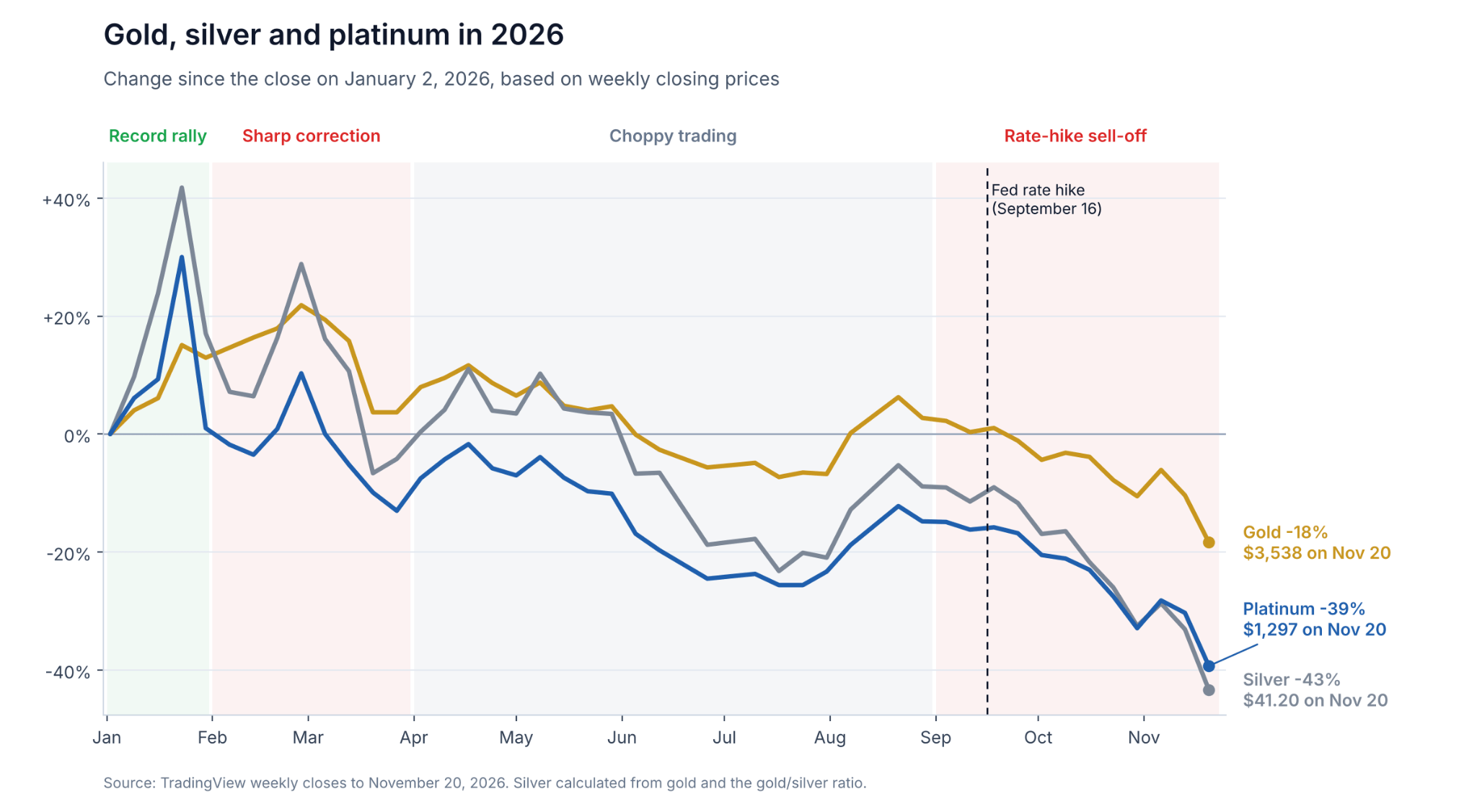
Gold, silver and platinum price changes in 2026, based on weekly closes. Source: TradingView.
The Four Core Macro Drivers Determining the Long-Term Trajectory of Precious Metals
Four forces will decide whether precious metals recover in 2027 or stay under pressure. Interest rates and the dollar hit all three metals at once, while demand, economic growth and safe-haven buying explain why silver and platinum often move differently from gold.
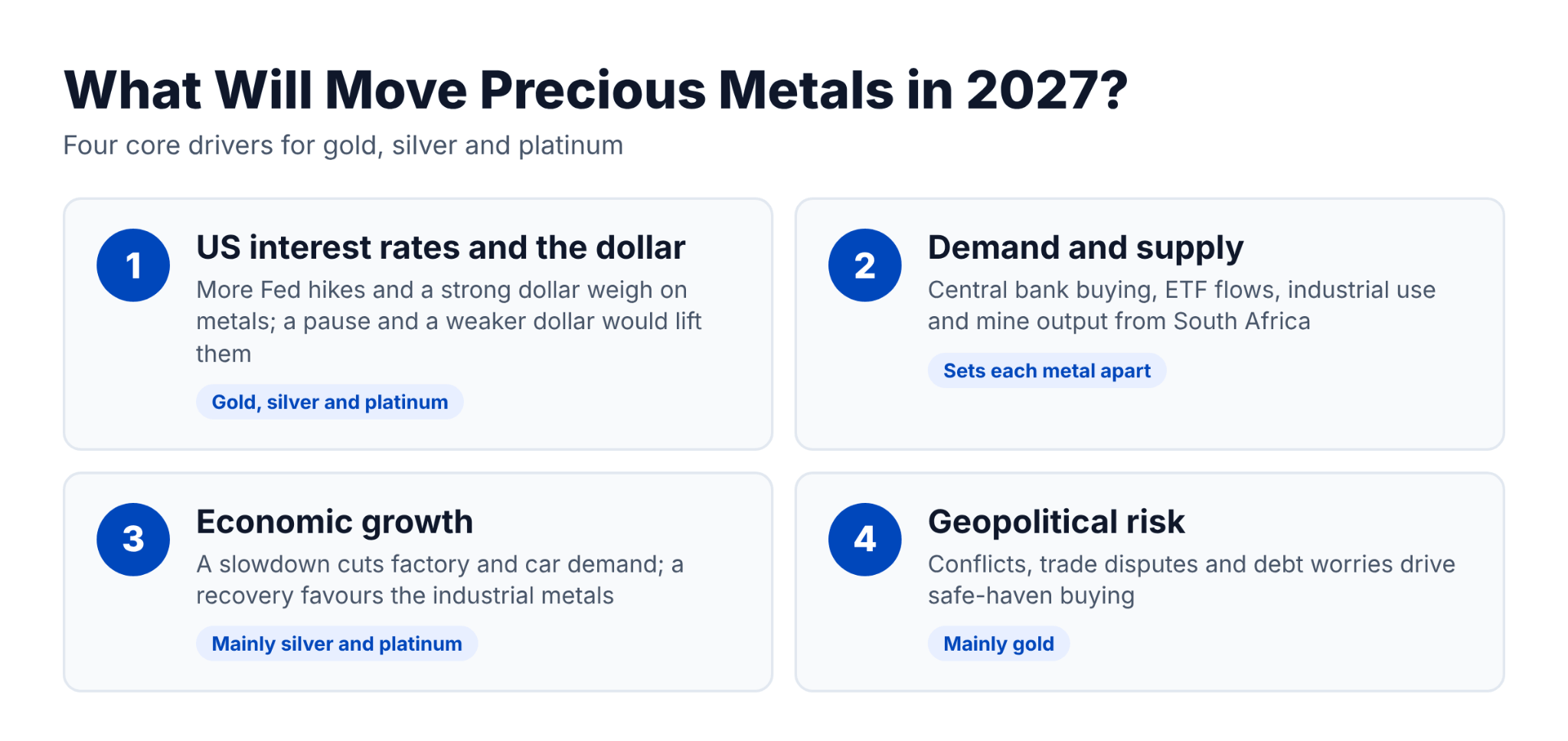
Four core drivers of gold, silver and platinum prices in 2027.
1 US interest rates and the dollar: Metals pay no interest and are priced in dollars, so higher rates and a stronger dollar both weigh on them. The Fed held its target range at 3.75% to 4.00% on October 28, 2026, but two members voted for a hike, and by November 20 the CME FedWatch tool priced a 99.3% chance of a December increase, while the dollar traded near a 19-month high. A clear pause in rate hikes and a weaker dollar would remove the main headwind for all three metals.
2 Demand and supply: Central banks bought 321 tonnes of gold in the third quarter of 2026, up 42% from a year earlier, and gold ETFs added 211 tonnes, but demand for bars, coins and jewellery fell sharply and platinum investors sold heavily. Silver has been in deficit for five straight years, with a shortfall of 46.3 million ounces in 2025, according to the Silver Institute, while platinum depends on car makers, glass and electronics producers and on mine output from South Africa. A return of investment buying would be the fastest route to a recovery.
3 Economic growth: Silver and platinum are used mainly in industry, so they depend more on the health of the global economy than gold does. A slowdown or recession in 2027 would cut demand from factories and car makers and keep both metals under pressure, while gold would likely hold up better. Steady growth combined with lower rates would favour silver and platinum, which tend to rise faster than gold in a recovery.
4 Geopolitical risk and safe-haven demand: Gold is the main safe haven among the three metals. Conflicts, trade disputes and worries about government debt tend to push investors towards gold, as safe-haven buying did during the record rally in January 2026. Rising tensions in 2027 would support gold first, while calmer conditions would remove part of that support and leave prices more dependent on interest rates.
Gold Forecast for 2026-2027
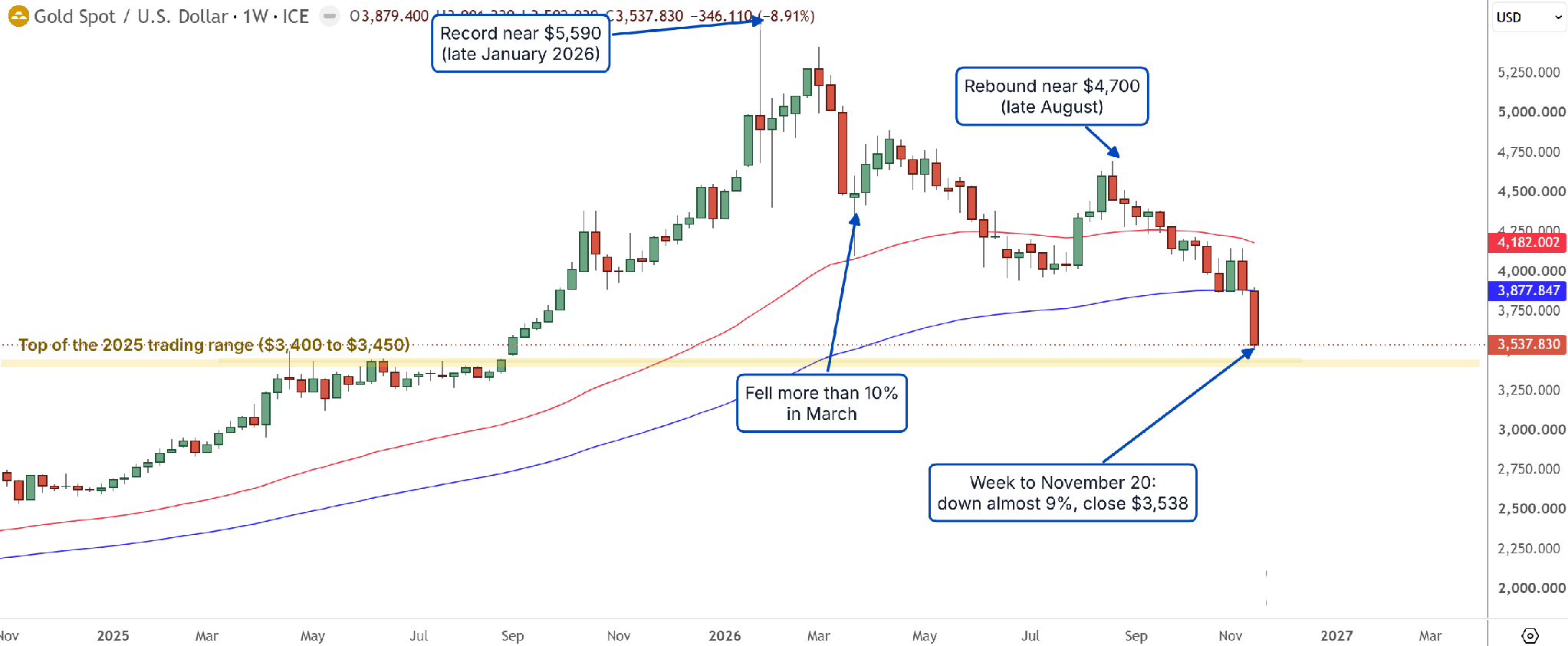
Gold weekly chart, November 2024 to November 2026. Source: TradingView.
Gold faces pressure into early 2027 as the Fed keeps raising rates, but most banks still expect a recovery later in the year. Their targets were cut in November 2026, yet remain well above the market price:
Strong central bank buying gives gold a firmer floor than silver or platinum. The main risk is a longer run of rate hikes, which would delay any recovery. The scenarios below are analytical ranges, not institutional forecasts:
Silver Forecast for 2026-2027
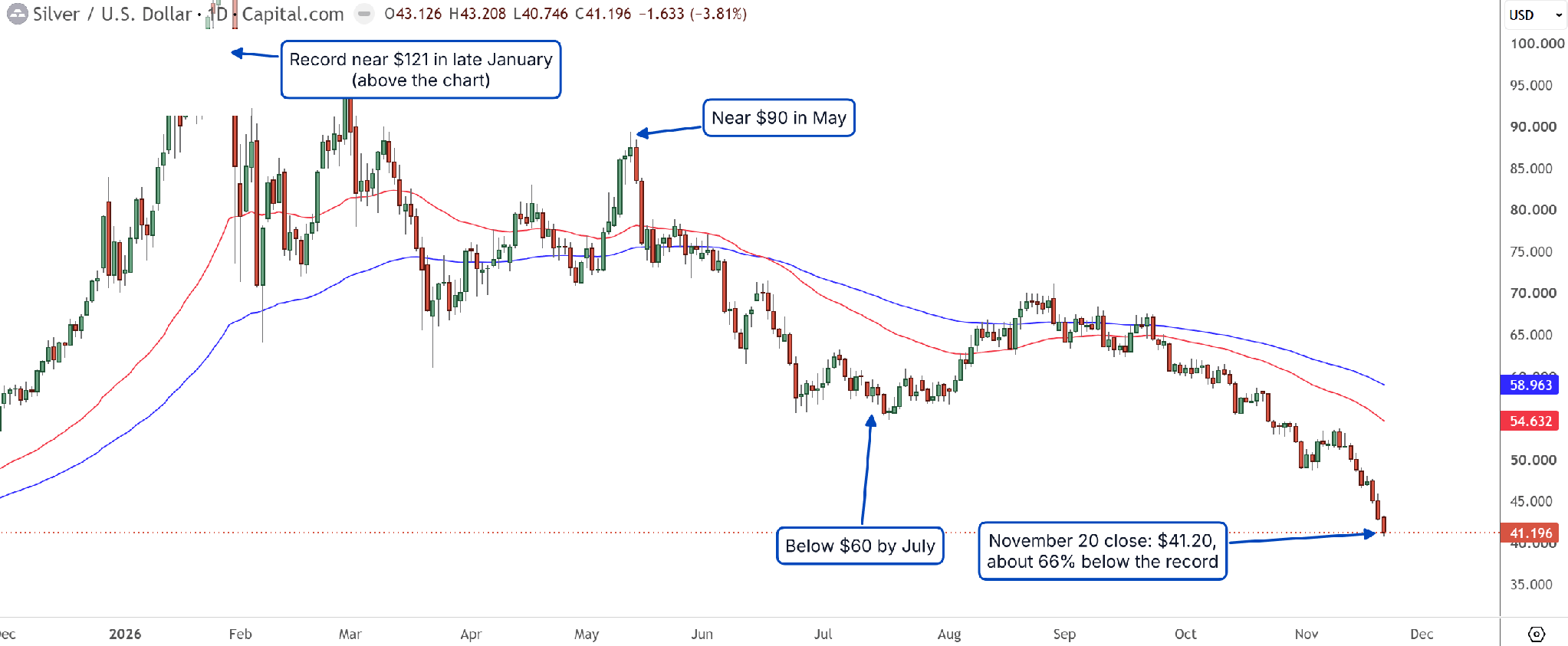
Silver daily chart, December 2025 to November 2026. Source: TradingView.
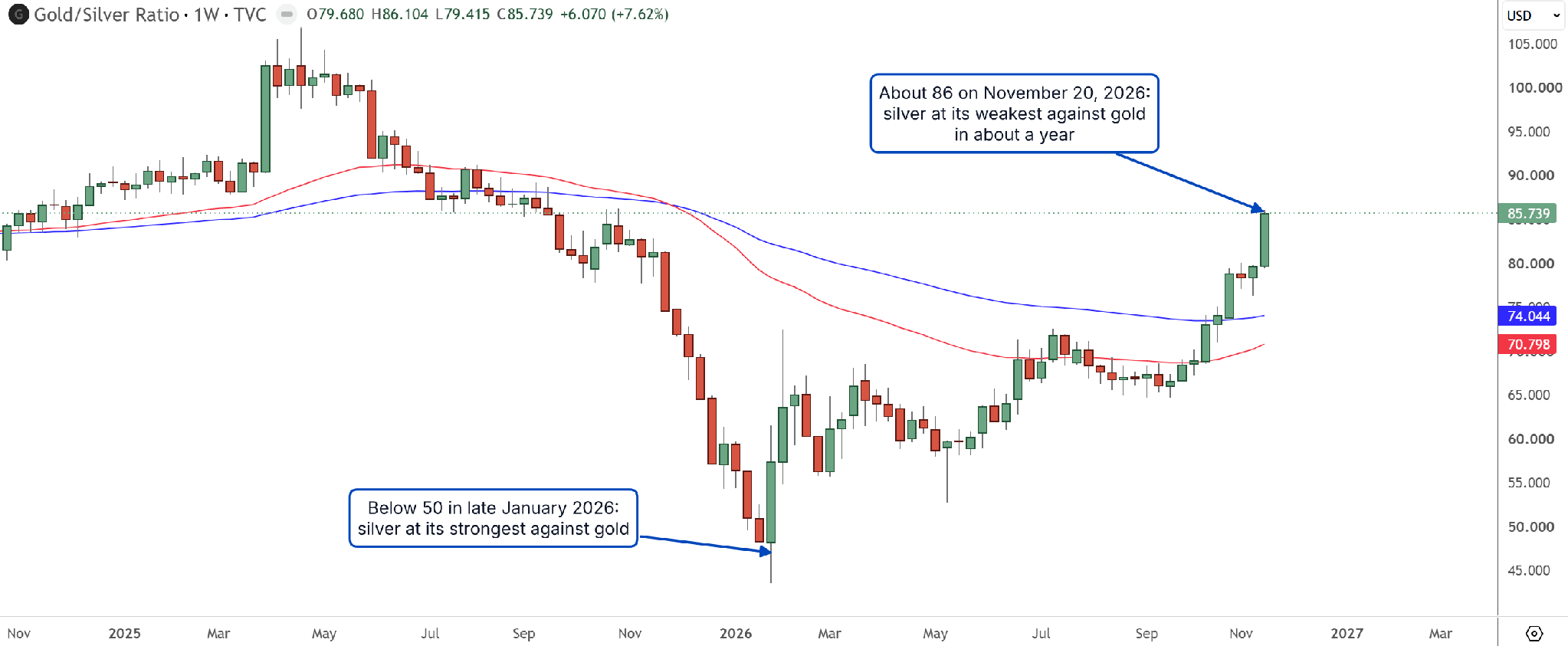
Gold/silver ratio weekly chart, November 2024 to November 2026. Source: TradingView.
Silver fell much harder than gold because it is both a precious and an industrial metal. Fears of a slowing economy, including a technology-led stock market slide in which the Nasdaq lost about 10% in the week to November 20, hit silver from both sides. The gold/silver ratio, which shows how many ounces of silver buy one ounce of gold, rose from below 50 in late January to about 86 on November 20, 2026. That leaves silver cheap relative to gold by the standards of the past two years.
Bank forecasts were set before the November sell-off and sit far above the market price:
The supply deficit supports silver over the long term, but weaker solar demand and a slowing economy could keep prices low in the coming months. The analytical scenarios for silver are:
Platinum Forecast for 2026-2027
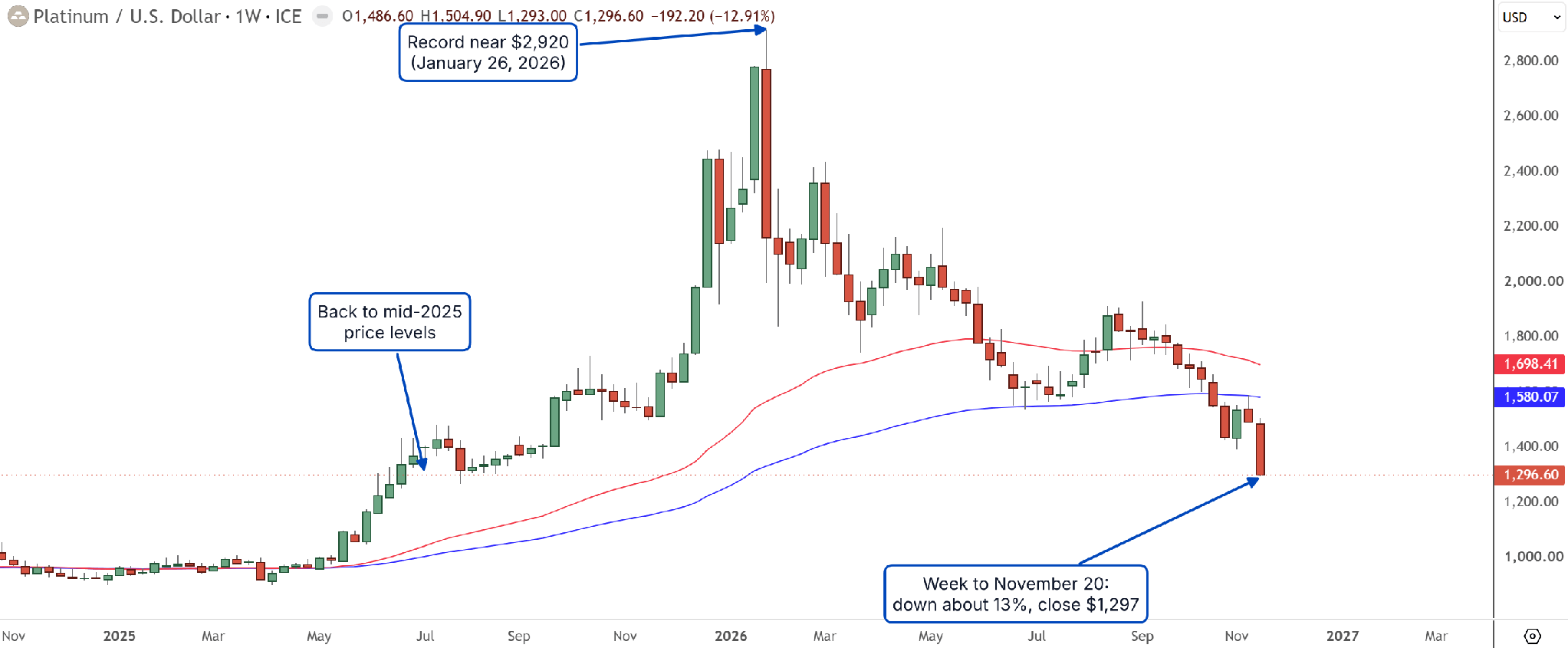
Platinum weekly chart, November 2024 to November 2026. Source: TradingView.
Platinum was down about 30% for the year by November 18, 2026, heading for its biggest annual fall since 2008, and it closed the week to November 20 near $1,300. The World Platinum Investment Council (WPIC) expects the market to swing from a surplus in 2026 to a deficit in 2027:
Mine supply is also expected to fall 1% in 2027 to 5.57 million oz, as weaker South African output is only partly offset by Zimbabwe. Even so, the 2027 deficit depends heavily on investors returning, so it is less certain than the surplus. Gradual losses in car demand as electric vehicles spread, weak jewellery buying in China and higher recycling are the main risks. The analytical scenarios for platinum are:
Gold vs. Silver vs. Platinum: Which Has the Best Upside and Fit for 2026–2027?
Each metal plays a different role, so the answer depends on what an investor needs from the position.
Between 2026 and 2027, Which Has the Greatest Upside Potential: Gold, Silver, or Platinum?
Silver and platinum have the most upside in a recovery because they fell the furthest, while gold offers the steadiest path:
Upside is measured from the November 20, 2026 closes of about $3,540 for gold, $41 for silver and $1,300 for platinum. Silver and platinum usually fall further than gold in a sell-off and rise faster in a recovery, so they suit traders who can accept larger swings.
Each metal suits a different type of investor: ★ Gold for conservative investors: Suits those who want a stable store of value and a hedge against market stress, with smaller swings than silver or platinum. ★ Silver for risk-tolerant traders: Suits those seeking the highest potential gains in a recovery who can accept sharp moves in both directions. ★ Platinum for patient value investors: Suits those who expect the 2027 deficit to lift prices and can hold a smaller, higher-risk position while they wait. |
Suggested Asset Allocation Ratios for Different Risk Preferences
Investors who hold precious metals as part of a wider portfolio often split that share between the three metals according to how much volatility they can accept. The example splits below show how the mix changes with risk preference:
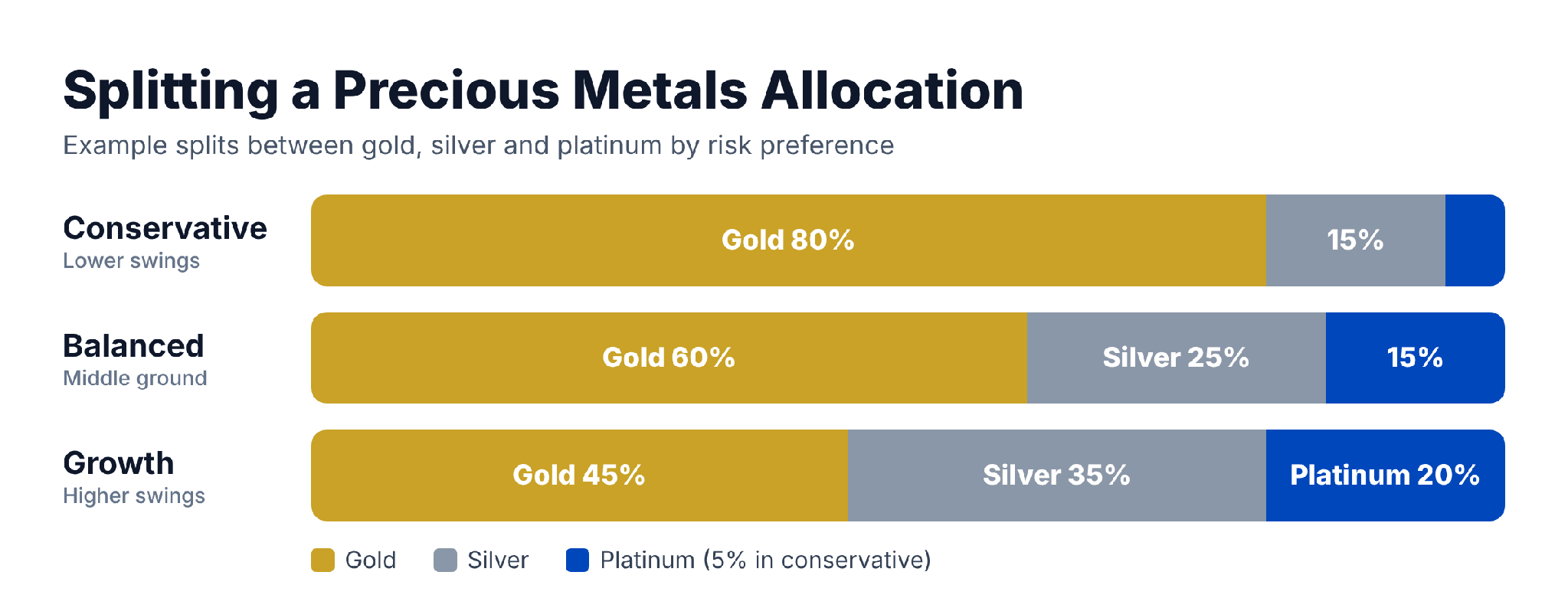
Example splits of a precious metals allocation by risk preference.
Example splits of a precious metals allocation by risk preference. ★ Conservative: 80% gold, 15% silver and 5% platinum. Gold's central bank support and lower volatility keep swings small. ★ Balanced: 60% gold, 25% silver and 15% platinum. More exposure to the metals with the largest recovery potential. ★ Growth: 45% gold, 35% silver and 20% platinum. Suits investors who accept sharp swings in exchange for higher potential returns. |
These splits are examples only, not recommendations, and should be reviewed against personal goals and time frames.
Is It a Good Time to Buy Gold, Silver or Platinum? How to Build a Position in Stages
Prices have fallen a long way, but further Fed rate hikes could push them lower before a recovery. Buying in three stages lowers the risk of investing everything at the wrong moment:
✅Long-term investors: Can use the three stages to build a position over several months, adding more only if the reason for holding metals still applies.
✅Short-term traders: Can use CFDs to trade price swings in either direction, with small position sizes and a stop-loss on every trade, as volatility is high. Waiting for the Fed's next rate decision before adding to a position can reduce the risk of a sharp move against it.
✅Cautious investors: Can wait for Stage 3, which means paying a higher price in exchange for confirmation that the downtrend has ended.
The reference prices are based on closing prices on November 20, 2026 of about $3,540 for gold, $41 for silver and $1,300 for platinum. They are a guide only, not a recommendation.

How to Trade Gold, Silver and Platinum on Mitrade?
Mitrade Financial Services LLC is authorised and regulated by the UAE Capital Market Authority. Through CFDs, traders can take positions on gold (XAUUSD), silver (XAGUSD) and platinum (XPTUSD) as prices rise or fall, without storing physical metal. For physical buying options, see the guide on how to invest in gold in the UAE.
Why to Choose Mitrade?
✅Zero commission and competitive spreads: No commission is charged on trades.
✅Low minimum deposit: Start from $50, with deposits and withdrawals in US dollars or dirhams through local banks.
✅$50,000 demo account: Practise with virtual funds before trading real money.
✅Risk management tools: Stop-loss, take-profit and trailing stop orders, plus negative balance protection.
✅Local support: Customer support is available 24/5 in Arabic and English.
3 Simple Steps to Trade on Mitrade
Step 1. Register and verify: Sign up on the website or app, complete identity verification and answer a short questionnaire about your trading experience.
Step 2. Deposit funds: Add from $50 in US dollars or dirhams, or start with the demo account.
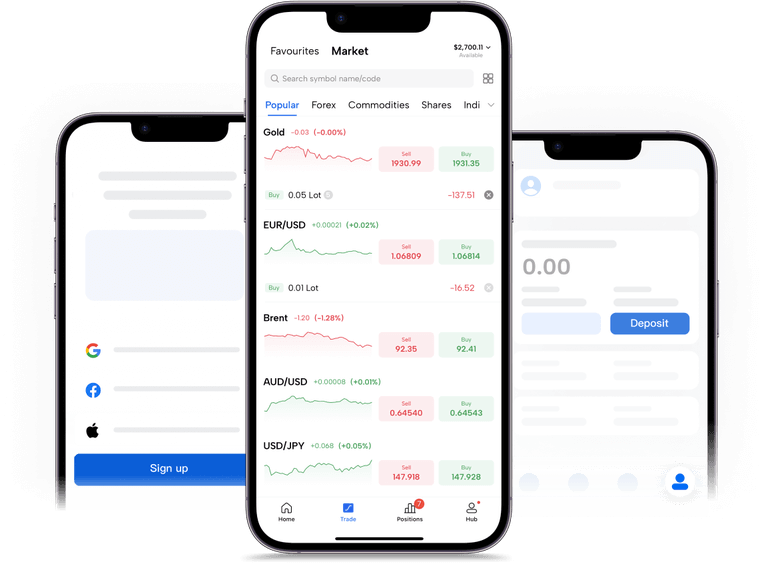
Step 3. Start trading: Search for XAUUSD, XAGUSD or XPTUSD, choose buy or sell, set the position size and add a stop-loss and take-profit before opening the trade.

Conclusion
Gold, silver and platinum lost between about 37% and 66% of their value from their January 2026 records as US interest rates rose and the dollar strengthened. Gold has the firmest support thanks to central bank buying, silver has the most room to recover if industrial demand holds up, and platinum's outlook rests on investors returning in 2027.
A practical approach is to build positions in stages rather than all at once. Traders can use CFDs on Mitrade to trade gold, silver and platinum in both directions: going long to benefit from a recovery, going short if prices keep falling, or hedging physical metal and ETF holdings against further losses.
Can silver come back to $100?
Not in the near term. Silver would need to rise by about 140% from $41 to reach $100. That would likely require Fed rate cuts, a much weaker dollar and a revival in industrial demand at the same time. Most bank forecasts for 2027 sit between about $64 and $80.
Why is platinum, despite being scarcer than gold, cheaper than gold?
Scarcity alone does not set the price; demand does.
First, most platinum is used up by industry, especially car makers, so its price rises and falls with the economy, while gold is bought by central banks and investors as a store of value.
Second, no central bank holds platinum in its reserves, and platinum's investment market is a small fraction of gold's.
Third, demand from diesel cars has fallen since 2015, and the spread of electric vehicles adds further pressure. As a result, an ounce of gold cost about 2.7 times as much as an ounce of platinum in November 2026.
How do a strengthening US dollar and a potential delay in interest rate cuts by the Federal Reserve differently affect the three major precious metals?
Both hurt all three metals, but in different ways. Gold suffers most from higher rates, as it pays no interest and is held mainly as an investment. Silver and platinum also suffer from the economic slowdown that higher rates can cause, which cuts industrial demand. In a recovery, silver and platinum usually rebound faster than gold.
* The content presented above, whether from a third party or not, is considered as general advice only. This article should not be construed as containing investment advice, investment recommendations, an offer of or solicitation for any transactions in financial instruments.


