



Few assets have kept their value as long as gold. People have bought it to protect their wealth for centuries, and it remains one of the most popular choices for UAE investors, whether as jewellery, bars, digital gold or ETFs. Whether it is a good investment today depends on what you need it to do.
This guide explains gold's strengths and risks, how it has performed, what drives its price and how to invest in or trade gold in the UAE.
Is Gold a Good Investment?
Gold can be a good investment, especially for those who want to protect their savings over many years and balance a portfolio of stocks or property. It suits income seekers and short-term savers less, because it pays no interest or dividends and its price can swing sharply.
Its appeal comes from four main qualities:
Store of value: Gold's supply grows only slowly because new metal has to be mined, and no central bank can print more of it. This scarcity is why gold has kept its purchasing power over decades, while paper currencies tend to lose value as prices rise.
Diversification: Gold's price is driven by different forces from company earnings, so it often moves independently of stocks and bonds. Holding some gold can reduce how much a portfolio falls when other assets drop at the same time.
Safe-haven demand: When investors are worried about war, financial stress or political shocks, they often move money into gold because it carries no default risk. This demand tends to support the price when riskier assets are falling.
Liquidity and easy access: Gold is traded around the world almost 24 hours a day on weekdays, so it is easy to buy and sell. In the UAE, investors can hold it in many forms, from bars and coins to digital gold and ETFs.
The table below sums up who gold suits and who may want to look at other assets first.
The Risks of Investing in Gold
Gold can be a good investment, but like any asset it comes with risks that investors need to weigh before buying:
No income: Gold pays no interest, dividends or rent, so its return depends entirely on the price rising. When interest rates are high, cash and bonds pay a steady return and the cost of holding gold increases.
Sharp swings: Gold is more volatile than many investors expect. Despite its safe-haven reputation, it can fall sharply over weeks or months when interest rates rise, the dollar strengthens or investors sell gold to raise cash.
Long flat periods: Gold can go years without making new gains. Investors who buy near a peak may have to wait a long time to recover their money.
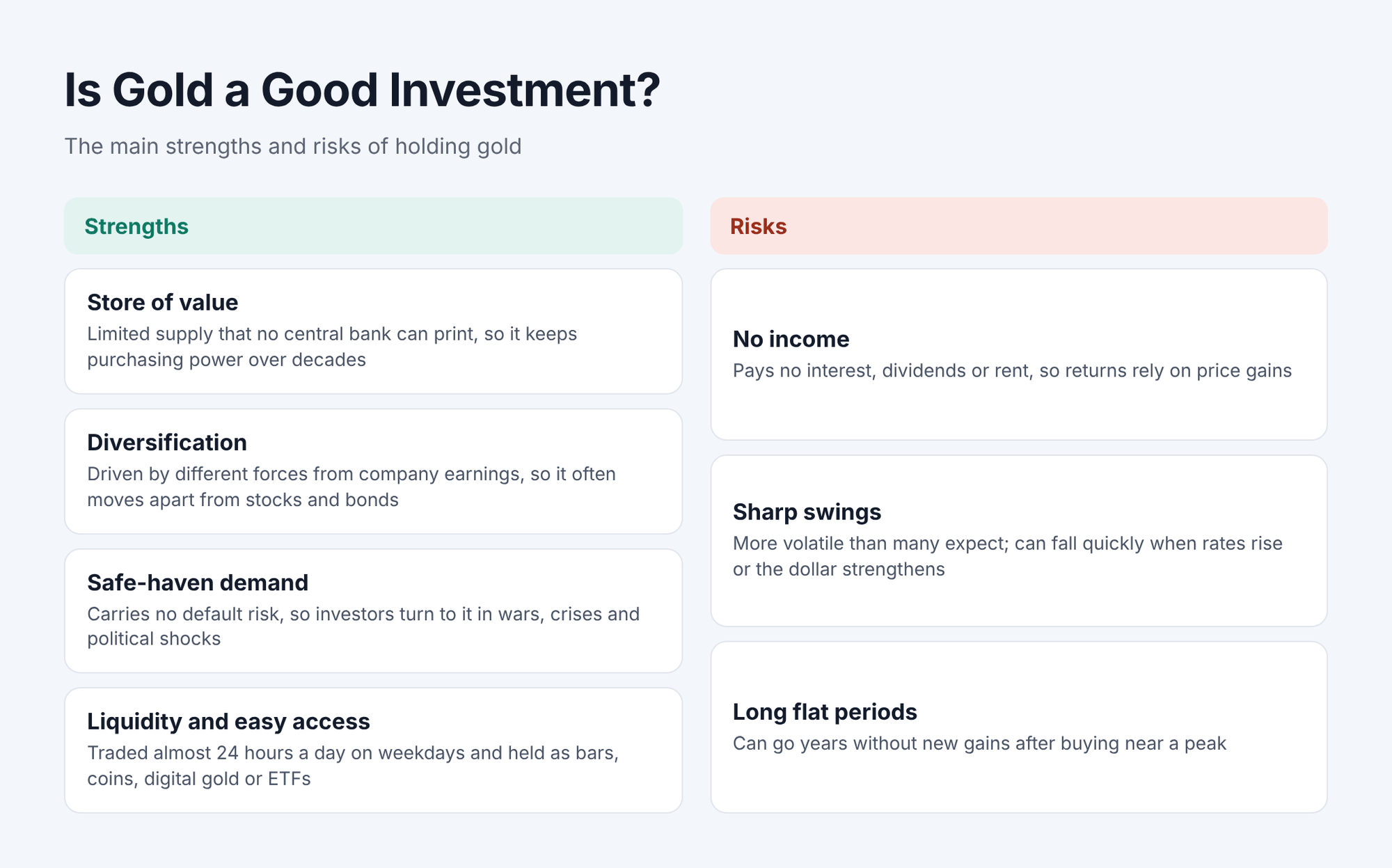
Gold as an investment: the main strengths and risks.
How Has Gold Performed as an Investment?
Gold has delivered strong long-term returns, but it is a volatile asset. Its price can rise or fall by 20% or more within a year, and its gains tend to come in bursts, with strong years followed by flat or falling periods. The table shows the yearly price change of the SPDR Gold Shares ETF (GLD), which tracks the gold price, since 2021.
Source: price data for the SPDR Gold Shares (GLD) ETF.
Gold was slightly lower in 2021 and 2022, rose in 2023, then had two strong years in 2024 and 2025 as central banks bought heavily and US interest rates fell. 2026 has moved in three phases:
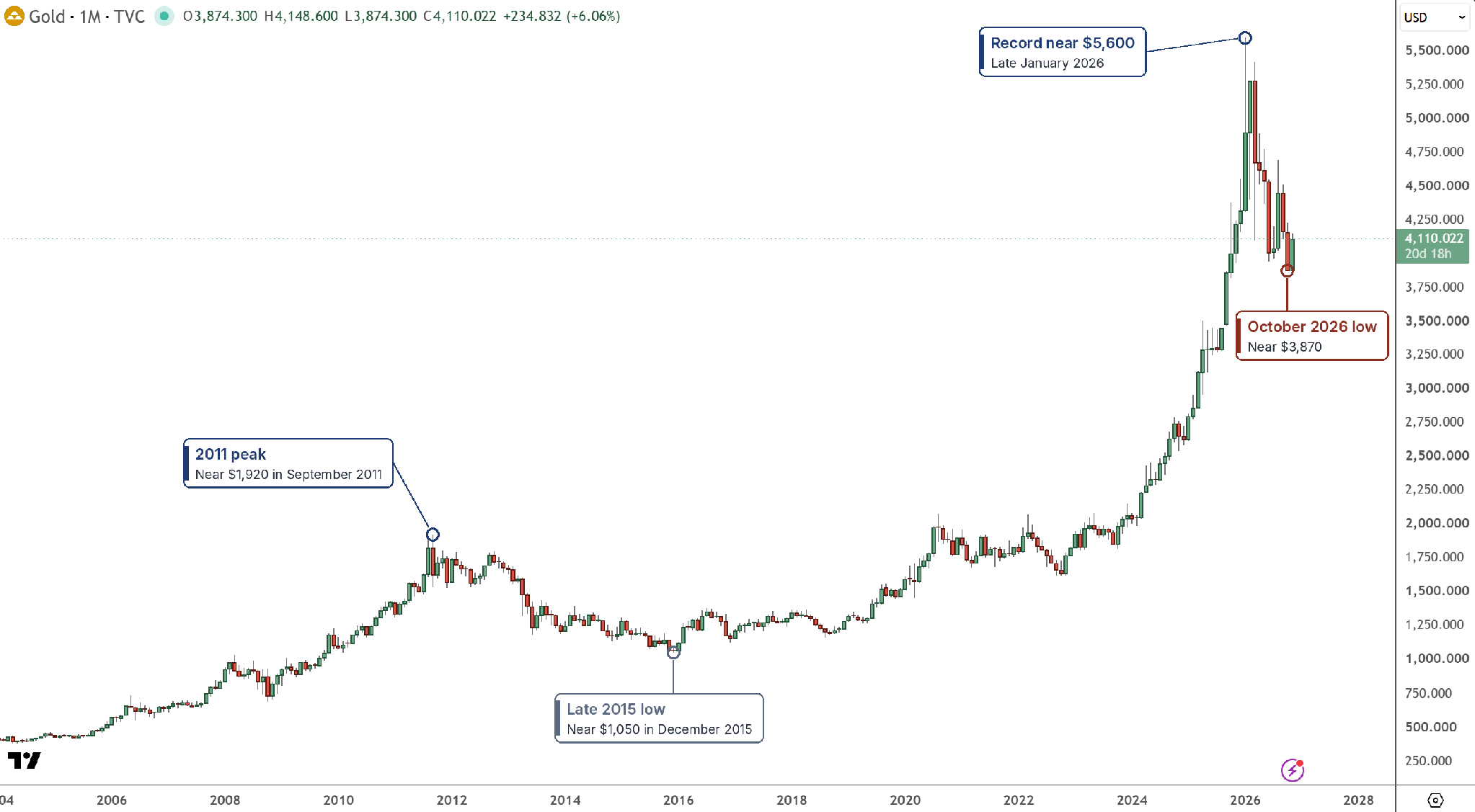
Gold price over the past 20 years. Source: TradingView.
January 2026: A record near $5,600, driven by safe-haven demand and central bank buying.
February to October 2026: A fall of about 30% as markets priced in Fed rate hikes, the Fed raised rates in September, and bond yields and the dollar climbed.
Early November 2026: A rebound to about $4,100 as the dollar weakened and oil prices eased.
Is Gold a Good Investment in 2026 and 2027?
Yes, but mainly for long-term investors. In the short term, gold's direction depends on US interest rates. As of November 9, 2026, markets saw about an 81% chance of another Fed rate hike in December, which could keep pressure on prices through the rest of 2026.
Over a longer horizon, the case for gold looks stronger. Central banks and investors kept buying in 2026, and most major banks still expect prices to stabilise and recover in 2027. For a detailed outlook, see the gold price forecast.
How gold fits your plan depends on the kind of investor you are:
✅Long-term investors: Gold can protect savings over many years. Buying in stages over several months reduces the risk of investing everything just before another dip.
✅Cautious investors: Waiting for signs that the Fed has stopped raising rates may mean paying a higher price, but it lowers the risk of buying into a falling market.
✅Income-focused investors: Gold pays no income, so it works best as a small addition to a portfolio built around dividends, bonds or rent.
✅Short-term traders: Gold's swings around Fed decisions and economic data create opportunities in both directions, but clear entry levels, stop-loss orders and small position sizes are essential.

Trade XAU/USD with Tight Spreads
Gold vs Other Investments: Which is Better?
Gold works best alongside other assets rather than instead of them. The table compares it with the main options UAE investors use.
In short, gold pays no income but helps protect wealth and steady a portfolio when other assets fall, while stocks drive growth, bonds and deposits provide income, and property offers both rent and long-term value. For most UAE investors, a sensible approach is to keep stocks, property or sukuk at the core of the portfolio and add a smaller share of gold as protection.
What Causes Gold Prices to Rise and Fall?
Gold has no earnings or cash flows, so its price moves with changes in demand and in the cost of holding it. Knowing what drives these moves helps investors judge when to buy, when to wait and how much risk they are taking. These are the five main forces:
1 Interest rates and real yields: Gold pays no interest, so it becomes less attractive when interest rates and inflation-adjusted bond yields rise, and more attractive when they fall. Expectations about Fed decisions often move gold more than any other factor.
2 The US dollar: Gold is priced in dollars, so a stronger dollar makes it more expensive for buyers using other currencies and tends to push prices down. A weaker dollar usually has the opposite effect.
3 Inflation: When inflation rises and erodes the value of cash, investors often buy gold to protect their wealth. However, if high inflation leads to higher interest rates, the overall effect on gold can turn negative.
4 Demand from central banks and investors: Central banks buying gold for their reserves, flows into gold ETFs and jewellery and bar demand in India and China all add to buying pressure. Steady purchases tend to limit falls, while a slowdown in buying removes an important source of support.
5 Safe-haven demand: Wars, financial crises and political shocks tend to push investors into gold. When tensions ease, part of that extra demand fades and prices can fall.
How Much of Your Portfolio Should Be in Gold?
There is no single right share of gold for every portfolio. Many investors hold between 5% and 10%, which is enough to help diversify without relying too heavily on an asset that pays no income. The right amount depends on your goals, time horizon and how much risk you can accept:
✅Conservative investors: A share of around 5% to 10% can add stability, especially for portfolios that hold mostly stocks or property.
✅Balanced investors: Around 5% is a common starting point, used as a diversifier alongside stocks and bonds.
✅Growth-focused investors: A smaller share, such as 2% to 5%, keeps some protection while leaving most of the portfolio in assets with higher long-term growth potential.
✅Rebalancing: Review the share once or twice a year. If a rise in the gold price pushes the holding above its target, selling some locks in gains; if it falls below, topping it up keeps the portfolio on track.
How to Invest in Gold in the UAE?
UAE investors can choose from five main ways to invest in gold. Each one works differently and suits different goals:
1- Physical gold: Buying bars, coins or jewellery means you own the metal directly. They are sold at the Dubai Gold Souk, jewellers, banks and dealer websites. Physical gold suits long-term savers but carries dealer premiums and storage costs.
2- Digital gold: Digital gold lets you buy small amounts of gold through a bank account or app, with the metal stored for you by the provider. Some apps start from AED 10, which makes it suitable for small, regular savings.
3- Gold ETFs and mining stocks: Gold ETFs are funds listed on stock exchanges that track the gold price, while mining stocks are shares in companies that produce gold. Both are bought through a licensed broker and suit investors who already hold stocks.
4- Gold futures: Futures are exchange-traded contracts to buy or sell gold at a set price on a future date. They come in large contract sizes and have expiry dates, so they suit experienced traders.
5- Gold CFDs: Contracts for difference let you trade gold's price without owning the metal, going long if you expect a rise or short if you expect a fall. They use leverage, which means you only need to put up a small deposit, called margin, to open a much larger position. This magnifies both gains and losses, so CFDs suit active traders who manage their risk carefully.
For a full comparison of these routes, see how to invest in gold in the UAE.
How to Trade Gold with Mitrade
Mitrade gives UAE traders a simple, low-cost way to trade gold's price moves in either direction. It is regulated by the UAE Capital Market Authority (licence number 20200000397), charges zero commission and accepts deposits from $50 in USD or AED. Risk tools such as stop loss, take profit and negative balance protection help keep losses under control, and a free demo account lets you practise before using real money. To start trading gold:
Step 1. Open and verify your account: Sign up on the Mitrade website or app, upload your ID and answer a short trading-experience questionnaire. Live accounts are for adults aged 18 and over.
Step 2. Practise on the demo account: Every account includes a free demo account with $50,000 in virtual funds to test gold trades before using real money.
Step 3. Fund your account: Deposit from $50, in USD or AED.
Step 4. Trade gold: Search for "Gold" or XAUUSD, choose Buy or Sell, set a small trade size, and add a stop loss and take profit before you confirm.
Conclusion
Gold is a good investment for most people who want to protect their wealth and diversify a portfolio over the long term. The trade-off is that it pays no income and can fall sharply in the short term, as it did in 2026. In the coming months, its price will depend mostly on US interest rates and the dollar, while central bank buying supports it over the longer term. A practical first step is to decide what share of your savings to hold in gold and build it in stages, or to practise trading gold's swings on a free Mitrade demo account with $50,000 in virtual funds.
Risk-Free Demo Account
CMA-regulated | 24х5 | 0 commission | low spreads. Enjoy limit and stop loss for every trade!
Is gold a good investment for beginners?
Yes, as a small part of a wider plan. Beginners can start with a 1-gram bar, small regular purchases on a digital gold app or a gold ETF. Those interested in trading gold's price can practise first on a free Mitrade demo account, then start with the smallest trade size.
Is gold a good hedge against inflation?
Over decades, yes: gold has kept its purchasing power while currencies have lost value. Over shorter periods it is less reliable, because rising interest rates can push gold lower even when inflation is high, as happened in 2026.
Do UAE residents pay tax on gold investments?
The UAE has no personal income tax, so gains on gold held as a personal investment are generally not taxed. Investment gold of at least 99% purity is zero-rated for VAT, while jewellery carries 5% VAT. Anyone trading gold as a business, or whose home country taxes worldwide income, should check with a tax adviser.
* The content presented above, whether from a third party or not, is considered as general advice only. This article should not be construed as containing investment advice, investment recommendations, an offer of or solicitation for any transactions in financial instruments.


