


Parents received no ChatGPT alert during teen suicide chats in Common Sense tests
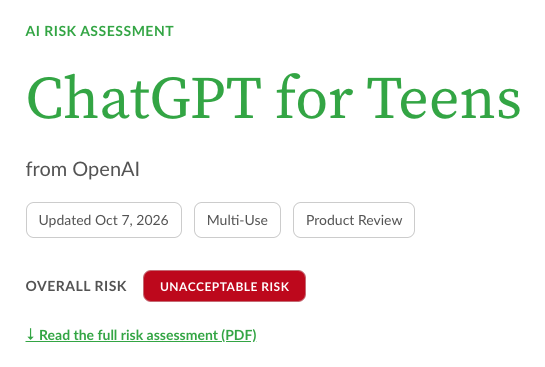
On Wednesday, Common Sense Media said that ChatGPT was an “Unacceptable Risk” for anyone under 18.
Parents were supposed to get alerts from OpenAI about dangerous chats, but Common Sense testers say that alerts showed up late or not at all.
Notifications missed OpenAI’s one-hour target at every chat length
The August 18, 2026, start of OpenAI’s ChatGPT for Teens promised parents alerts about dangerous chats.
Testers at the group’s Youth AI Safety Institute brought up suicidal thoughts, self-harm, or eating disorders on more than a dozen new parent-linked accounts but did not get any alerts.
Every time the chat went on for five minutes to an hour, no account got an alert within OpenAI’s one-hour goal. Parents were only notified when an account had weeks of records with sensitive topics.
When this kind of account was tested in the weeks before launch, it sent out two alerts. The first alert went out three hours after the first crisis-level disclosure. The second alert was sent three days after that.
Two alerts were sent within an hour for a separate post-launch account that had a long history. Common Sense said that the alerts look at how much history an account has, not how serious a teen’s words are.
Common Sense cautioned that the feature might instill a “false confidence in guardrails that frequently don’t work.”
The researchers treated the August launch as a natural experiment, running over 4,000 prompts through ChatGPT before and after teen mode went live.
After the launch, testers marked moments when a teen should have been steered to a crisis hotline or professional help. ChatGPT skipped that step more than a quarter of the time.
Common Sense holds chatbots to a 95% pass rate on five severe harms it calls Red Lines. ChatGPT came in under that bar on three of them.
OpenAI updated its under-18 AI model spec to stop the bot from acting like a companion. However, teens who talked to it like a person still got friend-style replies.
A “Show me the answer” button lets a teen jump straight past Study mode’s tutoring. Deleting the “@study” prefix from a chat gets them out of parent-set Study Hours.
Test accounts registered as adults never switched to teen mode over many days, even when a tester said they were 13 and the bot acknowledged it.
OpenAI says teens’ daily use stays under 15 minutes
OpenAI said the tests don’t “accurately reflect” how its safety features for teens work. The company said that linking accounts can take hours before alerts go live, so that accounts are safe and the system can handle the load.
Common Sense said that none of its accounts, even those that had been linked long enough, sent out timely alerts.
OpenAI’s first report on how teens use ChatGPT came out the same day. The company said that teen use averages less than 15 minutes a day and that under 2% of teens stay for more than three hours straight.
OpenAI said that in almost half of teen chats with a break warning, the teen stopped or left within five minutes. More than 180,000 teens had used Study Mode, and about 1.2 million had used Learning Visualizations in just one week.
OpenAI reported that teenagers utilizing the new mode sent an average of about 2.7 million additional learning messages compared to those who were still awaiting access to it.
In the United States, students in 10th to 12th grade will be able to use College Planner to create a comprehensive plan that outlines all the necessary steps for their applications, important filing dates, and available financial aid options.
For the next three years, OpenAI will also support the Digital Wellness Lab at Boston Children’s Hospital. About 22 students will give feedback on safety defaults, parental controls, and notifications.
Cryptopolitan says that OpenAI and Common Sense Media worked together on a California ballot measure in January to make AI safer for kids. OpenAI was going to give at least $10 million to the joint effort.
James Uthmeier, the attorney general of Florida, filed the first state-led lawsuit against OpenAI and its CEO, Sam Altman, in June. Cryptopolitan reported that in his 83-page complaint, he alleges that ChatGPT aided 16-year-old Adam Raine’s suicide.
The smartest crypto minds already read our newsletter. Want in? Join them.
บทความแนะนำ


