


Kakao Pay Securities and Dinari explore tokenizing Korean stocks for global investors
Kakao Pay Securities and Dinari are exploring the possibility of using tokenization for global distribution of shares listed on the Korea Exchange.
A partnership has been formed between the two companies to develop a framework for sourcing Korean equities, complete a proof of concept, and determine all legal, technical, and operational steps necessary for overseas distribution, particularly with regard to the U.S. market.
In the meantime, the initiative is still at a trial run stage, with no tokenized shares available for purchase at the moment.
From access arbitrage to distribution rail
The major advantage is better access. Foreign investors still have limited options when it comes to purchasing shares listed in Korea directly. So far, most of the Korean stock market is not covered by depositary receipts.
Tokenization can offer new possibilities, allowing investors to access Korean stocks through digital tokens that are underpinned by the original shares.
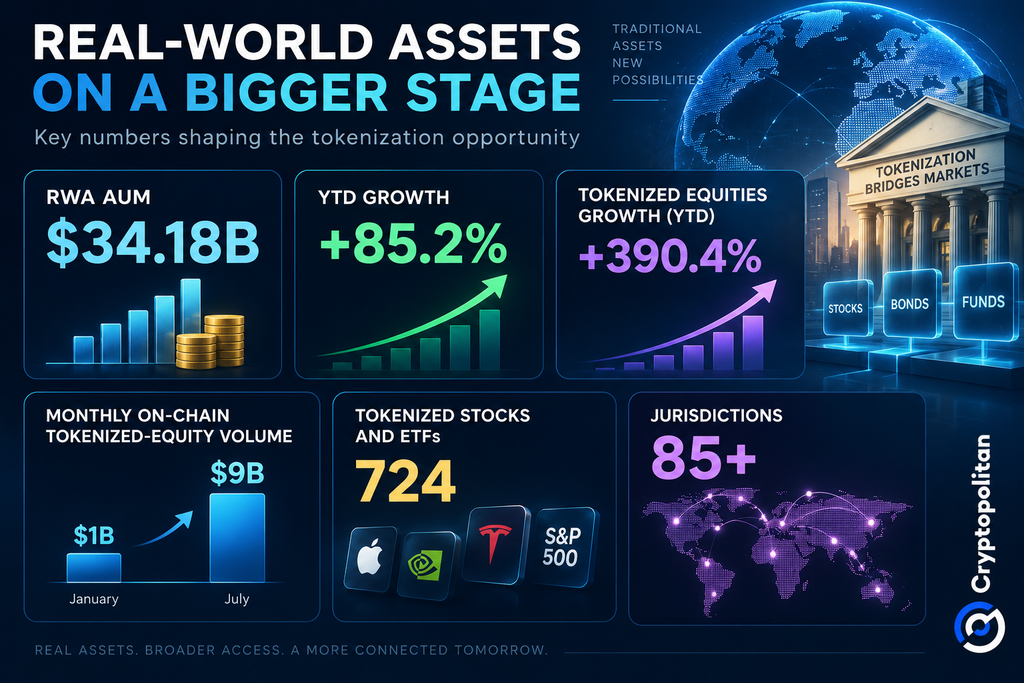
This supports the general trend we see for tokenized stocks. As reported by Cryptopolitan, the monthly on-chain volume increased from $1 billion in January to $9 billion in July as new platforms made stock tokens available to more investors.
The Kakao Pay-Dinari project takes this model of distribution and applies it specifically to Korean stocks.
How Dinari’s model works
Dinari employs a custodial structure for its dShares tokens, where there is one corresponding security backing each token. In August, Dinari stated that eligible U.S. investors will be able to trade 724 tokenized US stocks and ETFs, including the S&P 500, while companies can use the system via an API.
According to the company, dShares allows one to retain the advantages of dividends, voting rights, corporate actions, and NBBO execution, as it impacts investors in more than 85 countries.
South Korea’s pilot test is aimed at checking the possibility of using that infrastructure for the securities listed on the Korean stock exchange.
Two regulators moving at once
Korea is also expanding its tokenization framework. The country’s Financial Services Commission stated that the market would reach beyond fractional-investment products and also include traditional securities, such as stocks, bonds, and funds. The amendments, which will come into force on February 4, 2027, will make security tokens be regarded as securities in a digital form.
The Korea Capital Market Institute considers the amendments that were promulgated in February 2026 as a milestone for the capital market.
In the U.S., the SEC’s Innovation Exemption, which was introduced on September 17, provides some temporary, conditional relief for Tokenized Securities Venues that trade tokenized NMS stocks using regulated automated market makers.
Where it fits, and what still blocks it
The experiment arrives during rapid RWA growth. Binance Research put RWA AUM at $34.18 billion as of September 15, up 85.2% year to date, while tokenized equities had grown 390.4%.
Citi projects a $5.5 trillion tokenized-asset market by 2030 in its base case, but flags regulation, liquidity and interoperability as key hurdles. The IMF also warns that tokenization can create legal risks around the link between a token and the asset it represents.
That is what this trial ultimately has to prove: not just that Korean equities can be tokenized, but that the infrastructure can work across markets at scale.
If you're reading this, you’re already ahead. Stay there with our newsletter.
บทความแนะนำ


