

Australian Dollar sits near three-week top vs USD as hawkish RBA offsets weak GDP
- The Australian Dollar shrugs off a disappointing Q3 GDP print amid the RBA’s hawkish tilt.
- Rising December Fed rate cut bets continue to undermine the USD and support AUD/USD.
- Traders now look forward to the US ADP report and ISM Services PMI for a fresh impetus.
The Australian Dollar (AUD) reverses dismal domestic data-led intraday downtick and touches a fresh three-week high against a weaker US Dollar (USD) during the Asian session on Wednesday. The Australian Bureau of Statistics (ABS) reported that the economic growth slowed to 0.4% during the third quarter from the 0.6% previous quarter. Moreover, the reading fell short of consensus estimates and held back the AUD bulls from placing fresh bets, especially after the recent move up witnessed over the past two weeks or so.
The disappointing macro data, however, does little to revive expectations for further policy easing by the Reserve Bank of Australia (RBA). Adding to this, hawkish comments from RBA Governor Michele Bullock earlier today, saying that inflation has surprised on the upside, act as a tailwind for the Aussie amid a generally positive risk tone. The US Dollar (USD), on the other hand, remains depressed amid bets that the US Federal Reserve (Fed) will lower borrowing costs this month, and contributes to limiting the downside for the AUD/USD pair.
Australian Dollar sticks to positive bias as bulls largely shrug off dismal Q3 GDP growth data
- The Australian Bureau of Statistics reported this Wednesday that the economy grew by 0.4% during the July-September period, down from the 0.6% rise seen in the second quarter. The annual Gross Domestic Product growth rate stood at 2.1% compared to 1.8 % in the previous quarter. Both the quarterly and the yearly print missed expectations, prompting some intraday selling around the Australian Dollar during the Asian session.
- Speaking before a parliamentary committee earlier today, Reserve Bank of Australia Governor Michele Bullock said that the central bank is looking very hard at recent inflation numbers to see if some of the price pressures are temporary. Bullock added that if inflation proves to be persistent, it would have implications for future monetary policy. This dampens hopes for more policy easing and lends support to the Aussie.
- In fact, Australia's headline Consumer Price Index (CPI) accelerated from a 3.5% increase reported in the previous month to 3.8% YoY in October. Moreover, the RBA Trimmed Mean CPI rose 3.3% during the reported month from 3.2% in September. This indicated that inflation remains above the RBA’s 2% to 3% annual target and raises questions about just how much headroom the central bank has to cut rates further.
- The latest data published by RatingDog showed that China's Services Purchasing Managers' Index (PMI) dropped to 52.1 in November from 52.6 in October. This, however, was better than consensus estimates for a reading of 52 and does little to dent the underlying bullish sentiment surrounding the China-proxy AUD.
- The US Dollar hangs near its lowest level since November 14, touched on Monday, amid dovish Federal Reserve expectations, and contributes to limiting the downside for the AUD/USD pair. According to the CME Group's FedWatch Tool, traders are pricing in a nearly 90% chance of a 25-basis-point rate cut on December 10. Moreover, speculations of a dovish pick for the next Fed Chair undermine the Greenback.
- Meanwhile, the prospects for lower US interest rates, along with hopes for a peace deal between Russia and Ukraine, remain supportive of a generally positive tone around the equity markets. This further dents the safe-haven buck and benefits the risk-sensitive Aussie. Traders now look to the release of the US ADP report on private-sector employment and the US ISM Services PMI for a fresh impetus.
- The market attention, however, will remain glued to the US Personal Consumption Expenditure (PCE) Price Index, due on Friday, which will be scrutinized for cues about the Fed's future rate-cut path. This, in turn, will play a key role in influencing the USD and determining the next leg of a directional move for the AUD/USD pair. The fundamental backdrop, meanwhile, remains tilted in favor of bullish traders.
AUD/USD seems poised to climb further; breakout through 0.6535 confluence remains in play
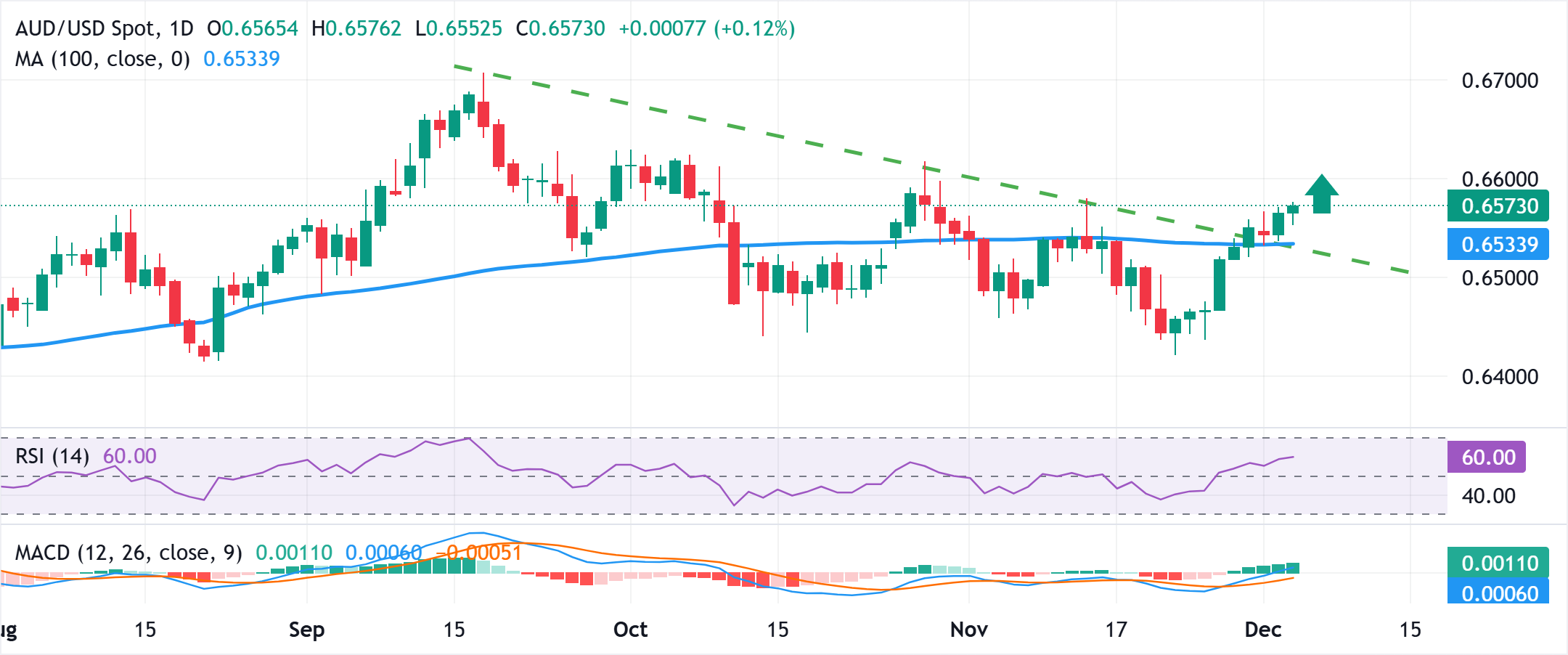
The recent breakout through a descending trend-line hurdle extending from the September swing high and acceptance above the 100-day Simple Moving Average (SMA) favors the AUD/USD bulls. Moreover, oscillators on the daily chart have been gaining positive traction and are still away from being in the overbought territory. This, in turn, validates the near-term positive outlook, suggesting that any corrective pullback could be seen as a buying opportunity near the aforementioned confluence resistance breakpoint, currently around the 0.6535-0.6530 region.
This is closely followed by the 0.6500 psychological mark. A convincing break below the latter could make the AUD/USD pair vulnerable to weaken further below the 200-day SMA, currently pegged near the 0.6465 zone, towards challenging a multi-month low, around the 0.6420 region, touched in November. Some follow-through selling, leading to a subsequent fall below the 0.6400 mark, will be seen as a fresh trigger for bearish traders and pave the way for deeper losses.
Nevertheless, the AUD/USD pair seems poised to prolong a two-week-old uptrend and aim to reclaim the 0.6600 mark, above which the momentum could extend further towards the next relevant hurdle near the 0.6660-0.6665 region. Spot prices could eventually climb to test the year-to-date high, levels just above the 0.6700 mark, touched in September.
Economic Indicator
Gross Domestic Product (QoQ)
The Gross Domestic Product (GDP), released by the Australian Bureau of Statistics on a quarterly basis, is a measure of the total value of all goods and services produced in Australia during a given period. The GDP is considered as the main measure of Australian economic activity. The QoQ reading compares economic activity in the reference quarter to the previous quarter. Generally, a rise in this indicator is bullish for the Australian Dollar (AUD), while a low reading is seen as bearish.
Read more.Last release: Wed Dec 03, 2025 00:30
Frequency: Quarterly
Actual: 0.4%
Consensus: 0.7%
Previous: 0.6%
Source: Australian Bureau of Statistics
The Australian Bureau of Statistics (ABS) releases the Gross Domestic Product (GDP) on a quarterly basis. It is published about 65 days after the quarter ends. The indicator is closely watched, as it paints an important picture for the economy. A strong labor market, rising wages and rising private capital expenditure data are critical for the country’s improved economic performance, which in turn impacts the Reserve Bank of Australia’s (RBA) monetary policy decision and the Australian dollar. Actual figures beating estimates is considered AUD bullish, as it could prompt the RBA to tighten its monetary policy.
추천 기사


