


Palantir vs. Nvidia: Which Stock Will Outperform in 2025?
Two of the top-performing tech stocks of 2024 were Palantir (NASDAQ: PLTR) and Nvidia (NASDAQ: NVDA). In terms of stock performance, Palantir was the clear winner in 2024, with its stock up about 325% as of this writing, compared to about a 180% gain for Nvidia. Those are both incredible returns.
The question, though, is which stock is most likely to outperform the other in 2025. Let's look at a couple of criteria to help decide.
Nvidia already has a wide moat
Companies with wide moats are generally considered desirable. In simplest terms, moat is the advantages a company has over its competitors that allow it to keep its competitive edge and maintain market share.
Nvidia is the biggest winner in the artificial intelligence (AI) infrastructure space due to the wide moat it created around its business through its CUDA software platform. The platform came about as a way for the company to expand the use of its graphic processing units (GPUs) beyond speeding up the rendering of graphics in things like video games, for which the chips were initially designed. The CUDA platform allowed its chips to be programmed to better handle other tasks, which led to more developers learning the program to the point where it became the de facto platform on which they were taught to program GPUs.
This led to the wide moat the company sees today and why it has nearly a 90% market share in the GPU space.
Palantir's moat isn't quite as clear cut, largely because the AI software space in which it is involved is still developing. However, its AI platform (AIP) has been gaining huge traction in the commercial space, and growth has started to reaccelerate in the government space. The company, meanwhile, established itself as an important part of mission-critical tasks for the government, with its technology being used for such things as fighting terrorism and tracking COVID-19 cases during the pandemic.
While many large tech companies are battling to create the best AI models, Palantir thinks AI models will become commoditized and that the real differentiation will be within the application and workflow layer on which it is focused. It believes its analytics and pattern recognition expertise will allow it to rigorously test AI applications and quickly move them from proof-of-concept to AI-powered software solutions.
It believes that this is its moat. So far, this appears to be playing out, but more time is needed for it to be conclusive.

Image source: Getty Images.
Both are seeing strong growth
Nvidia has seen explosive revenue growth this year, which is even more incredible given the large revenue base from which it started. Through the first nine months of the year, the chipmaker was able to grow its revenue by an astounding 135% to $91.2 billion. For its fiscal third quarter of 2025, revenue soared 94% to $35.1 billion. Meanwhile, it carries robust margins of around 75% to boot.
The company is continuing to see insatiable demand for its chips, with demand continuing to outpace supply for its newest GPU architecture. Growth is expected to remain strong in the years ahead as major tech companies continue to race to create more sophisticated AI models. These models need exponentially more computing power to be trained, with newer models, in many cases, using 10 times as many GPUs to be trained on than their prior versions.
Looking ahead, analysts are expecting Nvidia to grow its revenue by more than 50% in 2025 to $195.4 billion.
Palantir has not been growing nearly as briskly as Nvidia, but it has been seeing its revenue growth accelerate throughout the year. The company had 21% revenue growth in the first quarter from a year ago, and accelerated to 27% in Q2 and 30% in Q3 to $726 million.
Parts of its business, though, are growing much quicker, with U.S. commercial revenue soaring 54% last quarter and U.S. government revenue climbing 40%. International markets, however, have been lagging.
With customers growing strongly, including by 39% last quarter, and the company having a big revenue opportunity moving customers from prototype work to full production, Palantir has the potential to see revenue growth continue to accelerate. However, that is not currently baked into analyst estimates, which are projecting about 24% revenue growth in 2025 to $3.47 billion.
Valuation shows a clear winner
From a valuation perspective, Nvidia is the clear winner by a wide margin. It trades at an attractive valuation, with a forward price-to-earnings (P/E) ratio of just over 31 based on 2025 analyst estimates and a price/earnings-to-growth (PEG) ratio of approximately 1. A PEG ratio under 1 is generally viewed as undervalued, while growth stocks will quite often have PEG ratios well above 1.
Palantir, meanwhile, trades at a forward price-to-sales (P/S) ratio of about 47.5 times next year's analyst estimates. That's a high valuation for a company with 30% revenue growth and is more than double peak historic SaaS (software-as-a-service) multiples.
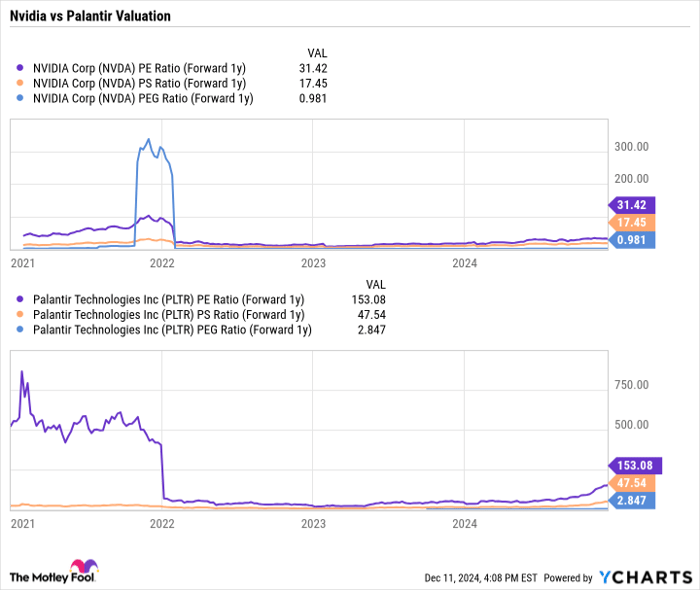
NVDA PE Ratio (Forward 1y) data by YCharts
The verdict
Nvidia is the clear winner on paper, with stronger revenue growth, a well-established moat, and a much more attractive valuation, which is why I prefer it heading into 2025. If analyst projections are in the general ballpark for both stocks, it should outperform.
That said, it is the unexpected that could determine a different outcome. If Palantir can prove its AI platform is the best and becomes widely adopted, sending revenue growth soaring, it could once again outperform. Meanwhile, if AI infrastructure spending unexpectedly falls, Nvidia could underperform. I'm sticking with Nvidia, but these are scenarios to watch out for in 2025.
Should you invest $1,000 in Palantir Technologies right now?
Before you buy stock in Palantir Technologies, consider this:
The Motley Fool Stock Advisor analyst team just identified what they believe are the 10 best stocks for investors to buy now… and Palantir Technologies wasn’t one of them. The 10 stocks that made the cut could produce monster returns in the coming years.
Consider when Nvidia made this list on April 15, 2005... if you invested $1,000 at the time of our recommendation, you’d have $853,765!*
Stock Advisor provides investors with an easy-to-follow blueprint for success, including guidance on building a portfolio, regular updates from analysts, and two new stock picks each month. The Stock Advisor service has more than quadrupled the return of S&P 500 since 2002*.
See the 10 stocks »
*Stock Advisor returns as of December 9, 2024
Geoffrey Seiler has no position in any of the stocks mentioned. The Motley Fool has positions in and recommends Nvidia and Palantir Technologies. The Motley Fool has a disclosure policy.
Recommended Articles


