


Accenture vs. Palo Alto Networks: Which Tech Stock Is a Better Buy for 2027?
Key Points
Accenture provides unmatched scale with more than 814,000 employees and deep integration into the operations of Fortune Global 100 companies.
Palo Alto Networks is capturing rapid growth through its AI-powered cybersecurity platform, achieving roughly 30.3% revenue expansion recently.
Which stock offers the better combination of steady revenue and high-growth potential for your portfolio through 2027?
- Motley Fool Issues Rare "Total Conviction" Buy Alert ›
Should you prioritize steady dividends and global scale with Accenture (NYSE:ACN), or chase high-growth cybersecurity tailwinds with Palo Alto Networks (NASDAQ:PANW)? Both companies look to dominate their respective markets in 2027.
Accenture is a professional services juggernaut helping companies navigate complex digital shifts and AI integration. Palo Alto Networks leads the cybersecurity space with its integrated platform approach. Investors often weigh the two when choosing between diversified services and specialized software in the evolving tech stocks landscape.
The case for Accenture
Accenture provides professional services to a massive global audience, helping enterprises reinvent their businesses with digital, AI, and cybersecurity solutions. The company serves more than 9,000 clients, including approximately three-quarters of the Fortune Global 100. It has maintained long-term partnerships with 85% of its top 200 commercial clients and all G7 governments for 20 or more years. These deep relationships provide a stable foundation, as Accenture categorizes 317 of its largest accounts as Diamond clients.
In the 12 months ended Aug. 31, 2026, revenue reached nearly $74.2 billion, an increase of roughly 6.5% compared to the prior year. Net income for the same period was approximately $8.4 billion, showing the company's ability to turn high-volume service contracts into consistent bottom-line results. These figures reflect a steady net margin of roughly 11.3% as Accenture continues to scale its operations across the Americas, Europe, and Asia Pacific.
As of its August 2026 balance sheet, the current ratio, which measures a company's ability to cover short-term debts with its current assets, stands at approximately 1.4. The debt-to-equity ratio is roughly 0.4, indicating a conservative use of leverage. In the fiscal year ended Aug. 31, 2026, free cash flow was approximately $11.6 billion. This cash generation allows the firm to invest in its global workforce of over 814,000 employees.
The case for Palo Alto Networks
Palo Alto Networks focuses on AI-powered network security, cloud security, and security operations for a global customer base. It utilizes a two-tier fulfillment model through a network of more than 8,700 channel partners, including distributors and resellers. As of its latest annual report, two distributors individually represented 10% or more of total revenue, collectively accounting for 30% of total revenue. Customer concentration like this adds a layer of risk to the business even as it expands its reach via various cloud marketplaces.
In the 12 months ended Oct. 31, 2026, revenue reached nearly $12.5 billion, representing significant growth of roughly 30.3% compared to the previous year. Net income was approximately $455 million. While the company is growing its top line rapidly, its net margin of roughly 3.7% is narrower than more mature service providers. This reflects the intense investment required to lead the AI-powered cybersecurity transition for government and enterprise end-customers.
As of Palo Alto's July 2026 balance sheet, the current ratio stands at approximately 0.9. The debt-to-equity ratio is roughly 0.1, suggesting the company uses very little debt relative to its shareholder equity. In the fiscal year ended July 31, 2026, free cash flow was close to $4.1 billion. Note that stock-based compensation accounted for roughly 39% of operating cash flow, inflating reported cash generation, since SBC is a non-cash expense added back in the cash flow statement.
Risk profile comparison
Accenture faces significant risks from global economic and geopolitical volatility, which can lead to reduced client spending or contract terminations. The company must successfully navigate rapid technological changes, particularly the necessity to deploy AI solutions while managing ethical and operational complexities. It also faces intense competition from global IT service firms and boutique consultancies. Vulnerability to cybersecurity incidents could compromise client data and damage Accenture's reputation, especially given its heavy reliance on global delivery models in India and the Philippines.
Palo Alto Networks faces intense competition from large incumbents like Alphabet (NASDAQ:GOOGL) and Microsoft (NASDAQ:MSFT). It also relies heavily on third-party manufacturing partners, particularly Flex (NASDAQ:FLEX), to meet hardware demand. The company faces risks related to the integration of acquired businesses, such as CyberArk and Chronosphere, which may disrupt operations. Failure to innovate in the rapidly evolving AI landscape could erode its market position, especially since it relies heavily on channel partners to generate a substantial portion of its revenue.
Valuation comparison
Accenture appears more affordable based on its lower forward P/E, which compares price to future earnings estimates, and its P/S ratio, which uses sales over the past 12 months.
| Metric | Accenture | Palo Alto Networks |
|---|---|---|
| Forward P/E | 14.9 | 84.8 |
| P/S ratio | 1.7 | 23.8 |
Valuation metrics include sourcing from Financial Modeling Prep (FMP) and may differ from other data providers.
Which stock would I buy for 2027?
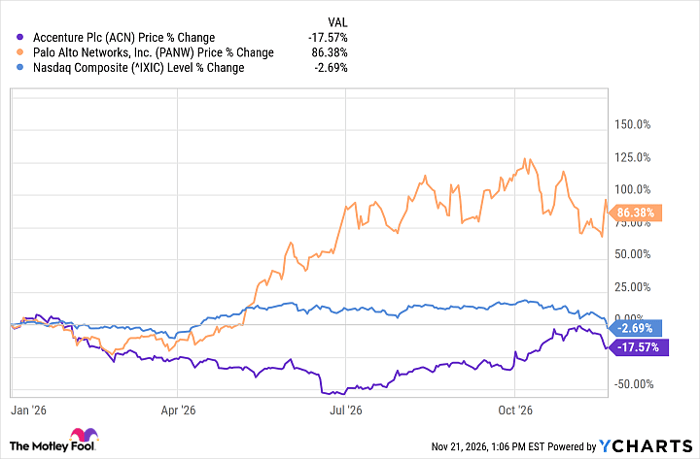
It feels a bit bold to be picking stocks amid the market's recent meltdown. Tech stocks in particular were hit hard in the past week, and the Nasdaq Composite (NASDAQINDEX:^IXIC) is now sitting on a year-to-date loss:
ACN data by YCharts
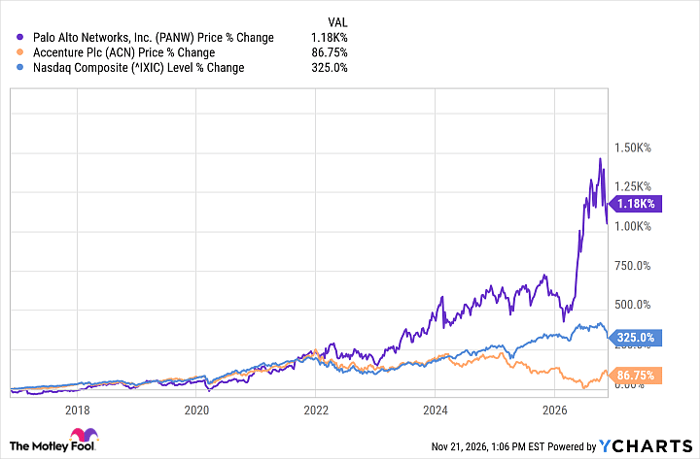
Palo Alto has seen some volatility, but at least has a gain for the year. The same can't be said for Accenture. Zooming out 10 years, the picture isn't much better for the consulting giant:
PANW data by YCharts
Accenture shares have been pretty stagnant over the past decade, trailing the Nasdaq Composite by more than 200 percentage points. Past performance is no indication of future results, but it's a bad look for the stock.
Now, Palo Alto is much more richly valued, which may give some investors pause. But cybersecurity is a must-have for any organization. It's more important than ever for companies to lock down data for reputational, regulatory, and legal reasons. I think Palo Alto's products and services are more necessary than Accenture's. Palo Alto Networks gets my vote for 2027 and beyond.
Should you buy stock in Accenture Plc right now?
Before you buy stock in Accenture Plc, consider this:
The Motley Fool Stock Advisor analyst team just identified what they believe are the 10 best stocks for investors to buy now… and Accenture Plc wasn’t one of them. The 10 stocks that made the cut could produce monster returns in the coming years.
Consider when Netflix made this list on December 17, 2004... if you invested $1,000 at the time of our recommendation, you’d have $305,941!* Or when Nvidia made this list on April 15, 2005... if you invested $1,000 at the time of our recommendation, you’d have $771,325!*
Now, it’s worth noting Stock Advisor’s total average return is 719% — a market-crushing outperformance compared to 192% for the S&P 500. Don't miss the latest top 10 list, available with Stock Advisor, and join an investing community built by individual investors for individual investors.
See the 10 stocks »
*Stock Advisor returns as of November 24, 2026.
Erin Kennedy has no position in any of the stocks mentioned. The Motley Fool has positions in and recommends Accenture, Alphabet, and Microsoft. The Motley Fool recommends Flex and Palo Alto Networks and recommends the following options: long January 2028 $260 calls on Accenture and short January 2028 $280 calls on Accenture. The Motley Fool has a disclosure policy.
Recommended Articles


