


US Dollar Index Price Forecast: Experts flag rally near 104.60 as overdone
- The US Dollar reflects broader strength amid the revival of investors’ confidence in global AI trade.
- ING expects DXY’s immediate highs of 104.60 would stay until before November’s CPI print and Fed policy.
- The US PCE inflation data for October is seen higher at 3.8% YoY.
The US Dollar (USD) outperforms its major currency peers on Tuesday, with the US Dollar Index (DXY) trading marginally higher at around 104.37. Still, the DXY is close to its 20-month high of 104.57 posted on Monday.
The USD Index rallied on Monday after the reinstatement of Jensen Huang as Nvidia’s CEO lifted the appeal of United States (US) Artificial Intelligence (AI) stocks.
According to Commerzbank, “the main theme overnight was a dramatic rebound in global equities as the unexpected reinstatement of the chief executive of a leading US chipmaker revived confidence in the AI trade.”
Dollar rally tests key DXY resistance ahead of Fed and US inflation
Analysts at ING note that the Dollar’s latest surge has carried the DXY index to a previously flagged objective, commenting that “in recent weeks, we floated a DXY target of 104.60, which has just about been hit.” They argue that, with “the prospect of a hot October core PCE print on Wednesday, and now perhaps a better-supported tech environment, it is certainly hard to fight dollar strength this week.” At the same time, ING cautions that “the dollar has come a long way in a short space of time” and suggests that “some early month-end flows in thinning holiday markets might be responsible for Monday's outsized dollar gains.”
Looking ahead, the bank continues to treat “104.60 as an important resistance area for the DXY” and says it “would be surprised if gains can be sustained above it this week.” ING expects that “a more sustainable pullback in the dollar, however, may have to wait until the Fed meeting on 9 December or the November CPI data on 10 December, where base effects could start to see year-on-year headline CPI fall sharply.”
On Wednesday, the US Personal Consumption Expenditure (PCE) Price Index data for October is seen at 3.8% Year-on-Year (YoY), higher than the September reading of 3.6%. The core PCE Inflation – which is Fed’s preferred inflation gauge, is also seen higher at 3.2% YoY vs. the previous release of 3.1%.
US Dollar Index Technical Analysis
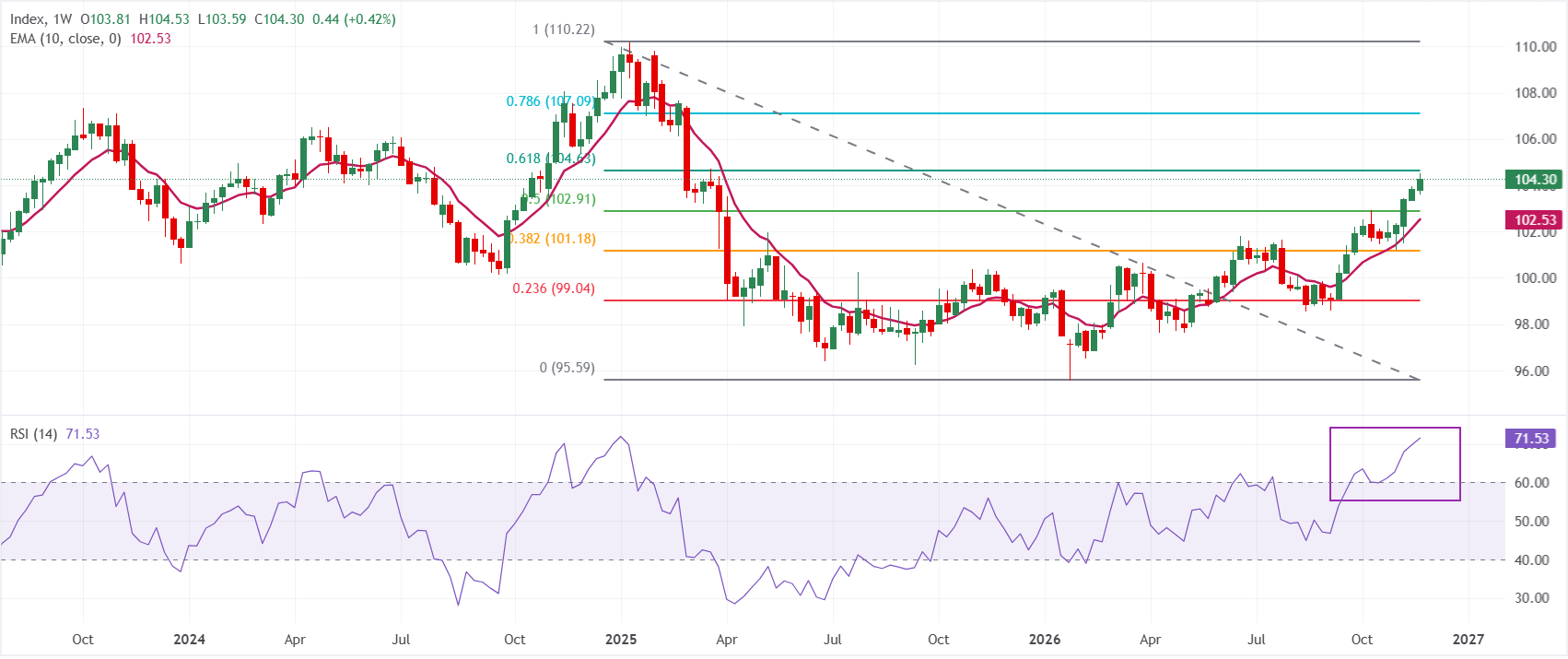
In the weekly chart, Dollar Index Spot trades at 104.32, maintaining a bullish near-term bias as it holds firmly above the 20-week exponential moving average (EMA) at 101.60 and key Fibonacci supports. Price action is pressing into overhead structural levels, with the 61.8% Fibonacci retracement at 104.65 acting as immediate resistance just above the market. The Relative Strength Index (RSI) at 71.61 sits in overbought territory, which hints that upside momentum is strong but increasingly vulnerable to consolidation or a corrective pullback.
On the topside, initial resistance is located at the 61.8% retracement at 104.65, followed by the 78.6% level at 107.10 and the full-cycle 100% retracement at 110.22. On the downside, first support emerges at the 50% retracement at 102.93, ahead of a broader demand cluster formed by the 20-week EMA at 101.60 and the 38.2% retracement at 101.21; deeper setbacks would expose the 23.6% retracement at 99.08 and the structural anchor near 95.64.
(The technical analysis of this story was written with the help of an AI tool. Know more.)
US Dollar FAQs
The US Dollar (USD) is the official currency of the United States of America, and the ‘de facto’ currency of a significant number of other countries where it is found in circulation alongside local notes. It is the most heavily traded currency in the world, accounting for over 88% of all global foreign exchange turnover, or an average of $6.6 trillion in transactions per day, according to data from 2022. Following the second world war, the USD took over from the British Pound as the world’s reserve currency. For most of its history, the US Dollar was backed by Gold, until the Bretton Woods Agreement in 1971 when the Gold Standard went away.
The most important single factor impacting on the value of the US Dollar is monetary policy, which is shaped by the Federal Reserve (Fed). The Fed has two mandates: to achieve price stability (control inflation) and foster full employment. Its primary tool to achieve these two goals is by adjusting interest rates. When prices are rising too quickly and inflation is above the Fed’s 2% target, the Fed will raise rates, which helps the USD value. When inflation falls below 2% or the Unemployment Rate is too high, the Fed may lower interest rates, which weighs on the Greenback.
In extreme situations, the Federal Reserve can also print more Dollars and enact quantitative easing (QE). QE is the process by which the Fed substantially increases the flow of credit in a stuck financial system. It is a non-standard policy measure used when credit has dried up because banks will not lend to each other (out of the fear of counterparty default). It is a last resort when simply lowering interest rates is unlikely to achieve the necessary result. It was the Fed’s weapon of choice to combat the credit crunch that occurred during the Great Financial Crisis in 2008. It involves the Fed printing more Dollars and using them to buy US government bonds predominantly from financial institutions. QE usually leads to a weaker US Dollar.
Quantitative tightening (QT) is the reverse process whereby the Federal Reserve stops buying bonds from financial institutions and does not reinvest the principal from the bonds it holds maturing in new purchases. It is usually positive for the US Dollar.
Recommended Articles


