


AMD Loses $67 Billion on a Short Report and New Export Rules, With $472.57 Now in Play
TradingKey - Advanced Micro Devices (NASDAQ: AMD) fell 7.72% to $489.19 on Thursday, November 19, from $530.14, and overnight trading points lower at $471.78. The stock opened higher, touched $555.01 early and then reversed to a low of $470.56, on volume of about 70.6 million shares, roughly twice its recent average, according to 24/7 Wall St.
The selloff erased about $67 billion of market value, according to the Wall Street Journal's count.
Two things hit at once: a short report from Hunterbrook questioning AMD's China exposure, and new Commerce Department license rules for advanced chips that took effect the same day. Even after the drop, AMD is still up about 128% this year, but it now sits 24.7% below its record close of $649.42 from October 6.
What Hunterbrook Alleges
Hunterbrook, an investigative outlet whose affiliated fund disclosed a short position in AMD, meaning it profits if the stock falls, reported that Chinese server maker Inspur Information, also known as IEIT Systems, kept receiving newer AMD firmware after the US added it to the Entity List, the Commerce Department's export blacklist, in March 2025. It counted at least six newer firmware versions since then, the latest released on October 19.
The report also said firmware used by three other companies, Maginfra in China, Kaytus in Singapore and Aivres in the US, is "highly similar" to Inspur's. Documents cited by Hunterbrook list Inspur as Kaytus's ultimate parent, and AMD's website lists Aivres as a maker of servers using its Instinct AI chips. Hunterbrook argued that AMD "appears no less at risk from China chip restrictions than Nvidia."
Notice what the report did not claim, though. Hunterbrook said its records do not "establish on their own a violation of export laws," and the path the firmware took is unclear. AMD told Barron's the claims "misrepresent AMD's business practices and relationships" and said it complies with US export laws. A separate report from The Bear Cave newsletter questioned how AMD finances some of its own customers.
The Export Rules Make the Risk Real
The timing made the report harder to dismiss. New Commerce Department rules that took effect on Thursday require licenses for certain advanced chips shipped to Singapore, Malaysia, Indonesia, Thailand and Brazil. Orders that need a license may not ship on the original schedule, even if customers have already placed them. A paused rule covering companies at least 50% owned by blacklisted firms is set to return on January 10, 2027.
AMD's own annual report shows why investors care. In 2025, it billed $7.75 billion, or 22.4% of revenue, to customers in China and Hong Kong, and $4.28 billion, or 12.4%, to customers in Singapore. Together, that is about 35% of sales, by my calculation.
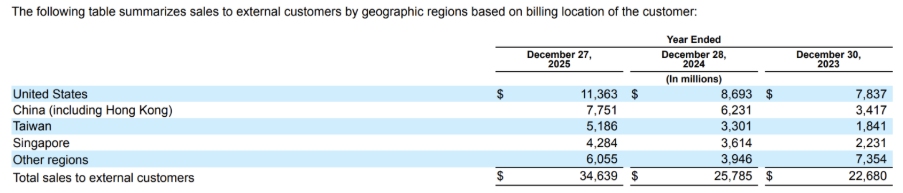
Source: AMD 2025 Form 10-K, filed February 4, 2026 (ir.amd.com)
Those figures are based on where customers are billed, not where the chips end up, so they measure exposure rather than sales at risk. There is a precedent, however. In 2025, export limits on AMD's MI308 chips led to about $800 million of inventory and related charges.
The Business Has Not Changed
Nothing in AMD's outlook changed on Thursday. On November 3, it reported record third-quarter revenue of $13.4 billion, up 45%, above the $13.1 billion consensus, and non-GAAP EPS of $2.09, against $1.97 expected. Data Center revenue nearly doubled to $8.5 billion, driven by EPYC server processors and the launch of its Instinct MI450 AI chips, and the segment's operating margin rose to 34% from 25%.
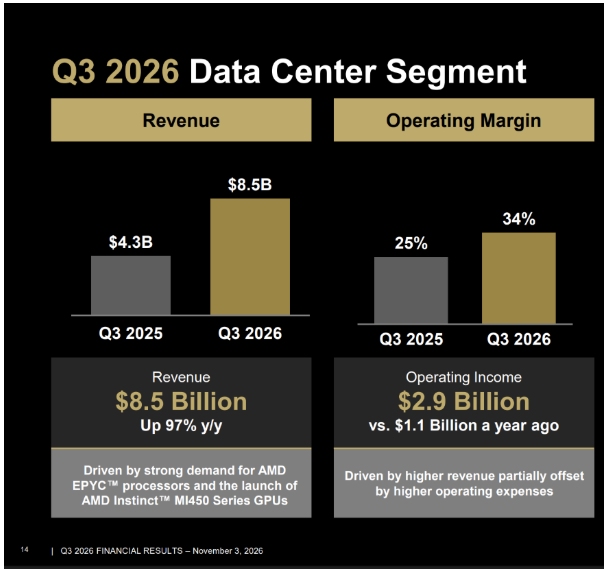
Source: AMD Q3 2026 earnings presentation, November 3, 2026 (ir.amd.com)
For the fourth quarter, AMD guided revenue to about $17 billion, plus or minus 3%, above the $16.3 billion consensus. CEO Lisa Su went further, saying, "We now expect revenue to grow more than 80% in 2027," with server revenue expected to double.
Valuation Leaves Little Room
That growth comes at a price. AMD trades at about 28.4 times expected earnings over the next 12 months, according to Barron's, a premium that makes the stock sensitive to any threat to its China or Southeast Asia business. Analysts remain positive, with 44 Buy ratings out of 55 and no Sells, and an average target of $657.74, about 34.5% above Thursday's close. Those targets were set before the short report, so any changes today will show how much risk the Street is now willing to price in.
AMD Technical Analysis: Daily Close Below $472.57 Could Open $439.25
Sellers pushed back sharply at $554.66, the pivot point that lines up with the falling trendline from the October high. A falling trendline connects a series of lower highs. Thursday's high of $555.01 came almost exactly at that level before the selling began. The rejection dragged the stock below both moving averages, which track the average price over recent sessions, at $530.27 and $510.67. The pattern of lower highs keeps the bigger trend bearish.
RSI, a momentum gauge that runs from 0 to 100, sits near 45, just below the neutral 50 line. The MACD, another momentum indicator, is still below zero and only slightly above its signal line, so momentum remains weak.
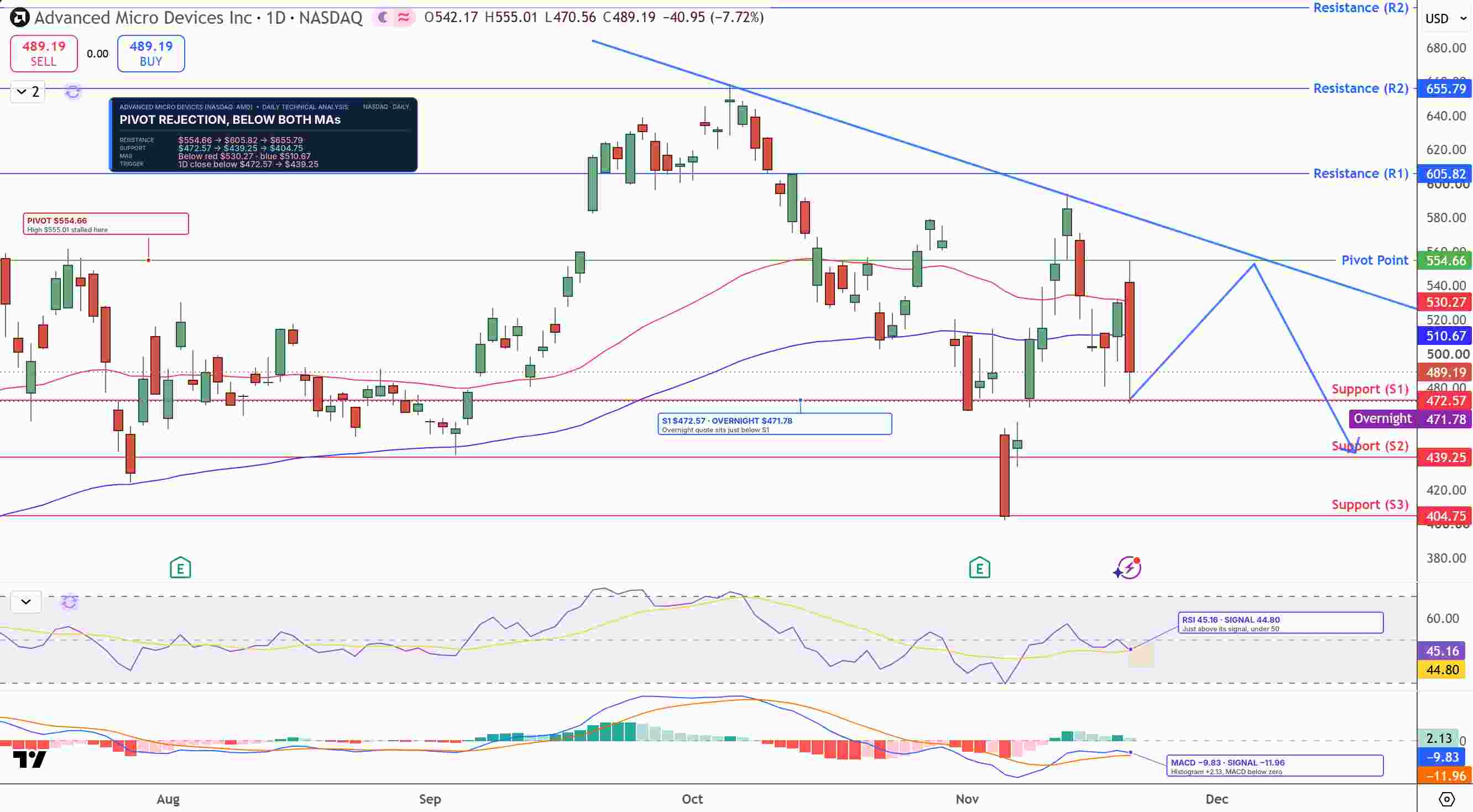
AMD Price Chart - Source: Tradingview
The overnight price is testing $472.57 support. A daily close below it could send AMD toward $439.25, followed by $404.75. If buyers hold $472.57, a rebound toward $510.67 and $554.66 is possible.
I'm cautiously bearish while AMD stays below $510.67, with $472.57 as the key support to watch.
Key Levels
- Last close: $489.19, down 7.72% on Thursday, November 19 (overnight: $471.78)
- Support: $472.57, $439.25, $404.75
- Resistance: $510.67, $530.27, $554.66
- RSI: 45.16
- Bullish trigger: Daily close above $510.67
- Bearish trigger: Daily close below $472.57
FAQs
Why did AMD stock fall?
AMD fell 7.72% after Hunterbrook, which is short the stock, reported that a blacklisted Chinese server maker kept receiving newer AMD firmware, on the same day new US license rules for chip exports to Singapore and four other countries took effect. AMD said the claims misrepresent its business.
What is the AMD stock forecast now?
The bias is cautiously bearish while AMD stays below $510.67. A daily close below $472.57 could send the stock toward $439.25 and $404.75, while holding that support could allow a rebound toward $510.67 and $554.66.
Bottom Line
AMD's growth outlook is unchanged, but a short report and new export rules have put about a third of its billings under a spotlight. The level that matters is $472.57. In my view, a daily close below it would open the way toward $439.25, while a recovery above $510.67 would suggest the market is treating Thursday as an overreaction.
Recommended Articles


