


Nvidia Has Lost More Than the Market Value of 495 S&P 500 Companies in 6 Weeks -- and Its Downtrend May Be Just Beginning
Key Points
Although Nvidia is the backbone of AI-accelerated data centers, it’s lost its identity following the resignation of now-former CEO Jensen Huang.
History isn’t on Nvidia’s side, at least over the short run.
This may be as good as it gets for Nvidia’s gross margin.
- 10 stocks we like better than Nvidia ›
On Oct. 6, Nvidia (NASDAQ:NVDA) peaked at an intraday high of $243.37 per share, reaching a valuation of $5.78 trillion. The face of the artificial intelligence (AI) infrastructure build-out holds a virtual monopoly in enterprise data centers with its several generations of graphics processing units (GPUs).
But it's been a bumpy ride over the last six weeks. Between its Oct. 6 intraday peak and the Nov. 17 close, Nvidia lost $2.03 trillion in valuation. In just six weeks, Nvidia lost more in market value than all but five S&P 500 (SNPINDEX:^GSPC) companies... one of which is itself.
Missed AI’s "Act 1"? Act 2 Could Be 15x Bigger. Most investors think they missed the AI boat because they didn't buy Nvidia in 2005. But according to our analysts, we’re only at the end of "Act 1"—the R&D phase. "Act 2" is the global rollout. Continue »

Image source: Getty Images.
While Nvidia's historically inexpensive valuation and its jaw-dropping Data Center segment growth suggest its stock is a bargain, it's also possible that its recent downtrend is just beginning.
Jensen Huang's departure leaves the company without an identity
Let's not beat around the bush: the resignation of now-former CEO Jensen Huang following an admission of an affair with an alleged Chinese spy and allegations of extramarital relations with up to two employees has left Nvidia without an identity.
Although Nvidia has an extensive order backlog, superior GPUs, and its pricing power continues to be aided by GPU supply shortages, the company's innovation schedule (bringing an advanced AI chip to market annually) and its circular financing deals are very much in question.
BREAKING: The US Securities and Exchange Commission (SEC) has opened an investigation into Nvidia, $NVDA, amid the Jensen Huang situation, per WSJ. The focus of the investigation includes whether the company’s disclosures misled investors. The Justice Department is also now reportedly leading multiple investigations involving Alice Huang.
— The Kobeissi Letter (@KobeissiLetter) November 17, 2026
Furthermore, Huang's actions and departure may have breached the trust of clients, consumers, and/or investors. Earlier this week, the Securities and Exchange Commission opened an investigation over whether the company misled investors in its disclosures.
Without trust, Nvidia becomes practically uninvestable.
History isn't Nvidia's friend
Although long-term trends strongly suggest that AI will be a game changer and that the benchmark S&P 500 will head higher, historical precedent isn't Nvidia's friend over the short run.
Every next-big-thing technology since (and including) the advent and proliferation of the internet in the mid-1990s has navigated an early-innings bubble. These bubbles form because investors consistently overestimate the pace of adoption and optimization of hyped innovations.
The good news for AI is that there isn't an adoption issue. Nvidia's quarterly results make it clear that businesses are freely spending to build out their data centers.
But it's an entirely different story when it comes to optimizing this technology. It took until well after the dot-com bubble burst before businesses figured out how to optimize internet-driven solutions to maximize sales and profits. As with the internet, AI will take time to mature, leaving Nvidia and its peers exposed to a possible bubble-bursting event.

Image source: Getty Images.
Nvidia's gross margin: As good as it gets?
Lastly, Nvidia's fiscal fourth-quarter gross margin is forecast to dip to 71%-72% from a reported 74.8% (based on generally accepted accounting principles, or GAAP) in the fiscal third quarter.
Although Nvidia's GAAP gross margin has pretty consistently hovered in the low-to-mid 70% range over the trailing three years, the company's fiscal fourth-quarter forecast must have some investors wondering if this is as good as it gets.
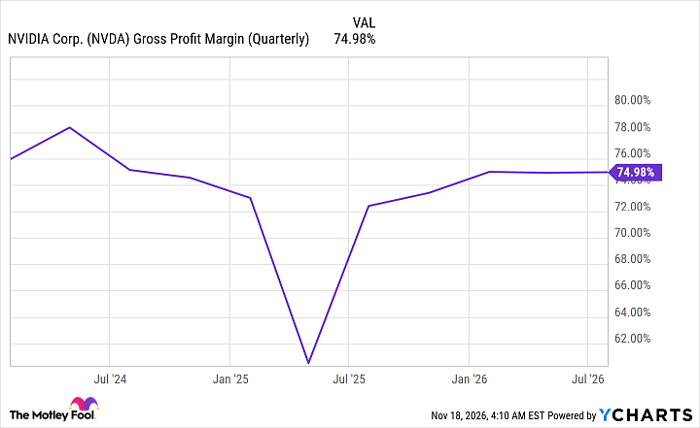
NVDA Gross Profit Margin (Quarterly) data by YCharts.
This two- to three-percentage-point dip in GAAP gross margin reflects higher memory prices and the near-term ramp-up associated with Vera Rubin shipments. But if GPU supply picks up from its competition, as is expected, Nvidia's pricing power and GAAP gross margin would be expected to wane over time.
In other words, Nvidia may not be the slam-dunk bargain it appears to be.
Should you buy stock in Nvidia right now?
Before you buy stock in Nvidia, consider this:
The Motley Fool Stock Advisor analyst team just identified what they believe are the 10 best stocks for investors to buy now… and Nvidia wasn’t one of them. The 10 stocks that made the cut could produce monster returns in the coming years.
Consider when Netflix made this list on December 17, 2004... if you invested $1,000 at the time of our recommendation, you’d have $322,605!* Or when Nvidia made this list on April 15, 2005... if you invested $1,000 at the time of our recommendation, you’d have $927,581!*
Now, it’s worth noting Stock Advisor’s total average return is 790% — a market-crushing outperformance compared to 202% for the S&P 500. Don't miss the latest top 10 list, available with Stock Advisor, and join an investing community built by individual investors for individual investors.
See the 10 stocks »
*Stock Advisor returns as of November 20, 2026.
Sean Williams has no position in any of the stocks mentioned. The Motley Fool has positions in and recommends Nvidia. The Motley Fool has a disclosure policy.
Recommended Articles


