


Warren Buffett Says Bad News Is an Investor's Best Friend. History Says He's Right.
Key Points
In October 2008, amidst the financial crisis, he wrote a famous op-ed in The New York Times.
He announced that he was buying U.S. stocks despite the recent bear market.
The worst times in U.S. history have been some of the best opportunities to buy stocks.
- 10 stocks we like better than Vanguard S&P 500 ETF ›
In October 2008, during one of the scariest moments of the global financial crisis, Warren Buffett published an op-ed in The New York Times. The stock market was crashing. Twenty-five banks failed in 2008, representing more than $373 billion of assets.
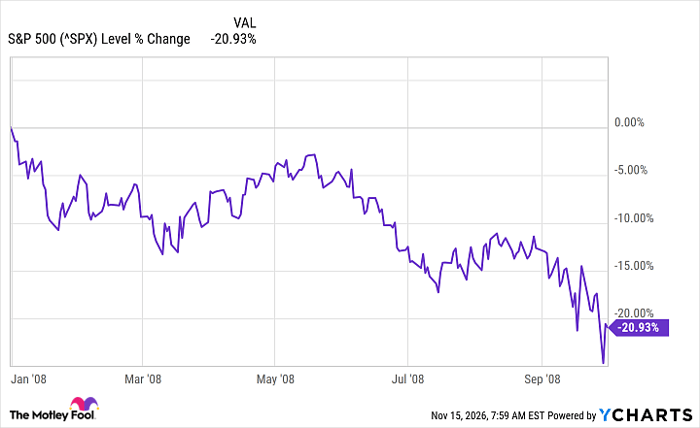
During the first 10 months of 2008, the S&P 500 index (SNPINDEX:^GSPC) entered a bear market, declining by about 21%.
Missed AI’s "Act 1"? Act 2 Could Be 15x Bigger. Most investors think they missed the AI boat because they didn't buy Nvidia in 2005. But according to our analysts, we’re only at the end of "Act 1"—the R&D phase. "Act 2" is the global rollout. Continue »
^SPX data by YCharts
Investors were understandably scared. But Buffett struck an optimistic note. His article in the Times explained that he was buying U.S. stocks -- not in spite of the recent stock market crash, but because of it. Buffett wrote:
In short, bad news is an investor's best friend. It lets you buy a slice of America's future at a marked-down price.
Let's look at what Buffett meant by bad news being the best friend of investors -- and why history says you should keep investing during good times and bad. (Especially bad.)
Image source: Getty Images.
Stock market history: Stock market crashes are the best times to buy
It sounds paradoxical, but it's true: The exact moments when stocks are at their lowest points, when investors are most afraid to buy stocks, when the economic news headlines are frightening, when the world seems to be collapsing, are the best times to invest.
Stock prices move up and down based on investors' moods and collective beliefs about the future. When people think the future looks bright and the economy will keep growing strong, they pour more money into stocks.
When people fear that the economy is going into recession, companies have taken on too much debt, or that a major crisis is going to disrupt everyday life (like the 2020 COVID-19 pandemic), they move money out of stocks and into "safe" assets like Treasury bonds.
In Buffett's op-ed, he explained that some of the best times to buy stocks in American history were during the worst times in American history:
- July 1932, during the Great Depression, when the Dow Jones Industrial Average hit a low of 41.
- April 1942, when the U.S. was struggling through its early months of World War II.
- The early 1980s, when, as Buffett wrote, "inflation raged and the economy was in the tank."
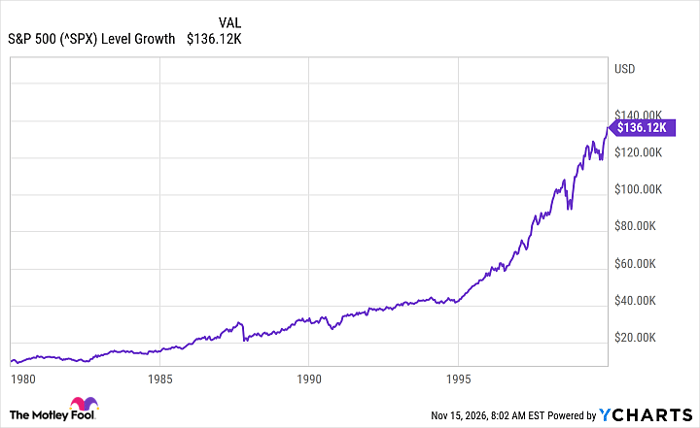
For example, if you had invested $10,000 in the S&P 500 on Jan. 1, 1980, 20 years later that investment would have grown to more than $136,000.
^SPX data by YCharts
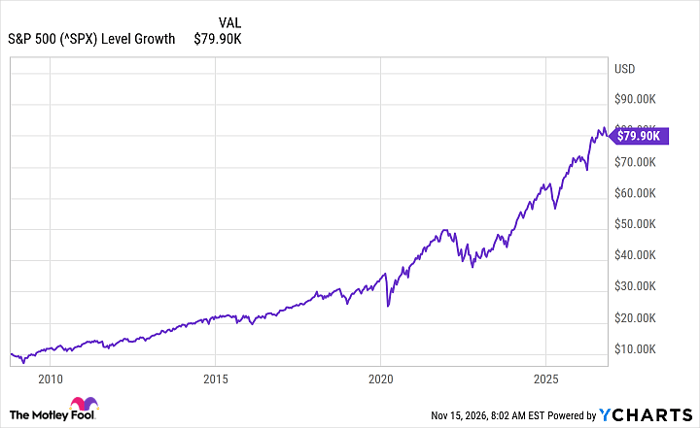
If you had invested $10,000 in the S&P 500 on Oct. 16, 2008 (the day Buffett published his op-ed), today your investment would be worth more than $79,000.
^SPX data by YCharts
Buy low, hold for years
Here's an idea that sounds obvious but that many investors struggle to accept: When stock prices go down, that's a good sign to buy more stocks. It means stocks are on sale. It means you can buy shares of great companies at a discount.
It's understandable to be nervous when headlines are bad, and stocks are plummeting. But it's wrong to believe that the stock market will never go up again. America's economy and the S&P 500 have recovered from many terrible crises and global conflicts during our nation's history. And over the past 98 years since 1928, the S&P 500 has delivered an average annual return of 9.98%.
The Vanguard S&P 500 ETF (NYSEMKT:VOO) is a great way to invest in the future of American businesses. It holds the stocks of 500 of the largest publicly traded companies in America, representing about 80% of the total value of the U.S. stock market.
The Vanguard S&P 500 ETF has delivered annualized returns of about 14.8% over the past 16 years since its inception, and about 12% over the past five years.
Warren Buffett is famous for his long-term optimism about the stock market, and his short-term uncertainty. He's often said that he doesn't know what will happen to stock prices tomorrow, next month, or this year. But in the long run, the stock market is likely to go higher. To capture those gains, it's not enough to just buy stocks when prices are low -- you also have to hold on to your stocks for years to come.
That's because America's largest companies tend to be good at making money. The economy tends to recover and grow. Every crisis inspires new healing, growth, and innovation. People tend to want to keep working, earning, building futures, buying, and investing.
You can own that brighter future by buying low-cost index funds today. Even if we're on the cusp of another stock market crash, buying S&P 500 ETFs is almost always a good long-term choice for patient investors
Should you buy stock in Vanguard S&P 500 ETF right now?
Before you buy stock in Vanguard S&P 500 ETF, consider this:
The Motley Fool Stock Advisor analyst team just identified what they believe are the 10 best stocks for investors to buy now… and Vanguard S&P 500 ETF wasn’t one of them. The 10 stocks that made the cut could produce monster returns in the coming years.
Consider when Netflix made this list on December 17, 2004... if you invested $1,000 at the time of our recommendation, you’d have $321,850!* Or when Nvidia made this list on April 15, 2005... if you invested $1,000 at the time of our recommendation, you’d have $955,232!*
Now, it’s worth noting Stock Advisor’s total average return is 793% — a market-crushing outperformance compared to 203% for the S&P 500. Don't miss the latest top 10 list, available with Stock Advisor, and join an investing community built by individual investors for individual investors.
See the 10 stocks »
*Stock Advisor returns as of November 18, 2026.
Ben Gran has no position in any of the stocks mentioned. The Motley Fool has positions in and recommends Vanguard S&P 500 ETF. The Motley Fool has a disclosure policy.
Recommended Articles


