


USA Rare Earth Has About $1.2 Billion in Cash, but Generated Just $3 Million in Quarterly Revenue. Which Matters More Right Now?
Key Points
USA Rare Earth is generating paltry amounts of revenue, but it has a healthy cash pile.
Investors should focus more on the cash position at the moment.
USA Rare Earth's cash gives the company some cushion, but the mining specialist may need to raise more funds before long.
- 10 stocks we like better than USA Rare Earth ›
USA Rare Earth (NASDAQ: USAR) is aiming to be a disruptive player in the mining industry, but it still has a lot of work to do on that front. The company reported its third-quarter results on Nov. 9, posting a loss of $0.02 per share on sales of $3 million. While the company's loss was $0.18 per share better than the average Wall Street analyst estimate, sales for the period came in roughly $10.6 million below expectations.
At the end of Q3, USA Rare Earth had about $1.2 billion in cash and short-term equivalents. The company's cash pile gives it substantial resources to fund operations, but the business has been generating paltry amounts of revenue compared to its market capitalization. Which of these characteristics is more important for investors right now?
Missed AI’s "Act 1"? Act 2 Could Be 15x Bigger. Most investors think they missed the AI boat because they didn't buy Nvidia in 2005. But according to our analysts, we’re only at the end of "Act 1"—the R&D phase. "Act 2" is the global rollout. Continue »

Image source: Getty Images.
Investors shouldn't overreact to the soft sales numbers just yet
Compared to Wall Street's expectations, USA Rare Earth posted a pretty substantial sales miss in the third quarter. While the business's bottom-line loss was significantly lower than expected, this can be largely attributed to the company's gross margin still being negative and sales that were expected to show up in the quarter not materializing.
Setting aside the company's recent acquisition of Brazil-based mining operation Serra Verde, USA Rare Earth is still in the very early stages of scaling up its mining business. The sales miss in Q3 certainly isn't encouraging, but lumpy sales performance at this relatively nascent stage in the game shouldn't be viewed as shocking or a particularly weighty indicator.
While the company recorded a profit of roughly $11.7 million using generally accepted accounting principles (GAAP), this was due to fair value accounting and not actual operations. On a non-GAAP (adjusted) basis, the company actually recorded a net loss of $125.6 million in the period -- bringing its adjusted net loss across the first nine months of the year to $183.3 million.
USA Rare Earth's cash pile gives it enough financial safety to continue comfortably funding its operations in the near term. As a result, the company's $1.2 billion looks more significant than the business's modest sales numbers. On the other hand, the company may need to raise funds sooner than its cash burn across this year's first three quarters might suggest.
USA Rare Earth faced some closing costs connected to its Serra Verde acquisition in the third quarter that pressured earnings, but operational costs will likely expand significantly with the integration of the unit, development of its mine in Texas, and the build-out of its minerals processing plant in South Carolina.
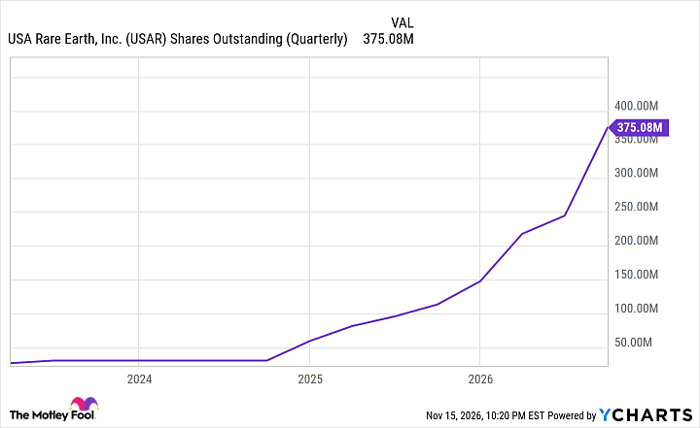
USAR Shares Outstanding (Quarterly) data by YCharts
Additionally, the company's net losses do not include capital expenditures because these investments in the business are actually recorded as assets. For reference, the business spent $190.9 million in capital expenditures in the third quarter. With the company's cash position and cash usage profile in mind, investors could be looking at more dilution as the company sells new stock to raise funds.
Should you buy stock in USA Rare Earth right now?
Before you buy stock in USA Rare Earth, consider this:
The Motley Fool Stock Advisor analyst team just identified what they believe are the 10 best stocks for investors to buy now… and USA Rare Earth wasn’t one of them. The 10 stocks that made the cut could produce monster returns in the coming years.
Consider when Netflix made this list on December 17, 2004... if you invested $1,000 at the time of our recommendation, you’d have $327,620!* Or when Nvidia made this list on April 15, 2005... if you invested $1,000 at the time of our recommendation, you’d have $959,410!*
Now, it’s worth noting Stock Advisor’s total average return is 802% — a market-crushing outperformance compared to 205% for the S&P 500. Don't miss the latest top 10 list, available with Stock Advisor, and join an investing community built by individual investors for individual investors.
See the 10 stocks »
*Stock Advisor returns as of November 17, 2026.
Keith Noonan has no position in any of the stocks mentioned. The Motley Fool has no position in any of the stocks mentioned. The Motley Fool has a disclosure policy.
Recommended Articles


