


Nvidia Reports Tonight at a 16-Month Low, With $149.09 the Floor to Hold
TradingKey - Nvidia (NASDAQ: NVDA) fell 4.12% to $156.14 on Monday, November 16, its lowest close since July 1, 2025, and overnight trading is slightly higher at $157.32. The company reports fiscal third-quarter results at about 4:20 pm ET on Tuesday, November 17, with the call at 5:00 pm ET.
The stock is now about 35% below its record close of $239.24 on October 6, and about 16% below its November 6 close of $186.64. About $735 billion of market value has been lost since the leadership crisis began, according to Implicator.
Export Rules, a Weak Market and Leadership Doubts Hit the Stock
Export policy added to the pressure on Monday. The Commerce Department said it would require licenses to ship advanced chips to Malaysia, Thailand, Indonesia, Singapore and Brazil, aiming to stop Chinese customers from using US chips remotely through data centers in other countries. US technology companies could receive exceptions, but the rule adds a new layer of uncertainty for Nvidia's sales in those markets.
The broader market also fell. The Nasdaq dropped 2.49%, the S&P 500 lost 1.92% and the Dow fell about 1.41%, while the VIX, a measure of expected stock market swings often called the fear gauge, rose about 19%.
Leadership remains the biggest question. Jensen Huang resigned as president, CEO and director on November 12, and CFO Colette Kress is interim CEO while keeping her finance role. Over the weekend, Reuters, citing the Financial Times, reported that Huang had discussed a possible return with confidants. On Monday, however, CNBC and The Wall Street Journal reported that the board is not considering reinstating him. Tonight, Kress leads her first earnings call as interim CEO.
What Nvidia Needs to Deliver Tonight
In August, Nvidia guided third-quarter revenue to $108.0 billion, plus or minus 2%, which would be about 12% higher than the $96.2 billion it reported in the second quarter. Analysts expect a little more. Bloomberg consensus calls for revenue of $109.15 billion, nearly double the roughly $57 billion a year earlier, EPS of $2.47, up from $1.30, and data center revenue of $101.85 billion.
The company guided gross margin, the share of revenue left after production costs, to 74.0%, plus or minus 0.5 percentage point, down from 75.0% in the second quarter. The guidance assumes no data center sales to China. Kress has said Vera Rubin, Nvidia's new chip platform, should make up about 20% of data center revenue this quarter, and that growth of about 70% in fiscal 2028 will be limited by supply, even though customer forecasts point to faster growth.
The fourth-quarter outlook will likely matter more than the third-quarter numbers. Before Huang's resignation, options were pricing in a move of about 10.6% in either direction after the report.
Analysts Cut Ratings, but the Valuation Has Reset
At least 10 analysts cut their ratings to Hold after Huang's exit, according to Implicator. Bernstein moved to Market Perform with a $200 target, Baird cut to Neutral with a $200 target, and Mizuho lowered its target to $250. UBS analyst Tim Arcuri called the market's assumptions "incredibly draconian."
The selloff has also made the stock cheaper. At $156.14, by my calculation, Nvidia trades at about 16 times the annualized consensus EPS of $2.47, a low multiple for a company expected to nearly double its revenue from a year earlier. The business has not slowed, at least on paper. The stock has fallen on leadership and policy risk rather than weaker demand.
Nvidia Technical Analysis: Daily Close Below $149.09 Could Open $134.61
That shift shows clearly on the daily chart. The slide has become steep since the stock broke its rising trendline, a line drawn under its higher lows, in late October. It has now lost $189.54 and $171.03 in quick succession. The red moving average at $204.83 is also crossing below the blue one at $208.26, a bearish signal, since moving averages track the average price over recent sessions. An earnings marker on the chart points to more volatility ahead.
RSI, a momentum gauge that runs from 0 to 100, has dropped to about 23, deep in oversold territory, below the 30 level where selling is often seen as stretched. The MACD, another momentum indicator, keeps falling too. Selling looks stretched, so a short bounce is possible, but it is not guaranteed.
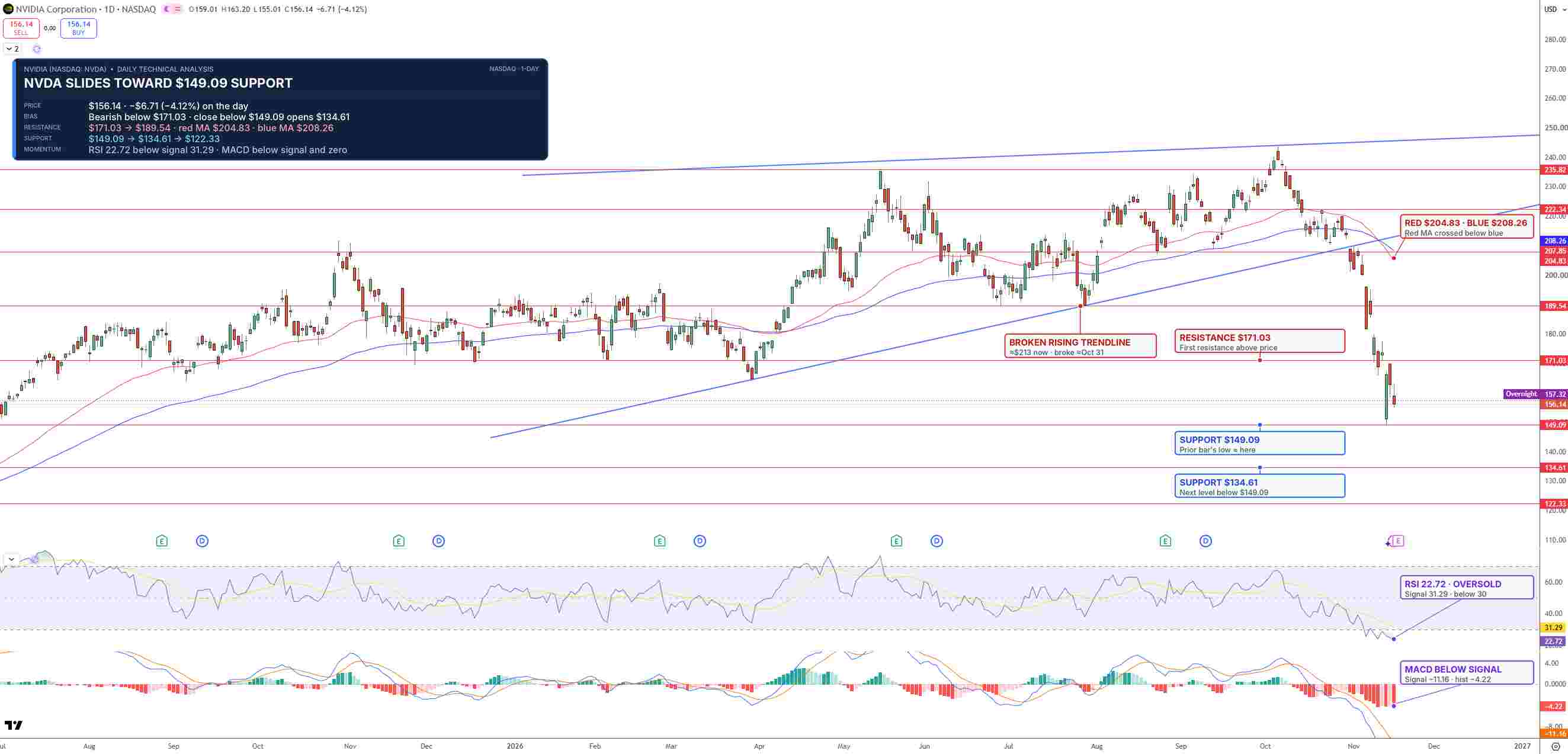
NVDA Price Chart - Source: Tradingview
On the downside, $149.09 is the key floor, just above last Thursday's intraday low of $148.80. A daily close below it could send NVDA toward $134.61, followed by $122.33. For buyers, reclaiming $171.03 would be the first sign of relief.
I'm bearish while NVDA stays below $171.03, with $149.09 as the level to watch.
Key Levels
- Last close: $156.14, down 4.12% on Monday, November 16 (overnight: $157.32)
- Support: $149.09, $134.61, $122.33
- Resistance: $171.03, $189.54
- RSI: 22.72
- Bullish trigger: Daily close above $171.03
- Bearish trigger: Daily close below $149.09
FAQs
What do analysts expect from Nvidia's Q3 earnings?
Bloomberg consensus calls for revenue of $109.15 billion, EPS of $2.47 and data center revenue of $101.85 billion, against Nvidia's own guide of $108.0 billion, plus or minus 2%, and a gross margin of about 74%.
What is the Nvidia stock forecast now?
The bias is bearish while NVDA stays below $171.03 on the daily chart. A daily close below $149.09 could send the stock toward $134.61 and $122.33, while reclaiming $171.03 would be the first sign of relief.
Bottom Line
Nvidia reports tonight with the business still growing fast but the stock weighed down by leadership and export risks. The level that matters is $149.09. In my view, a strong fourth-quarter outlook could spark a bounce from oversold levels, while a daily close below $149.09 would open the way toward $134.61.
Recommended Articles


