


Plug Power Has About $134 Million in Cash and Is Burning $28 Million a Quarter. Here's Why That Matters.
Key Points
Plug Power's recent quarterly results beat Wall Street's targets.
The company's unrestricted cash pile still declined by $28 million in the quarter.
Plug Power's current financial profile suggests the company could move to sell stock again in the not-too-distant future.
- 10 stocks we like better than Plug Power ›
Plug Power (NASDAQ: PLUG) reported its third-quarter results on Nov. 9, giving investors an updated look at its business progress and financial foundations. Sales and earnings beat expectations, with the business recording a break-even quarter on revenue of roughly $201 million while the average analyst estimate had targeted a loss of roughly $0.06 per share on sales of roughly $193.3 million.
But while Plug Power reported a break-even quarter, the company's cash position actually declined by $28 million due to capital expenditures, and its bottom-line earnings performance was bolstered by mark-to-market gains in the value of its investments. The company provided an update on its cash position, noting it ended the third quarter with roughly $134 million in unrestricted cash and short-term equivalents. Here's why the declining cash position is a significant issue for Plug Power investors.
Missed AI’s "Act 1"? Act 2 Could Be 15x Bigger. Most investors think they missed the AI boat because they didn't buy Nvidia in 2005. But according to our analysts, we’re only at the end of "Act 1"—the R&D phase. "Act 2" is the global rollout. Continue »

Image source: Getty Images.
Plug Power will likely need to raise funds again in the near future
Plug Power's Q3 report showed substantial operational improvements. The company's gross margin for the quarter came in at -2.7%, still negative but representing a dramatic improvement over the -68% gross margin in the prior-year period. The company's net cash usage of $28 million in the quarter also represented a significant improvement over roughly $61 million in the second quarter of this year.
While the company's net cash usage improved substantially, Plug Power still posted an operating loss of roughly $75.2 million in this year's third quarter. Granted, this still represented a significant improvement over the prior-year operating loss of roughly $348.8 million -- but operating losses remain sizable and suggest the business will once again need to raise capital to continue operations.
With borrowing costs on the rise recently and the company recording interest expense of roughly $19.3 million in the most recent quarter, adding to the company's debt load doesn't look terribly appealing right now. I think that makes newly issued stock sales more likely to be the primary avenue for raising funds, which raises problems for investors on a couple of levels.
For starters, the sale of new stock will deliver another round of dilution for shareholders and could create significant downward pressure on the company's share price. With the stock currently trading just above $1 per share and the company currently valued at roughly $1.6 billion, there's a real possibility that new or convertible stock sales to raise substantial operating capital will push stock below $1 per share.
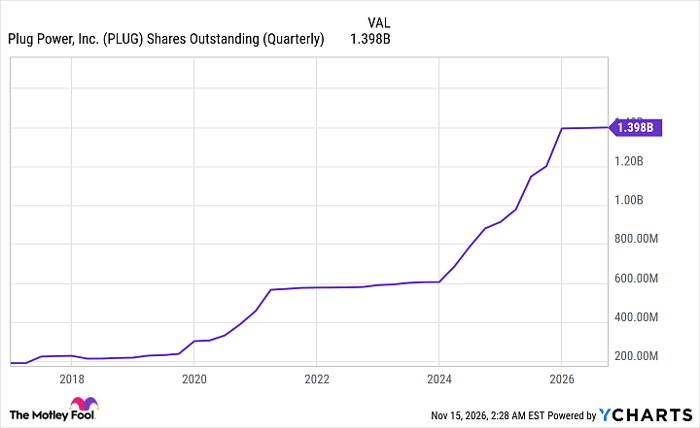
PLUG Shares Outstanding (Quarterly) data by YCharts
If Plug Power falls below $1 per share and remains there, its stock would face delisting from Nasdaq. To prevent delisting, the company would likely implement a reverse stock split -- and reverse splits tend to be followed by additional selling pressure.
It also wouldn't be shocking to see the company announce a reverse split before its stock actually falls below $1 per share. The company's gross margins and operating efficiency have improved significantly, but Plug Power's dwindling cash pile creates a challenging dynamic for shareholders.
Should you buy stock in Plug Power right now?
Before you buy stock in Plug Power, consider this:
The Motley Fool Stock Advisor analyst team just identified what they believe are the 10 best stocks for investors to buy now… and Plug Power wasn’t one of them. The 10 stocks that made the cut could produce monster returns in the coming years.
Consider when Netflix made this list on December 17, 2004... if you invested $1,000 at the time of our recommendation, you’d have $335,171!* Or when Nvidia made this list on April 15, 2005... if you invested $1,000 at the time of our recommendation, you’d have $1,000,640!*
Now, it’s worth noting Stock Advisor’s total average return is 823% — a market-crushing outperformance compared to 208% for the S&P 500. Don't miss the latest top 10 list, available with Stock Advisor, and join an investing community built by individual investors for individual investors.
See the 10 stocks »
*Stock Advisor returns as of November 16, 2026.
Keith Noonan has no position in any of the stocks mentioned. The Motley Fool has no position in any of the stocks mentioned. The Motley Fool has a disclosure policy.
Recommended Articles


