


The Best Copper Stocks to Buy and Hold for Decades
Key Points
Here are three ways to consider investing: a commodity-based ETF, a stock-based ETF, and an individual stock.
The highlighted stock trades at a significant discount relative to analyst estimates and the current copper price.
- Motley Fool Issues Rare "Total Conviction" Buy Alert ›
Investors nervous about stock valuations, notably AI-related stocks, but who remain positive on the long-term economic trend and the electrification of everything might want to consider investing in copper. The industrial metal remains one of the best ways to gain exposure to these trends.
The investment case for buying copper stocks
The case for copper is based on a combination of long-term structural demand from the electrification-of-everything megatrend, which encompasses electric vehicles, charging networks, renewable energy, industrial automation, AI data centers, and the power and grid networks that support them, as well as ongoing supply constraints.
Missed AI’s "Act 1"? Act 2 Could Be 15x Bigger. Most investors think they missed the AI boat because they didn't buy Nvidia in 2005. But according to our analysts, we’re only at the end of "Act 1"—the R&D phase. "Act 2" is the global rollout. Continue »
The latter is sometimes underestimated, but rising costs, difficulty acquiring permits, and declining ore grades in mature copper mines all threaten future supply and create a demand/supply imbalance that favors higher copper prices. You can see charts supporting these arguments in the linked article above.
Still, the question is how best to take advantage of these scenarios. There are three ways.

Image source: Getty Images.
United States Copper Index Fund
First, buy a listed exchange-traded commodity (ETF), such as the United States Copper Index Fund (NYSEMKT: CPER), which aims to provide direct exposure to the daily performance of copper futures on the Commodity Exchange (COMEX) in the U.S. by holding long positions in copper futures.
This lets you invest in copper prices without taking on stock-specific risk. This is an important point because, in theory, a rising copper price doesn't necessarily translate into higher earnings for copper companies if costs also increase significantly.
Global X Copper Miners ETF
Second, investors can diversify away from stock-specific risk by buying a basket of copper mining stocks via an ETF such as the Global X Copper Miners ETF (NYSEMKT: COPX). The ETF currently holds 40 positions in leading copper miners worldwide, with miners from seven countries contributing 5% of the fund's exposure. It has an expense ratio of 0.65% and offers investors a simple way to gain exposure to copper prices.
As noted above, in theory, miners don't necessarily benefit from higher copper prices. Still, in reality, when copper prices rise, they see margin expansion and super-profit growth because of their relatively high fixed costs. You can see this in the chart below, which shows how the ETF outperforms the ETC discussed above (which follows copper futures).
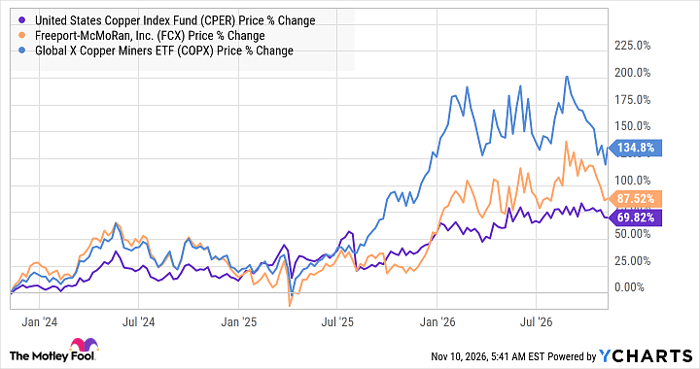
CPER data by YCharts
Freeport-McMoRan
If you do want stock-specific risk, then U.S. miner Freeport-McMoRan (NYSE: FCX) is an excellent option. Not only does it have expansion plans in the pipeline (management just approved a $4.5 billion expansion program in a copper mine in Bagdad, Arizona), but it also has an exciting low-cost leaching initiative that will recover copper from existing stockpiles.
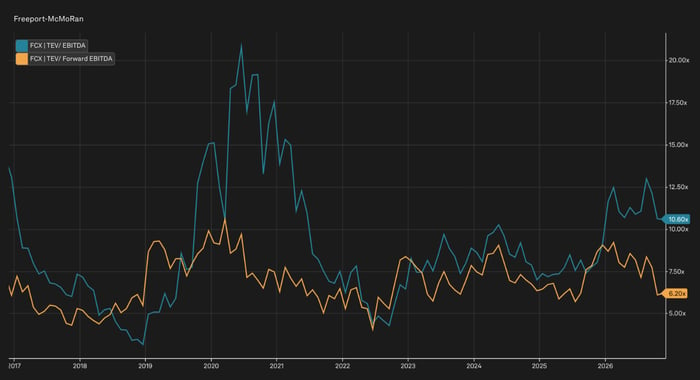
Image and data source: S&P Global Market Intelligence.
Moreover, as you can see above, its ratio of forward total enterprise value (TEV) to earnings before interest, taxes, depreciation, and amortization (EBITDA) trades at a discount to the level its EV/EBITDA has generally traded over the last decade. While there's no guarantee copper prices will remain supportive, Freeport-McMoRan looks undervalued given relatively stable prices, and significantly undervalued if copper prices move higher.
Should you buy stock in United States Commodity Index Funds Trust - United States Copper Index Fund right now?
Before you buy stock in United States Commodity Index Funds Trust - United States Copper Index Fund, consider this:
The Motley Fool Stock Advisor analyst team just identified what they believe are the 10 best stocks for investors to buy now… and United States Commodity Index Funds Trust - United States Copper Index Fund wasn’t one of them. The 10 stocks that made the cut could produce monster returns in the coming years.
Consider when Netflix made this list on December 17, 2004... if you invested $1,000 at the time of our recommendation, you’d have $335,171!* Or when Nvidia made this list on April 15, 2005... if you invested $1,000 at the time of our recommendation, you’d have $1,000,640!*
Now, it’s worth noting Stock Advisor’s total average return is 823% — a market-crushing outperformance compared to 208% for the S&P 500. Don't miss the latest top 10 list, available with Stock Advisor, and join an investing community built by individual investors for individual investors.
See the 10 stocks »
*Stock Advisor returns as of November 16, 2026.
Lee Samaha has no position in any of the stocks mentioned. The Motley Fool has no position in any of the stocks mentioned. The Motley Fool has a disclosure policy.
Recommended Articles


